


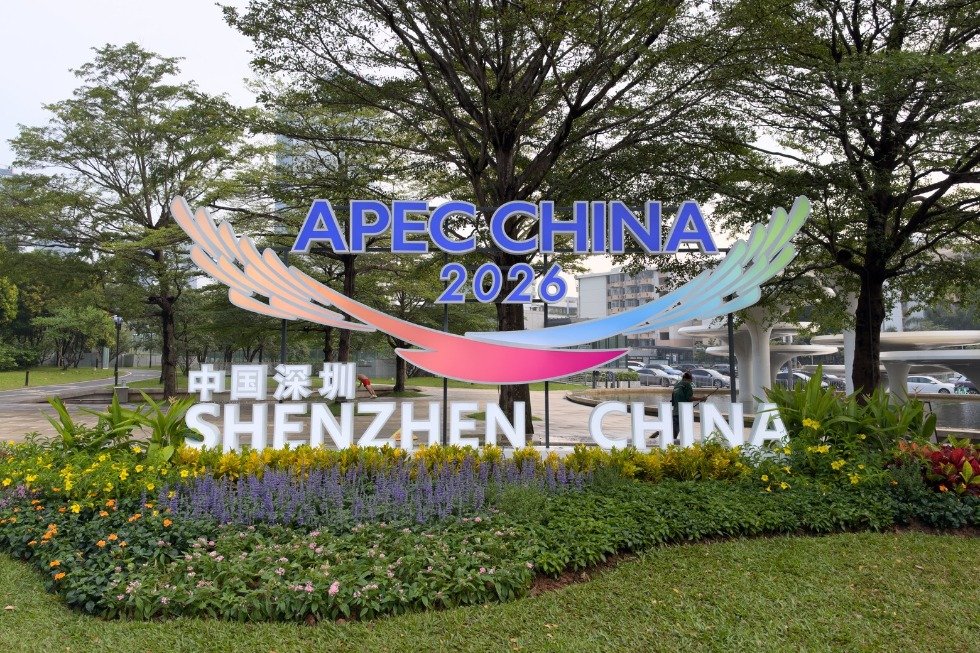



On November 18 and 19, amid political turbulence, China hosted Asia-Pacific Economic Cooperation (APEC) members in Shenzhen, near Taiwan. Many leaders, including US President Donald Trump, Chinese President Xi Jinping, and Russian President Vladimir Putin, attended. The leaders also held a historic trilateral meeting on November 19.
One notable issue in Asia is Taiwan, which has been struggling under pressure from China. A number of questions have arisen regarding the island: Does Taiwan have an equal seat at the meeting? Is Taiwan a part of the conversation? And does Taiwan have a specific outcome from the APEC meeting?
Taiwan’s seat struggle
Taiwan does not have official status in the United Nations, where most countries have recognized the People’s Republic of China since 1971 and severed ties with Taiwan. As a result of several international organizations excluding it, such as the World Health Organization, Interpol and the UN, Taiwan lacks the ability to run and set its foreign policy agenda, including in APEC.
Since Taiwan joined the organization in 1991, no single president has participated in APEC. This year, President Lai Ching-te dispatched Taiwanese businessman and ACER cofounder Stan Shih as Taiwan’s special envoy, marking his second time as envoy since the 2007 APEC meeting in Australia. Taiwan’s agenda was clear: It aimed to protect economic interests, contribute economic perspectives to the global community and ensure the forum heard Taiwan’s voice.
Since Tsai Ing-wen won Taiwan’s 2020 presidential election, relations between China and Taiwan have taken a dicey turn. Taiwan’s ruling Democratic Progressive Party won’t follow China’s hopes of being one territory and adopting a one-country, two-systems model. China continues to conduct military exercises around the island. Recently, without any official announcement, China carried out a large exercise across the Western Pacific and around Taiwan, which Taiwan named a campaign of “silent intimidation.” Furthermore, Taiwanese Foreign Minister Lin Chia-lung said that, in welcoming APEC, China did not send an invitation to Taiwan, but instead sent it only by email.
Taiwan’s place in the trilateral meeting
Trump and Xi’s meeting is the third between the two leaders this year, after Xi visited the United States in September. He is deeply concerned about semiconductor chips — Taiwan’s primary export — and US–China relations over artificial intelligence have grown tense. Arthur Zhin-Sheng Wang, an expert on cross-strait relations at Taiwan’s Central Police University, believes the Trump administration does not consider the Taiwan situation to be a core issue between the US and China.
Trump has no clear position toward Taiwan. On November 2, 2025, during an interview with CBS, Trump asserted that “‘[China] would never do anything while President Trump is president, ‘because they know the consequences.’” But he argued last June that the Taiwanese government “stole” America’s semiconductor industry. He has also made provocative remarks, calling for the island to “pay” the US for defending the territory from China.
Meanwhile, the Trump administration has signed an $11 billion arms package to Taiwan, and this year, he is expected to submit a $14 billion package to Congress. Trump recently commented that the arms sales are a “very good negotiating chip,” meaning he needs feedback from Taiwan. James Crabtree, a scholar at the publication Foreign Policy, believes the US’s long-standing policy of “strategic ambiguity” toward Taiwan is biased and weakening, causing regional instability.
Trump is deeply concerned about semiconductor chips — Taiwan’s primary export — and US–China relations over artificial intelligence have grown tense. Arthur Zhin-Sheng Wang, an expert on cross-strait relations at Taiwan’s Central Police University, believes the Trump administration does not consider the Taiwan situation to be a core issue between the US and China.
Instead, Xi raised the subject, telling Trump that the US “must keep doing the right thing to avoid the emergence of great turbulence in the China-U.S. relationship.” Over three decades, the US has consistently refrained from supporting Taiwan’s independence. Xi, however, wants Trump to oppose its independence, which demands he take a side. In addition, the US has to limit its arms sales to Taiwan in order to simplify China’s path to unification.
Taiwan’s semiconductor advantage
The APEC meeting offered Taiwan a chance to create business opportunities. Taiwan Semiconductor Manufacturing Company (TSMC), a Taiwan-based company, is the world’s largest chipmaker and fabricates around 90% of semiconductors for AI and quantum computing applications, holding roughly 60% or more of global chip capacity. This means Taiwan holds an indispensable, irreplaceable position as a leader in the global supply chain. That is its strongest card. It could have convinced Taiwan’s global partners and elites to collaborate with TSMC amid the US–China rivalry.
APEC forum represents a valuable opportunity for a significant meeting among Donald Trump, Xi Jinping, and Vladimir Putin, individuals with substantial resources who have the capacity to define a global agenda. In this context, it would be prudent to consider Taiwan’s involvement, particularly in light of its leadership in the semiconductor sector. Taiwan’s expertise in chip manufacturing is essential for facilitating advancements in technology worldwide.
Taiwan may be absent from the agenda, but it boasts abundant capabilities. Without its chips, the world’s most advanced technology cannot be created.
[Lee Thompson-Kolar edited this piece.]
The views expressed in this article are the author’s own and do not necessarily reflect Fair Observer’s editorial policy.
Taiwan Watches and Prepares Amid Global Uncertainty
The American and Israeli attack on Iran has created a global crisis. Between this volatile conflict and fears of an...
Taiwan, China and the US: Not Playing a Tit-For-Tat Game
The Pentagon forecasts a Chinese invasion of Taiwan by 2027. Taiwanese President Lai Ching-te has thus proposed massive defense spending...
China–Taiwan Tensions: An Indonesian Perspective
Tensions between China and Taiwan have escalated, bringing increased military activity in the region. Indonesia is diplomatically aligned with China...

How to Defrost the Cold War With China
From an unstable Russia to climate change, the world is too full of problems for its two greatest powers, the...

Support Fair Observer
We rely on your support for our independence, diversity and quality.
For more than 10 years, Fair Observer has been free, fair and independent. No billionaire owns us, no advertisers control us. We are a reader-supported nonprofit. Unlike many other publications, we keep our content free for readers regardless of where they live or whether they can afford to pay. We have no paywalls and no ads.
In the post-truth era of fake news, echo chambers and filter bubbles, we publish a plurality of perspectives from around the world. Anyone can publish with us, but everyone goes through a rigorous editorial process. So, you get fact-checked, well-reasoned content instead of noise.
We publish 3,000+ voices from 90+ countries. We also conduct education and training programs
on subjects ranging from digital media and journalism to writing and critical thinking. This
doesn’t come cheap. Servers, editors, trainers and web developers cost
money.
Please consider supporting us on a regular basis as a recurring donor or a
sustaining member.
Will you support FO’s journalism?
We rely on your support for our independence, diversity and quality.




Comment