




 | ||||||||
| ||||||||
Dear FO° Reader, In these uncertain times, we hope you are staying sane and present. With the recent surge of violence in Iran, the flood of distractions following the US Department of Justice’s convoluted release of the Epstein files and other crises, staying grounded is no easy task. Our hearts go out to all civilians in the regions affected by warfare who are grieving the loss of loved ones, as well as to those in the diaspora. Still, what human soul can hold the grief of all the others? I recently spoke with my Fair Observer colleague Roberta Campani about the divine and the humane, and she mentioned a book that may bring us solace: Stand Out of My Light (2018), by philosopher, design-technology expert, and former Google strategist, James Williams. Williams’s choice to leave the world of big-tech and study philosophy later in his life is telling and would deserve a reflection on its own. Today, I’m sharing my interpretation of some of his book’s insights with you. Its ideas may inspire us to remain attentive and alert amidst informational chaos. They may even motivate us to defend not only our freedom of expression but also our freedom of thought. Because, the whole idea of the book is that today’s tech systems are designed to capture our attention for profit, distracting us and diverting us from our own intentions and goals.
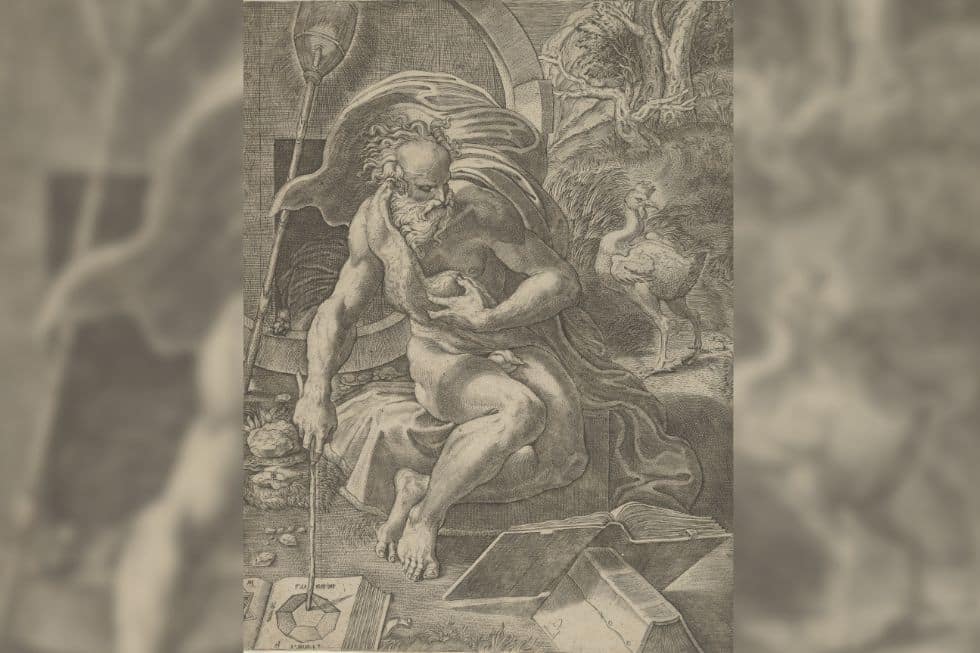
Many Athenians found Diogenes’s simple way of life as representing an ideal because it was free from material and conventional constraints. Others labelled his lifestyle as eccentric or even mad. Similarly, today many instinctively agree with the moral of the anecdote. Money may secure a comfortable lifestyle, not confined to a barrel, but it can’t buy introspection, freedom or attention. James Williams’s book, especially the chapter “The Age of Attention,” offers a modern perspective on Diogenes’s response to Alexander in the context of our current era of pervasive technology. Williams argues that the ability to self-regulate and maintain one’s attention surpasses the worldly power and wealth of emperors like Alexander the Great. These days though, even if the message resonates, it’s easy to doubt it.
Diogenes seated with his barrel behind him, and reading a book while holding a stick that rests on a geometry book to his right, print, Giovanni Jacopo Caraglio, after Parmigianino, 1524–27, Wikicommons]
We need words to describe a new reality
One of Williams’s most significant contributions comes from his gift for coining terms, particularly in the context of policymaking. These terms could lay the groundwork for protecting basic rights that have not yet been formally recognized. Examples include “brain privacy,” “freedom of attention” and “cognitive liberty.” From this perspective, Williams views attention as a concrete and measurable concept that can be protected by law. Although defending our cognitive liberty may seem like just one of many pressing issues, it’s particularly relevant in times like these. In light of the military actions against Iran and the start of what risks becoming a prolonged war, we can begin defending our “cognitive liberty” by combating the fragmentation and falsification of historical memory and truth through purposeful self-instruction, sometimes referred to as “autonomous learning.” In an age when the idea of reading an entire book has nearly disappeared, studying the millennial history of Persian culture or even the past century of Iranian history should be seen as a valuable pursuit for responsible citizens. And if you can do it, even minimally, don’t do it alone. Share your understanding with real people around you. Complex stories need sharing. Cognitive liberty through historical understanding One practical way to reclaim our focus is to take history seriously, beginning with just becoming curious about the past. For example, to better understand the context of the recently assassinated Ayatollah Khamenei as well as his predecessor Ruhollah Khomeini’s rise to power and its aftermath, I propose we turn our attention to two fundamental books. The first is the popular graphic novel Persepolis (2000) by Marjane Satrapi, which covers the 1979 Islamic Revolution and the subsequent exile of millions of Iranians after the overthrow of the Shah. Another valuable read is Shah of Shahs (1982) by Polish journalist Ryszard Kapuściński. In an era of superficial headlines, analyzing the decline and fall of Mohammad Reza Pahlavi, the last Shah of Iran, sheds much needed light on the events that led to the installation of the theocratic Ayatollah regime, now experiencing its most vulnerable moment since its formation in 1979. Only time will tell if the regime’s downfall will resemble that of the Hydra with its many heads. Intentionally engaging with historical knowledge can be one of the “vectors of rebellion” that Williams calls for in his book, when he talks about replacing attention with intention. However, when considering another paradigmatic example from today, such as the wilfully disorganized release of a large number of the Epstein files — the Pandora’s box of 2026 — it is likewise incumbent on all of us to avoid falling into the rabbit-hole of distraction. This “release,” in particular, presents a challenge to our freedom of attention due to the apparently deliberated lack of a formal investigation to make sense of the massive, disorganized amount of data. This type of release is a classic example of flooding the zone, creating an environment conducive to the speedy, meaningless circulation of clickbait. In this case, establishing discernment criteria within an overwhelming archive is a first step in defending our “brain privacy” and acknowledging that we may be being inundated on purpose. Back to Diogenes
In closing this Wednesday letter, I would like to return to Diogenes and the Cynics. As mentioned, Cynics typically embody a type of frankness or truth called “parrhesia” in Greek. The French philosopher Michel Foucault defined parrhesia as the courage to speak truthfully, even when it puts the speaker at risk due to confrontation with power. It is somewhat ironic, then, that Foucault himself traveled to Iran and met with Āyatollāh Ḫomeynī in 1978, drawn by the idea that a spiritual revolution could offer a form of political insight, even if history would later complicate that hope. I wish for all of us to have the same type of courage that the Cynics had when they defended their truth and confronted attempts to control their ability to think. Finally, when our feeds grow louder and our minds more crowded, it may be worth remembering that other philosophers — such as Slavoj Žižek — worry that the true battleground of the future is the space of conscience itself. To defend that fragile interior freedom — the quiet place where intention is born — is perhaps the most radical act available to us. And so, with a touch of Cynic courage, we might simply say: Stand out of our light! Thank you for making it this far, dear reader. We hope you have a productive remainder of your week, whether you’re distracted by emperors like Alexander the Great or any of today’s wannabe emperors who were not fortunate enough to have Aristotle as a tutor. Take care, Laura Pavón Contributing Editor Suggested readings
| ||||||||
We are an independent nonprofit organization. We do not have a paywall or ads. We believe news
must
be free for everyone from Detroit to Dakar. Yet servers, images, newsletters, web developers and
editors cost money.
So, please become a recurring donor to keep Fair Observer free, fair and independent. 
| ||||||||
| ||||||||
| About Publish with FO° FAQ Privacy Policy Terms of Use Contact |









Support Fair Observer
We rely on your support for our independence, diversity and quality.
For more than 10 years, Fair Observer has been free, fair and independent. No billionaire owns us, no advertisers control us. We are a reader-supported nonprofit. Unlike many other publications, we keep our content free for readers regardless of where they live or whether they can afford to pay. We have no paywalls and no ads.
In the post-truth era of fake news, echo chambers and filter bubbles, we publish a plurality of perspectives from around the world. Anyone can publish with us, but everyone goes through a rigorous editorial process. So, you get fact-checked, well-reasoned content instead of noise.
We publish 3,000+ voices from 90+ countries. We also conduct education and training programs
on subjects ranging from digital media and journalism to writing and critical thinking. This
doesn’t come cheap. Servers, editors, trainers and web developers cost
money.
Please consider supporting us on a regular basis as a recurring donor or a
sustaining member.
Will you support FO’s journalism?
We rely on your support for our independence, diversity and quality.





Comment