






|
||
|
||
|
||
|
Dear FO° Reader,
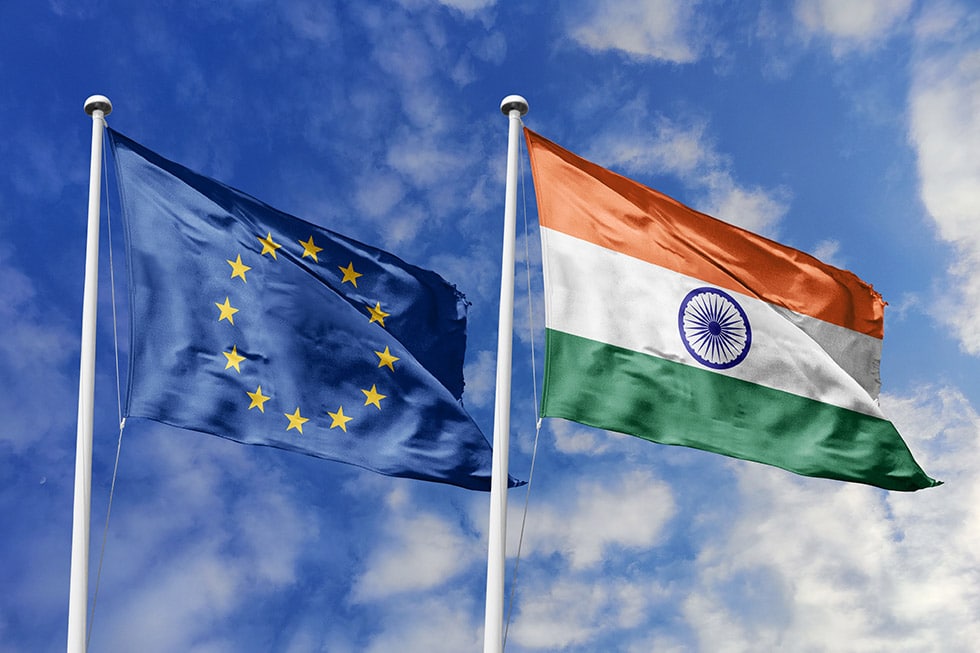
I am writing to you from the largely warm city of Zaandam in the Netherlands. The country is getting ready to experience the summer heat. However, the political summer might have already begun. Indian Prime Minister Narendra Modi was recently on a diplomatic visit to the Netherlands as part of a five-country trip that also included Denmark, Sweden, Norway and Italy. Modi also became the first Indian prime minister to visit Norway in 43 years. He attended the India-Nordic summit in the country, which included all of the heads of state of Nordic countries. European leaders have shown an extraordinary willingness to enhance economic and defense ties with India. As someone born in India and having lived in the Netherlands for many years, I find this an extraordinary turnaround. Just 15 years ago, India was dismissed as a third-world country incapable of achieving anything of substance.
via Shutterstock India stares down the barrel 2012–2014
I have vivid memories of the days immediately after a 17-year-old boy brutally raped and stabbed a woman in Delhi in 2012. During a school assembly, I was asked by another student, “Aniruddh, is rape common in India?” I must confess that I had no answer to the question. The question about rape was just a start. Within a few days of that question, I overheard a kid ask an Indian kid, “Do people in India have electricity?” I stood flabbergasted when I heard that. In yet another instant that very same year, I was asked, “Did you grow up in a shack?” This was how India was perceived nearly 15 years ago. Most of my schoolmates and teachers saw India as a poor, filthy and disgusting country. This sentiment cut across nationalities at the British School in the Netherlands, my alma mater. The global press was just as scathing in its dismissal of India’s ability to achieve global significance. In an attempt to highlight India’s inability to manage power supply, a newspaper called the Arkansas Democrat-Gazette sarcastically titled its piece, “Power on, India exits worst-ever blackout.” This characterization of the situation was unsurprising. In July 2012, India experienced its largest-ever electricity blackout. Six hundred million people in 20 states were without electricity for three days because three out of five electricity grids failed. My native state of Tamil Nadu in Southern India was only one of eight states that escaped the electricity blackout, though it faced at least a six- to seven-year period of power cuts lasting eight to 16 hours a day for reasons that were entirely unconnected to the 2012 blackout. I remember studying using candlelight whenever electricity went out during coaching classes. At times, the power cut lasted for the entire two-hour class. An inquiry committee formed after the electricity blackout did not directly blame the then United Progressive Alliance (UPA) government. However, it did note that instances of grid indiscipline, in the form of noncompliance with the provisions of the Indian Electricity Grid Code (IEGC) and the Regional Load Dispatch Centres’ (RLDCs) directions, were brought to the attention of the inquiry committee members. It also stated that visualization and situational awareness at the RLDCs were severely constrained by the unavailability of real-time data from many locations. The report pressed the urgent need for a thorough audit of protective systems. Some of these points suggested that the government may have neglected at least some of the systemic issues that India’s power sector was facing. While the electricity blackout was a significant event, it wasn’t the sole reason why the UPA was severely criticized by the international media. In fact, a large number of people in India were extremely critical of the overall leadership of the then government. In a January 2013 opinion poll, only 23% of respondents rated the government’s performance as good. The public wasn’t wrong to rate the government so poorly. A 2013 article by India Today was titled “UPA report card: Nine years, nine scams,” to indicate the extent to which corruption was a serious issue in the then government. I personally haven’t seen corruption dominate the headlines in Indian media the way it did from 2012 to 2014. The actions of former Prime Minister Dr. Manmohan Singh were also criticized both within the country and beyond. He was seen as an individual who did not take decisive action when it mattered. In 2012, India’s Supreme Court made oral observations stating that the prime minister’s 15-month-long silence on allegations of corruption against a sitting cabinet minister was “too long a period.” The court also observed that Singh “could have said the material on record was insufficient and declined the sanction.” It is another matter that a few years later, the Central Bureau of Investigation (CBI) special court acquitted individuals associated with the case. By this time, Singh was no longer India’s prime minister, and the individual concerned was no longer a cabinet minister. The government also failed to control inflation. During the final three years of the UPA government, retail inflation exceeded 9% for 22 of the 28 months. As was the case with corruption, in my 30 years I cannot recall another period when inflation was so widely debated. However, the impact of the overall failure of leadership was most evident in India’s foreign relations with various countries, particularly with the EU. India first began negotiating a free trade agreement (FTA) with the EU in 2007. By 2012, EU trade officials were so visibly frustrated with the slow progress towards the agreement that they decided to inform the government that if an FTA wouldn’t be reached by the date they had indicated, they would have no choice but to stop negotiations. This ultimately happened in 2014. EU officials cited “the lack of flexibility of Indian negotiators in providing access in dairy, wine and automotive sectors.” This lack of leadership resulted in damning headlines about India in the international media, with India relegated to a third-world backwater and a general sense that it had no capability to achieve anything. It was due to this perception that India was staring down the barrel between 2012 and 2014. The tide turns 2014–2018
All of these missteps had one thing in common — a lack of decent leadership. So, when the chance came to completely shift leadership, the people of India jumped on it. Pessimism had given way to optimism when Narendra Damodardas Modi became India’s 15th prime minister in 2014. Many people saw his entry as the beginning of a new age for the country, and I was one of them. I had turned 18 in May that year. As elections were a few months after my birthday, my mom asked me who I would vote for. I answered Modi. One very important step the Modi government took after coming to office was improving India’s bilateral relations with many countries. Between 2014 and 2016, I remember Modi visiting several countries and delivering rousing speeches. Members of the Indian diaspora came to stadiums in droves to listen to Modi. As an 18-year-old, I found it a different experience. Never before had I seen an Indian prime minister getting the thunderous welcome Modi did in those years. A number of factors drove this: his background as someone who sold tea on railway station platforms, his ability to give Hindi speeches on foreign soil and a sense among the diaspora that a decisive leader capable of taking decisive action had finally arrived. Foreign nationals also noticed this transformation. One day in a class, a Kenyan professor made the remark, “Who is this Modi? He gets a lot of crowd wherever he goes.” I was in visible shock hearing those remarks from a non-Indian. I did not know that Modi’s popularity was being noticed beyond the Indian diaspora. India inches its way onto the global stage
It was during this time that a key turning point in the India–EU relationship took place — India’s admission to the Wassenaar Arrangement (WA) in 2017, a multilateral arms control arrangement involving multiple countries. The key country that contributed to India’s entry was France. Then-ambassador to India Alexandre Ziegler played a key role as president of the WA this year and as co-rapporteur for India’s candidacy. The grouping, in a joint statement, also stated that: [WA] participating states reviewed progress of a number of current membership applications and agreed at the plenary meeting to admit India which will become the arrangement’s 42 participating state as soon as the necessary procedural arrangements for joining the WA are completed. In addition to France, countries such as Germany and Italy also supported India’s entry. Germany released a statement saying that it “welcomed India’s accession to the Missile Technology Control Regime” and that it had no objection to India joining the WA. With regard to Italy, the country wanted India to resolve certain diplomatic issues before it could support India’s entry into the WA. After the issues were resolved, Italy supported India’s entry. The EU also emphasized India’s growing significance in 2018 when the multi-country bloc released a new strategy for cooperation with India. The EU called it a geopolitical pillar in a multipolar Asia, crucial for maintaining the balance of power in the region. The strategy became a part of the EU’s Indo-Pacific strategy. India shed its image as a third-world backwater. However, it wasn’t until 2026 that India began to cement itself as a major country on the world stage. 2026 — India and the EU have attained geopolitical proximity
It is now 2026, and my school and university days are long over. In fact, very recently, a friend and I from my college days were discussing how it has been 12 years since we finished high school. We touched on how education in schools has looked vastly different from what it was when we finished. The profound changes artificial intelligence has brought to the secondary education system have been a shock to us. With yet another college friend, I was shocked to discover the changes that university education has undergone. I have even discovered that the songs that I listened to during my school and university years feel very different today. The point I am trying to demonstrate is very simple. Unlike in 2012, 2014, 2016 or 2018 when I had an opportunity to witness important geopolitical or even moments of national importance with friends and professors, today my experience is more individualized. The friends who criticized India for what they perceived as a shambles of a country or the professor who noticed Modi’s crowds are no longer present in my life. Personally, I simply did not expect that India and the EU would sign the free trade agreement (FTA) in January this year. The one constant between 2012 and this year was India’s reservations about opening up the agricultural sector. The EU wanted India to align its labor and environmental standards with its own. However, the changing geopolitical realities of the current era might have prompted India and the EU to increase their economic cooperation despite reservations. Before the trade agreement was signed, the Trump administration imposed 50% tariffs on Indian goods, including a 25% penalty for Delhi’s refusal to stop buying oil from Russia. Individual EU member states faced fresh tariff threats and were grappling with what to do if the administration decided to invade Greenland. Prominent South Asia expert Michael Kugleman noted that “One could argue that the Trump factor provided a very strong impetus to the deal because both India and the EU are facing shock US tariffs that they never expected.” In India’s case, the trade agreement represented its prominence as a country that mattered on the world stage. The FTA represents “a market for nearly 2 billion people who account for a quarter of the world’s GDP.” India also has an opportunity to expand its economic growth potential through a bloc of 27 countries with a population of 450 million. In the coming years, the enormous opportunities for growth cannot be missed. Projections indicate that India’s apparel, chemicals, textiles and leather industries are expected to realize the greatest economic gains from the FTA. At India’s level of economic development, an expansion of labor-intensive industries is most important. Wages for skilled and unskilled workers are also projected to increase. Prime Minister Modi visited the Netherlands, Denmark, Sweden, Norway and Italy to make full use of the opening created by the FTA. A key outcome of the visits was the signing of a Memorandum of Understanding (MoU) between Dutch photolithography company ASML and Indian multinational conglomerate Tata Electronics. The key takeaway of the MoU is that it is designed to enable the establishment and ramp-up of Tata Electronics’ Dholera lab with its holistic suite of lithography tools and solutions. The significance of this agreement cannot be overlooked, as ASML is the only organization in the world capable of producing Extreme Ultraviolet (EUV) lithography machines. India’s current prominence in the EU has taken time, effort and favorable circumstances to bear fruit. A more decisive administration under Modi has also ensured it can set its direction clearly and take a path. But one must not forget the work that lies ahead for India to sustain the current prominence. As someone born in India, I am happy to see India’s relationship with the EU reach the level it has. The future is uncertain, but it is promising if India stays on its current track. Wishing you a thoughtful week, Aniruddh Rajendran Commissioning Editor |
||
|
We are an independent nonprofit organization. We do not have a paywall or ads. We believe news
must
be free for everyone from Detroit to Dakar. Yet servers, images, newsletters, web developers and
editors cost money.
So, please become a recurring donor to keep Fair Observer free, fair and independent. 
|
||
|
||
| About Publish with FO° FAQ Privacy Policy Terms of Use Contact |




Explore More FO° Reflections

Support Fair Observer
We rely on your support for our independence, diversity and quality.
For more than 10 years, Fair Observer has been free, fair and independent. No billionaire owns us, no advertisers control us. We are a reader-supported nonprofit. Unlike many other publications, we keep our content free for readers regardless of where they live or whether they can afford to pay. We have no paywalls and no ads.
In the post-truth era of fake news, echo chambers and filter bubbles, we publish a plurality of perspectives from around the world. Anyone can publish with us, but everyone goes through a rigorous editorial process. So, you get fact-checked, well-reasoned content instead of noise.
We publish 3,000+ voices from 90+ countries. We also conduct education and training programs
on subjects ranging from digital media and journalism to writing and critical thinking. This
doesn’t come cheap. Servers, editors, trainers and web developers cost
money.
Please consider supporting us on a regular basis as a recurring donor or a
sustaining member.
Will you support FO’s journalism?
We rely on your support for our independence, diversity and quality.





Comment