


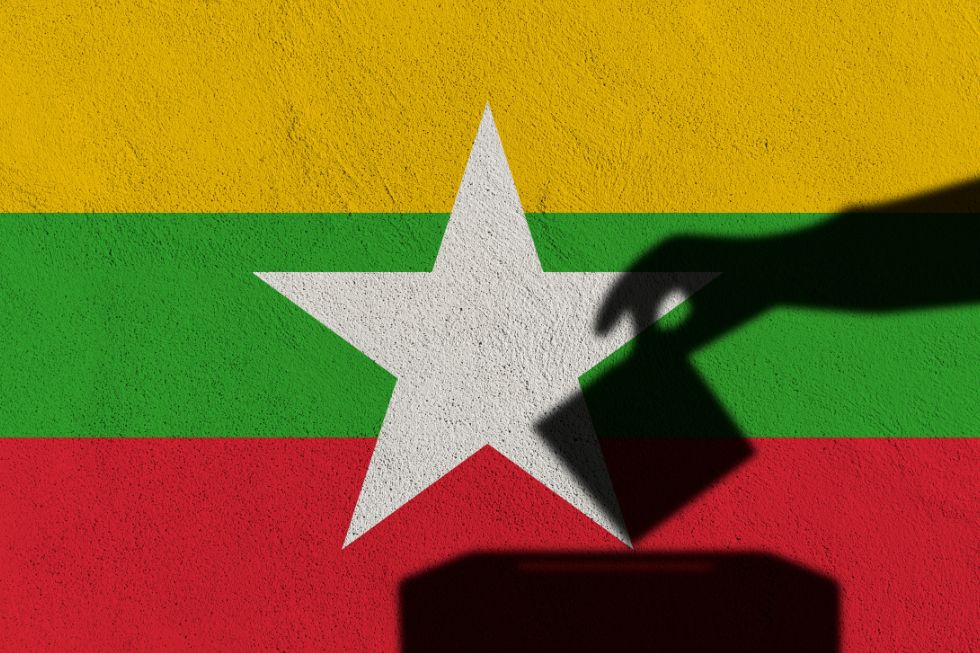



Myanmar held its first nationwide elections since the February 2021 military coup on January 25, 2026. Despite ongoing conflict and a boycott campaign led by the National Unity Government (NUG) and allied armed groups, voting was conducted in 265 of the country’s 330 townships, primarily in areas most accessible to the authorities. The parallel government-in-exile, formed by politicians, lawmakers and activists ousted during the February 2021 military coup, continues to reject the legitimacy of any initiative proposed by Min Aung Hlaing’s military regime. Its military wing, the People’s Defence Forces, continues to conduct combat operations on the ground and attempts to consolidate diverse ethnic militia groupings.
Given these constraints, the reported turnout of approximately 55% in participating constituencies is relatively high for a country affected by widespread displacement, armed violence and political polarization. The military authorities presented the elections as a step toward restoring political order and ending open hostilities, though critics remain skeptical about their inclusiveness and intent.
The political process was also closely watched by neighboring countries, including India, as the situation in Myanmar is increasingly shaping not only border security and refugee flows, but the geoeconomic ambitions of regional players, as well.
Consolidation of power
The Union Solidarity and Development Party (USDP), closely associated with Min Aung Hlaing’s military regime, won the majority of the contested seats. The USDP now has a majority in both chambers of Parliament. They secured 232 of the 263 seats in the lower Pyithu Hluttaw and 109 of the 157 seats announced so far in the upper Amyotha Hluttaw. Combined with the constitutionally mandated allocation of 25% of parliamentary seats to unelected military appointees, this outcome gives the military junta effective control of the legislature and forecloses meaningful parliamentary opposition. In practical terms, the election has reinforced existing power structures, lending formal political cover to continued military authority rather than altering the balance of power.
The Association of Southeast Asian Nations (ASEAN) declined to certify or endorse the election, stating that conditions for a credible and inclusive process were absent and confirming that no ASEAN observer mission would be deployed. Meanwhile, neighboring states that have direct security and economic interests in Myanmar took a more pragmatic position.
China publicly welcomed the completion of the election and reiterated its support for stability and continued bilateral cooperation, framing the vote as part of a domestic political process. India had previously expressed support for Myanmar’s plan to hold elections in a “fair and inclusive” manner and sent monitoring teams. These actions and rhetoric reflect New Delhi’s priority for stability and sustained engagement over diplomatic isolation. Vietnam and Cambodia also sent observers, signaling a willingness among some regional actors to maintain channels of contact with Naypyidaw despite broader international skepticism. This position reflected longstanding divisions within the bloc regarding engagement with Myanmar’s post-coup authorities.
Myanmar’s instability and India’s security
For New Delhi, developments in Naypyidaw are directly related to domestic security concerns. The Indian states of Arunachal Pradesh, Nagaland, Manipur and Mizoram share a 1,643-kilometer border with Myanmar. The conflict in Myanmar has intensified since 2021, creating instability in weakly controlled border regions, such as Mizoram and Manipur.
Indian law enforcement agencies have reported an increase in cross-border crimes, including weapons and drug smuggling, militia infiltration and the establishment of insurgent training camps. In Mizoram’s Champhai, Saiha and Lawngtlai districts, operations have led to the seizure of explosives, weapons and narcotics. Between September 2025 and January 2026, the value of confiscated illegal substances exceeded $15.5 million. Further north, Manipur authorities recorded 22 drug smuggling cases and 12 arms trafficking cases in the first quarter of 2025 alone.
The instability in Myanmar, caused by conflict between the junta and the NUG as well as deep internal divisions between local national insurgents fighting on the side of opposition forces, creates conditions for a growing number of refugees and causes civil and ethnic unrest.
In mid-2025, clashes between the Myanmar militia groups Chin National Front (CNF) and Chin Defense Force (CDF) forced up to 4,400 people to flee to the Indian state of Mizoram. By March 2026, the number of officially registered Myanmar nationals in Mizoram had reached 28,355. Of these, 27,574 had passed biometric registration. The total number of Myanmar asylum seekers in India is more than 86,000. Despite the deep ethnic kinship between the majority Mizo people in Mizoram and the Chin people in Myanmar, this prompted the deployment of additional police and Assam Rifles units.
The influx of Myanmar refugees has led to growing tension amongst the locals due to the increase in competition for limited job opportunities as the state grapples with rising youth unemployment, which is estimated to be around 12%. Furthermore, the situation is worsening due to the rising crime rate. In June 2025, Mizoram Home Minister K. Sapdanga stated that more than 50% of criminal cases in the state were linked to individuals who had entered the country illegally or as refugees.
The rising cost of internal strain
While Mizoram is more tolerant of refugees from Myanmar, neighboring Manipur is notorious for ethnic violence. On May 3, 2023, a dispute between the Meitei majority in Manipur and the Chin communities over Scheduled Tribe status escalated into a devastating conflict. Rooted in territory and identity, the situation was significantly exacerbated by the influx of approximately 10,000 refugees from Myanmar, resulting in at least 260 deaths and the displacement of over 60,000 people. Meitei groups also cited the growth of new settlements and a 30% increase in poppy cultivation as evidence of a “narcoterrorist” threat from Myanmar. This prompted the Indian government to scrap the Free Movement Regime, which allowed local tribes to travel freely without visas, and to start construction of a border fence in February 2024.
This situation poses a significant threat to India’s domestic security and challenges its geoeconomic ambitions. Regions affected by conflict, such as Manipur in India, which borders Chin state, one of the three regions bordering India, are of particular concern as they are along the India–Myanmar–Thailand Trilateral Highway. This route is a flagship connectivity project under India’s Act East policy. New Delhi has invested over $250 million in the project directly and has extended more than $1 billion in credit lines for broader ASEAN connectivity initiatives.
Studies on ASEAN-India cooperation estimate that extending these corridors to Cambodia, Laos and Vietnam could generate up to $70 billion in additional regional GDP and create around 20 million jobs by the middle of the decade. India is expected to benefit from this expansion through increased trade and development in its northeast region. However, persistent insecurity in Myanmar and its derivatives continues to delay construction, raise costs and cast uncertainty over the project’s long-term viability.
Elections in the border regions
Ahead of and during the electoral process, the junta pursued local negotiations with ethnic armed organizations to secure ceasefires or tacit noninterference, thereby enabling limited polling, particularly in border areas. These efforts yielded mixed results. Chin State was almost entirely excluded from the electoral process because resistance forces linked to the NUG and local People’s Defense Force units retained significant territorial control there. These armed groups rejected the vote outright, preventing the establishment of conditions for polling.
In Sagaing and Kachin, the situation was similarly fragmented. Armed actors repeatedly attempted to disrupt the election by targeting logistics and security deployments. In Sagaing, 11 of the 34 townships were excluded from voting due to security concerns, and clashes were reported in seven others during the election. In Kachin State, elections could not be held in four townships and additional incidents were recorded in two more.
While areas immediately adjacent to the Indian border remained relatively calm during the initial phase, security conditions deteriorated further inland as the process continued. Myanmar Witness documented over 150 conflict-related incidents in townships that were officially designated as “active” or “stable” for voting. Insurgent groups sought to derail the process by threatening officials and voters, attacking supply routes and otherwise intimidating people.
An unsettled outcome
Although the junta held elections in most accessible areas and established institutional control, stability remains elusive because the NUG and affiliated insurgent groups have invested significant resources in preventing ceasefires and disrupting electoral activity rather than facilitating political de-escalation.
The elections showed that the war in Myanmar won’t stop in the short term and that political dialogue is the only way forward. All foreign actors should assist in this dialogue, and the idea of “isolation” should not be supported. The election was a reminder to all critics of Min Aung Hlaing’s military regime that the USDP has its supporters, even if their number is less than the official electoral statistics indicate. It’s impossible to ignore this part of the population and their interests. Otherwise, the situation will be mirrored, and the NUG will become another totalitarian regime.
The stance of key international actors, such as India and China, has reinforced the rationale behind taking a calibrated and pragmatic approach to Myanmar. India’s strategy prioritizes stability, dialogue and reducing violence over ideological positioning, aiming to achieve tangible results. New Delhi continues to engage with the authorities in Naypyidaw, not to endorse military rule, but to preserve border security, sustain humanitarian access and maintain channels for political de-escalation.
This stance contrasts with that of several ASEAN members, whose refusal to engage with the junta has enabled opposition forces to reject ceasefires and disrupt the electoral process through armed conflict. Only a change in approach among ASEAN countries and mediation could bring peace closer. Without offering feasible political solutions, isolating the Naypyidaw authorities could prolong the conflict and have regional consequences, including human casualties and destroy Myanmar’s economic potential for years. Moreover, it will affect neighboring countries with escalating refugee crises and ethnic tensions, as well as undermine projects that would promote social and economic growth in Myanmar and throughout Southeast Asia.
[The Indian Narrative first published a version of this piece on February 6, 2026.]
[Aysha Sadak Meeran edited this piece.]
The views expressed in this article are the author’s own and do not necessarily reflect Fair Observer’s editorial policy.
Defense Without Strategy: India’s Strategic Pretense
Swami Vivekananda, the great Yogi, said, “With every man, there is an idea; the external man is only the outward...
Operation Hot Pursuit: The Indian Army’s Surgical Strikes into Myanmar
On June 9, 2015, India conducted a cross-border strike codenamed Operation Hot Pursuit, against insurgents in Myanmar in response to...

Support Fair Observer
We rely on your support for our independence, diversity and quality.
For more than 10 years, Fair Observer has been free, fair and independent. No billionaire owns us, no advertisers control us. We are a reader-supported nonprofit. Unlike many other publications, we keep our content free for readers regardless of where they live or whether they can afford to pay. We have no paywalls and no ads.
In the post-truth era of fake news, echo chambers and filter bubbles, we publish a plurality of perspectives from around the world. Anyone can publish with us, but everyone goes through a rigorous editorial process. So, you get fact-checked, well-reasoned content instead of noise.
We publish 3,000+ voices from 90+ countries. We also conduct education and training programs
on subjects ranging from digital media and journalism to writing and critical thinking. This
doesn’t come cheap. Servers, editors, trainers and web developers cost
money.
Please consider supporting us on a regular basis as a recurring donor or a
sustaining member.
Will you support FO’s journalism?
We rely on your support for our independence, diversity and quality.
The Myth of Pakistan’s War Economy: Debunking the “Dollars for Conflict” Narrative
Pakistan rejects claims that it profits from conflict, emphasizing the massive human, economic and infrastructural losses it has suffered, which...
Why Capitalism Failed in the Ottoman Empire and the Turkish Republic
Turkey’s economic struggles arise from a bureaucratic tradition that favors state control over the creative destruction essential for capitalism. Political...

The Quest for Conscious AI: Balancing Economic Growth with Human Well-Being
AI is making gains in the world economy, causing increased productivity across many sectors. However, workers often left with a...






Comment