



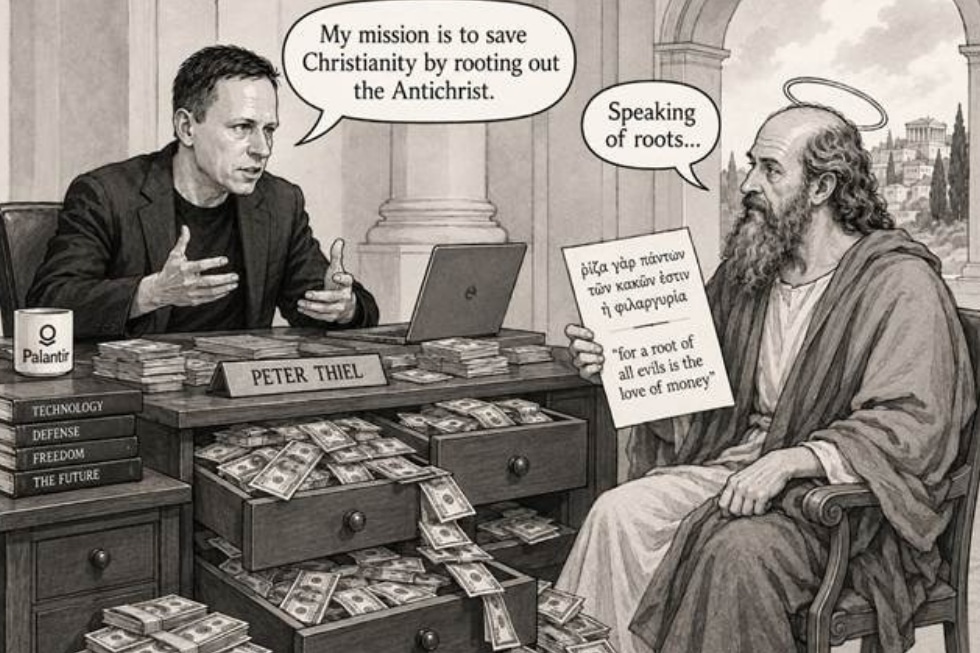



One of the most famous quotes from the New Testament is St. Paul’s condemnation of something the Greeks called φιλαργυρία. Most English translations require three words to translate the single compound Greek term: “love of money.” Writing in Greek, Paul cited philargyria — literally, “love of silver” — as the “root of all evils” (1 Timothy 6:10).
Apparently, this was a common proverb among the ancient Greeks rather than what some fundamentalist Christians believe: that the text of the Bible infallibly represents the word of God. The Cynic philosopher Bion of Borysthenes three centuries earlier declared that philargyria “is the metropolis [capital city] of all evils.” Writers, as is always the case, can choose their metaphors. Paul was nursing and growing a new religion and quite naturally was thinking less about capital cities than roots. (He was later decapitated by Nero in the empire’s capital city).
There’s one sense in which we can claim the West today has not lost those particular Christian roots Paul mentioned. Given the prestige attained by philargyria in today’s evolved Gordon Gekko version of Christendom, the roots of the epistle are thriving as never before, though with the twist. What was evil has now become its opposite. “Greed, for lack of a better word… is good,” Gekko explains to a captive audience.
Fun fact: the translators of Oliver Stone’s movie, Wall Street, apparently preferred the word “απληστία (aplestia)” for Gekko’s “greed” in the English text. Aplestia means something closer to “insatiability.” Had Paul been able to observe what the “love of money” has become today, he might have concurred. Christian ethics appear to have evolved. Thanks to the growth of our prosperous economy, the apostle’s philargyria is no longer just about the love of “silver” (argyria). It has now become confounded with the insatiable greed for power.
In our consumer society, satiety should never be achieved. It’s not just greed but also growth that is good. And growth must never stop. Satiety would ruin the economy. In contrast, Paul naively maintained that “if we have food and clothing, we will be content with that.” We might then ask ourselves this impertinent question: How much food and clothing can a billionaire afford?
Money or power?
Our media thrills at reporting the horse race between those exceptional individuals who may one day pass the trillion-dollar threshold and the following day fall behind, as others seek to overtake them. But it’s no longer about money or what money can be. None of these megabillionaires craves a trillion dollars for the wealth alone. All of them — Elon Musk, Jeff Bezos, Larry Ellison and the other handful of contestants — are focused not just on how to control markets, like the Rockefellers and Carnegies of the past, but increasingly the politics of their own and other nations, and increasingly the tastes, beliefs, opinions, values and more generally the minds of entire populations.
Most of humanity has a limited “love of money” targeted at avoiding misery and being in a position to manage things in a way that might make life reasonably enjoyable for themselves and their families. A select few, cultivating the finer techniques associated with the art of philargyria, have turned the quest for obscene levels of wealth the basis of their identity.
Contrast that with the ethos of the late 19th century’s “Gilded Age,” when the industrial elite sought to consolidate wealth and power strictly within the physical domains they controlled. Even while expanding their reach through aggressive vertical and horizontal integration within the industries that had built, they appeared to recognize the boundaries of their respective realms. Today’s elite, by contrast, seem driven by aplestia: a totalizing insatiable desire to dominate global discourse, human attention and the fundamental structures of daily life.
In the same epistle, Paul observed that some people mistakenly suppose “that gain is godliness.” But today’s practitioners of philargyria see gain not just as a proof of godly virtue but as the device that literally turns them into gods. Or rather God, since these disciples of “Judeo-Christian culture” are content to reflect rather than consciously honor their culture’s monotheistic roots.
None more ostentatiously than venture capitalist Peter Thiel, the self-appointed slayer of the Antichrist who offers this wisdom:
“In business, money is either an important thing or it is everything. Monopolists can afford to think about things other than making money; non-monopolists can’t.”
For someone who clearly worships the god of money, Thiel’s belief in monopolism correlates curiously with his own special version of monotheism, surrounded by enemies and in need of Palantir’s surveillance tools to defend it. For Thiel there is one supreme God, whom he sees in the mirror, which may help to explain his obsession with rooting out the Antichrist. He sees him (or her… Greta Thubberg?) as a challenger to his monopoly.
Monopoly as an article of faith
Paul quoted a common Greek proverb. The Christian tradition has immortalized the proverbial phrase as a guideline for Christian economic morality. Should we conclude that it has now been turned on its head by the modern cult of the insatiably wealthy? When Paul warned of the danger of loving money, he insisted that love should be directed elsewhere, focused on what he refers to as “the life that is truly life.” Money was an abstraction, an imperfect, unreliable measure of value.
In the Gilded Age, the Robber Barons manipulated markets and the laws to achieve domination over physical industries — railroads, steel, oil, electricity — that had a direct relationship with “life that is truly life.” Banking itself was an industry for industry, as JP Morgan clearly understood. But over the past half century, all that has changed. Industry itself has become a mere backdrop and to a large extent a pretext for something else: the financial fiction of predictive markets.
Podcaster and motivational speaker Tom Bilyeu describes how the US economy has left behind the logic of industrial production. He loudly proclaims that “what America ended up doing was financializing everything.”
“So now I can financialize my economy. And what that means is instead of having to build the thing you can just trade on betting on the thing and it becomes a totally different game. It is a miracle of capital aggregation. It is a phenomenal way for people who understand assets to get wealthy. It is a great thing if you do that on top of having a great manufacturing base.”
The shift began some time ago, and it began as physical industries gave way to a new digital reality. In 2011, Silicon Valley investor Marc Andreessen declared that “Software is eating the world.” He was clear about the consequences:
“This problem is even worse than it looks because many workers in existing industries will be stranded on the wrong side of software-based disruption and may never be able to work in their fields again. There’s no way through this problem other than education, and we have a long way to go.”
Who will fail to seize the terrible irony behind this prediction, which everyone in government, from US President Barack Obama downwards, took seriously? “If we want America to stay on the cutting edge, we need young Americans like you to master the tools and technology that will change the way we do just about everything.” Just as Andreessen suggested and Obama insisted, education adapted… only to discover a dozen or so years later a new reality. Software was the past. AI was now “eating the world.” The perspective for the generation that had learned how to code was now mass unemployment.
So what was left for those who could not hope to build the kinds of monopolies Thiel, Musk, Bezos and others had become so skilled at building? In a world that has now “financialized everything,” there’s one thing to do: intervene in prediction markets. They’re called Polymarket or Kalshi, but as YouTube content creator James Li demonstrates, there may be more than one way to financialize certain data.
“What you’re interacting with is a market that operates a lot like the stock market,” explains Kalshi’s head of enforcement. And he’s right. The stock market is fed by the belief that something that exists today — whatever it is and whatever goods or services it produces — will be worth more tomorrow than today. At its base, it’s all about betting on something that will change over time. Who needs to know whether it makes sense? The only thing that matters is whether its value increases.
This fundamental logic led to the creation over time of what are called derivative markets. Investopedia defines a derivative as “a kind of financial contract between two or more parties, the value of which fluctuates based on the price of one or more underlying assets.” Πάντα ῥεῖ (panta rheî) is the Greek phrase that summarizes pre-Socratic philosopher Heraclitus’s view of the world. “Everything flows” or “it’s all about change,” the modern equivalent of which is political strategist James Carville’s famous dictum addressed to presidential candidate, Bill Clinton. “It’s the economy, stupid.”
It’s the education, stupid
Political scientist Francis Fukuyama was right in the end. We have reached what looks like the “end of history,” at least of our economic history. The only thing that makes economic sense now is anticipating change and betting on it. Building and producing as physical activities produced by humans and increasingly machines still exist, simply because material reality cannot be abolished. But value exists only in flux. We’ve produced a culture that lives for flux, not because we flow with history — which humanity used to do — but because we now believe we may possess the intelligence to exploit flux for profit.
When everything is financialized, reality itself fades into the background. Events have meaning only because they fluctuate, making it possible to bet on one outcome rather than another. We’ve created a system designed to make some people trillionaire-level wealthy. The others, the vast majority, have literally “no future” other than the one they can bet on with whatever means they happen to have at the time.
Andreessen and Obama told us it was all about education. But look at what education has become, apart from the dead-end our recently trained army coders are now discovering. New generations bet the family jewels and their entire future on the supposed value of a diploma, not for what it represents in terms of knowledge and skills, but for its financialized market value. At the end of the process, many — perhaps most — are now discovering that value has disappeared, but certainly not the debt.
Money itself is an abstraction in the form of a bet. It represents the confidence you have in a promise by an institution, be it a government or a bank, to give you back the value you’ve transferred to it. You’re betting the institution is solid enough to pay you back, and to reward you with a profit, usually but not always in the form of interest.
It may sound like quibbling, but St. Paul might be satisfied to know that philargyria has in the most literally terms disappeared from the landscape. It’s no longer about silver (argyria). It’s about the abstract value of assets, whose valuation is the result of bets made in the marketplace. It’s increasingly about derivatives, about what you and I can get out of prediction markets, mimicking the kind of success Warren Buffet achieved with the “legitimate” stock market. The more we dig around in the dirt that’s produced today’s wealth, the less we are likely to find anything resembling physical roots.
*[The Devil’s Advocate pursues the tradition Fair Observer began in 2017 with the launch of our “Devil’s Dictionary.” It does so with a slight change of focus, moving from language itself — political and journalistic rhetoric — to the substantial issues in the news. Read more of the Fair Observer Devil’s Dictionary. The news we consume deserves to be seen from an outsider’s point of view. And who could be more outside official discourse than Old Nick himself?]
[Lee Thompson-Kolar edited this piece.]
The views expressed in this article are the author’s own and do not necessarily reflect Fair Observer’s editorial policy.
A Trillion Reasons Democracy Is Doomed
Two new “trillionaires” — the US military and Elon Musk — now occupy the headlines. Both represent a dangerous concentration...
Peter Thiel: The Antichrist Hunter of Silicon Valley
One journalist describes Peter Thiel as a fan of the Bible. Columnist Ross Douthat calls him an influential right-wing intellectual....

Peter Thiel Fights the Antichrist and Defends Mamdani Voters
Peter Thiel surprisingly urges fellow MAGA conservatives to understand, not dismiss, why young New Yorkers elected a Muslim democratic socialist...
Peter Thiel’s Bitcoin Paranoia
A firm believer in the disruptive cryptocurrency, Peter Thiel sees one reason to doubt.

The Sadly Illusory Spontaneity of the Super-Rich
The new elite has used its taste for hyperreality to invent a new relationship between the sexes.

Support Fair Observer
We rely on your support for our independence, diversity and quality.
For more than 10 years, Fair Observer has been free, fair and independent. No billionaire owns us, no advertisers control us. We are a reader-supported nonprofit. Unlike many other publications, we keep our content free for readers regardless of where they live or whether they can afford to pay. We have no paywalls and no ads.
In the post-truth era of fake news, echo chambers and filter bubbles, we publish a plurality of perspectives from around the world. Anyone can publish with us, but everyone goes through a rigorous editorial process. So, you get fact-checked, well-reasoned content instead of noise.
We publish 3,000+ voices from 90+ countries. We also conduct education and training programs
on subjects ranging from digital media and journalism to writing and critical thinking. This
doesn’t come cheap. Servers, editors, trainers and web developers cost
money.
Please consider supporting us on a regular basis as a recurring donor or a
sustaining member.
Will you support FO’s journalism?
We rely on your support for our independence, diversity and quality.





Comment