




The famed capitalist thinker Adam Smith’s quarrel was never with government as such. It was with a particular arrangement between government and established business, under which charters, monopolies, navigation acts and guild restrictions were maintained in the name of national prosperity and to the profit of those who had lobbied for them. Merchants of the same trade, he observed, rarely gather without the conversation ending in a conspiracy against the public and the mischief he identified was not that they conspired but that the state so reliably obliged them. The Wealth of Nations is, among other things, a catalogue of rent extraction.
I mention this because The Economist has recently taken aim at Daron Acemoglu (a Massachusetts Institute of Technology professor and economist) in what the magazine evidently understands to be a defense of markets and because it is not one. Acemoglu called the piece a hit job. I am less interested in his standing than in two claims the article treats as discredited because of its association with him. Both concern entry and competition. Both belong to the liberal tradition rather than to its critics. On both, the magazine has ended up defending not the market order but the parties currently sitting inside it.
What extractive institutions extract
An extractive institution is an arrangement in which those who profit from barriers to entry use politics to enforce them: Property is secure for insiders and precarious for everyone else, entry is conditional on permission and courts respond to whoever already holds the charter. Inclusive institutions are its negation. They are not a program of redistribution. They are the absence of a standing veto over new entrants.
Begin with the sovereign, because the sovereign is the limiting case. A ruler who needs capital would prefer to borrow cheaply and repay when convenient; lenders, anticipating exactly this, charge accordingly or decline altogether. The ruler is thus worse off for his own unlimited discretion and he cannot repair the problem by promising, since discretion is precisely what permits him to break promises.
The American economists and political scientists Douglass North and Barry Weingast read the English settlement of 1688 as the solution to this bind: Parliamentary control over revenue and courts the Crown could not simply override, made royal commitments credible and the state’s borrowing costs fell in consequence. Nothing about English capital or English enterprise changed in that decade. What changed was that the largest potential expropriator in the kingdom had been tied down and the capital markets priced the difference.
The same logic runs downward, because rulers are not the only parties capable of closing an economy. The famed economist and Nobel Prize winner George Stigler’s account of regulatory capture supplies the mechanism by which private closure is achieved: as a general matter, he argued, regulation is acquired by the industry it governs and operated for that industry’s benefit, because producers have concentrated interests and consumers have diffuse ones. The producer knows precisely what a licensing requirement is worth to him and can afford the lobbyist; the consumer bears a cost too small to notice individually and too large in aggregate.
This is not a theory about corrupt officials. It is a theory about the asymmetry of stakes, and it predicts that protection will be sought by those best positioned to obtain it, using the state as the instrument of a private restraint of trade.
That the resulting theory is not circular can be demonstrated rather than asserted, because it generated a prediction that could have failed. In 2002, Acemoglu, Johnson and Robinson documented a reversal of fortune: Among territories Europeans colonized, the places that were prosperous and densely populated in 1500 — Mesoamerica, the Andes, Mughal India — are the poor places today, while the thinly settled territories became rich. Geography does not move. No explanation resting on climate or terrain can generate an inversion of the ranking. The institutional explanation can be dense and productive populations were worth organizing for extraction, while empty ones offered nothing to extract, obliging settlers to secure their own property instead. The claim was exposed to refutation and it held.
Evidence of the kind that requires no expert to score a country has since accumulated. Melissa Dell’s study of the Peruvian mita compares households across the boundary of a forced-labor conscription system that ran from 1573 to 1812. The line cut through continuous terrain, with the same peoples and the same colonial administration on either side. Consumption today is roughly 25 % lower on the conscripted side and childhood stunting is higher by about six percentage points, with the persistence running through land tenure, public goods and integration into road networks. Nathan Nunn’s work on the African slave trades finds a comparable long shadow. Neither depends on a perception index compiled by analysts who already knew the answer.
The literature is not monolithic in discussing this matter. Stelios Michalopoulos and Elias Papaioannou (two Greek economists and professors), comparing ethnic homelands partitioned by colonial borders, find that differences in national institutions across those borders do not systematically produce differences in local development. Their result suggests that the operative margin in much of Africa is local rather than national — that what matters is the institution actually governing the village, not the flag over the capital. That refines the thesis. It does not rescue the alternative, since the alternative was that institutions do not matter at all.
The theory’s sharpest implication is the one most relevant to the present dispute: rulers and incumbents will obstruct productive innovation when the innovation threatens their position. The Habsburg and Russian states resisted railways; Ottoman authorities restricted printing for the better part of three centuries. These were not failures of imagination but accurate assessments, by men who understood their own circumstances, of what mobility and literacy would do to them. Creative destruction is a phrase that flatters the creation and understates who does the destroying. Incumbents notice.
Intellectual honesty requires naming the defeat condition. Extractive regimes can certainly grow; the Soviet Union managed four decades of it by moving peasants into factories and China has done something structurally similar at greater scale. The claim is narrower: that such regimes cannot sustain innovation-led growth at the frontier, because frontier growth requires permitting the displacement of whoever is currently powerful. Should China reach frontier income per head under unconstrained single-party rule, the framework is not merely embarrassed but refuted and those of us persuaded by it will owe an accounting. What has occurred instead — the interventions against Ant Group, against Didi, against the private tutoring sector — is the predicted behavior in daylight.
The AI trajectory is not a market verdict
The Economist closes by asking who the “we” is that would steer artificial intelligence and by what authority anyone determines which technologies ought to complement human beings. The question presupposes that the present direction of development is a market outcome and that the alternative to accepting it is installing someone else to decide. Neither half survives contact with the policy environment.
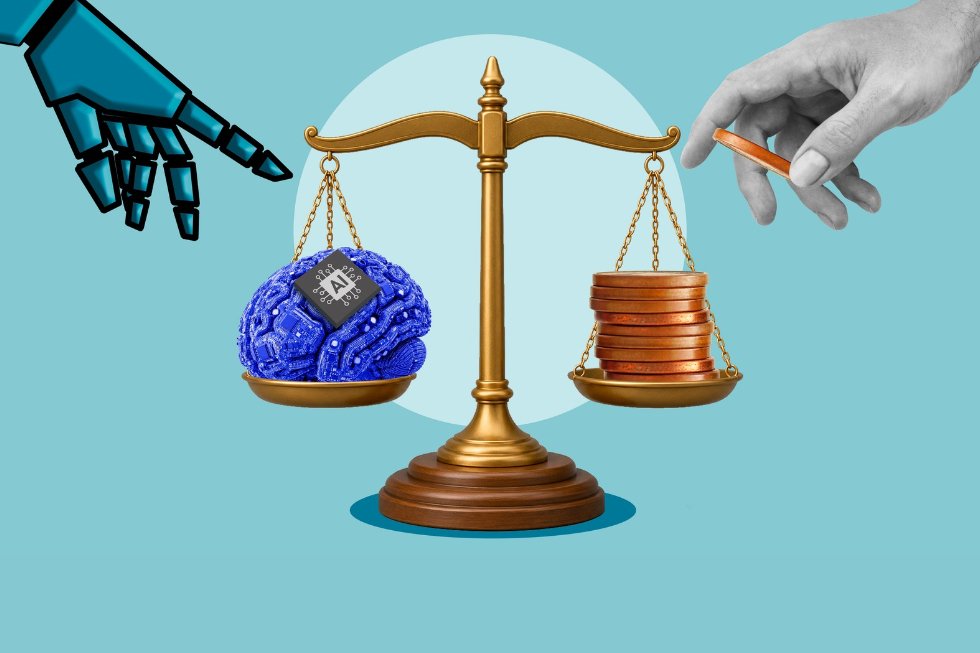
Examine how the tax system influences the decision to hire human labor versus adopting automated solutions. Acemoglu, Andrea Manera and Pascual Restrepo estimate effective US tax rates on labor in the range of 25.5 to 33.5 %, against effective rates on software and equipment capital of roughly 10 % in the 2010s and 5 % thereafter. A firm weighing a worker against a machine confronts a relative price that the tax code has bent, substantially, in one direction.
Their finding is that this induces automation past the point of efficiency: firms adopt marginal technologies that displace labor without generating much productivity, because a fiscal thumb on the scale has made privately profitable what is not socially worthwhile. Correcting the asymmetry, on their estimates, would raise employment by around 4 % while restoring automation to something nearer its optimum.
This ought to be read as a market-liberal finding, because that is what it is. A distorted relative price is producing a distorted allocation and the remedy is neutrality between factors of production — the same remedy any competent economist would prescribe for a subsidy to coal or a tariff on steel. It also reconciles the two Acemoglu positions his critics treat as contradictory. His low estimate of AI’s productivity effect and his worry about displacement are not in tension; they are the same phenomenon observed twice, since what the tax code subsidizes is precisely the automation that substitutes for labor without producing much. One need not accept his particular figure, or share his broader appetite for regulation, to see that mechanism coheres and that this policy conclusion is market-liberal in spirit.
Procurement bends trajectories as thoroughly as taxation does and the historical record here is unambiguous. David Noble’s account of postwar machine-tool automation describes two viable control systems. Record-playback captured a skilled machinist’s movements and reproduced them, keeping programming on the shop floor. Numerical control specified tool paths in advance from an engineering office. Record-playback was in several respects simpler and cheaper. Numerical control prevailed, carried by the US Air Force procurement and by the institutional enthusiasm that funding sustained.
Whatever one concludes about the relative merits, the industry did not arrive at that configuration through unsubsidized competition among buyers. A government customer with extraordinary purchasing power selected a path and the private sector followed the money. Anyone suspicious of industrial policy should find this history disquieting rather than reassuring.
The contemporary arrangement is not obviously cleaner. Frontier model development proceeds under export controls determining who may purchase the hardware, under procurement relationships with defense and intelligence agencies, under energy and permitting decisions determining where computation can physically be sited, under an intellectual property regime whose treatment of training data is being settled in litigation rather than statute and under a liability framework nobody has yet written. To call the resulting configuration the verdict of a free market is a category error. It is a policy environment and a fairly interventionist one.
The knowledge problem does not stop at the firm’s door
The strongest objection to any of this is Frederich Hayek’s and it deserves stating at full strength. The knowledge required to allocate resources well is dispersed, local and substantially tacit; no central authority can assemble it; decisions about what to build should therefore be pushed outward toward those who hold the particular knowledge of time and place. Nobody in 1975 could have identified which lines of computing research merited support and a body empowered to make that judgment would have erred expensively.
I take this to be correct. But observe what it establishes. It is an argument against concentrating allocative decisions in any entity too distant from dispersed knowledge. It is not a certification that some particular existing arrangement disperses them. When capital requirements, computation, data and specialized talent are held by a handful of firms and when the terms of access to all four are set within those firms, the resulting decision structure resembles the object of Hayek’s critique more than its remedy. Add compliance regimes whose costs fall hardest on entrants — licensing, certification, audit — and Stigler’s mechanism becomes available in the ordinary way. A rule that only the largest firms can afford to satisfy is a barrier to entry regardless of what the preamble says it is.
The liberal question is therefore not whether to leave technology alone or direct it. It is whether the institutional environment surrounding it keeps entry open and rents competed away or whether it is being closed by the parties best positioned to close it, using instruments a market-liberal magazine ought to recognize on sight.
Which side the argument is on
Acemoglu is, on both contested claims, making a competition argument. Inclusive institutions are those that prevent incumbents from foreclosing entry. The worry about artificial intelligence is a worry about rents, distorted factor prices and productive capacity concentrating faster than any institution has managed to respond. Neither claim requires believing that governments allocate capital well and neither improves if one assumes they do.
The Economist has spent much of its history opposing arrangements of precisely this kind and it has been right to. What it has done here is mistake the defense of an existing distribution of advantage for the defense of the market order that distribution has learned to work. The two are not the same thing and Smith knew it in 1776.
[Patrick Bodovitz edited this piece]
The views expressed in this article are the author’s own and do not necessarily reflect Fair Observer’s editorial policy.
Why Capitalism Failed in the Ottoman Empire and the Turkish Republic
Turkey’s economic struggles arise from a bureaucratic tradition that favors state control over the creative destruction essential for capitalism. Political...

Beyond the Boom: Understanding AI’s True Economic Impact and Hidden Financial Danger
AI promises transformative economic potential but its measurable impact remains uncertain due to slow diffusion and inadequate productivity metrics. Massive...

Turkey Must Adopt Free Markets to Revitalize Its Faltering Economy
Turkey’s economic turmoil stems from policy missteps that have eroded financial stability and investor confidence. Deep-rooted structural issues, including governance...

Support Fair Observer
We rely on your support for our independence, diversity and quality.
For more than 10 years, Fair Observer has been free, fair and independent. No billionaire owns us, no advertisers control us. We are a reader-supported nonprofit. Unlike many other publications, we keep our content free for readers regardless of where they live or whether they can afford to pay. We have no paywalls and no ads.
In the post-truth era of fake news, echo chambers and filter bubbles, we publish a plurality of perspectives from around the world. Anyone can publish with us, but everyone goes through a rigorous editorial process. So, you get fact-checked, well-reasoned content instead of noise.
We publish 3,000+ voices from 90+ countries. We also conduct education and training programs
on subjects ranging from digital media and journalism to writing and critical thinking. This
doesn’t come cheap. Servers, editors, trainers and web developers cost
money.
Please consider supporting us on a regular basis as a recurring donor or a
sustaining member.
Will you support FO’s journalism?
We rely on your support for our independence, diversity and quality.




Comment