


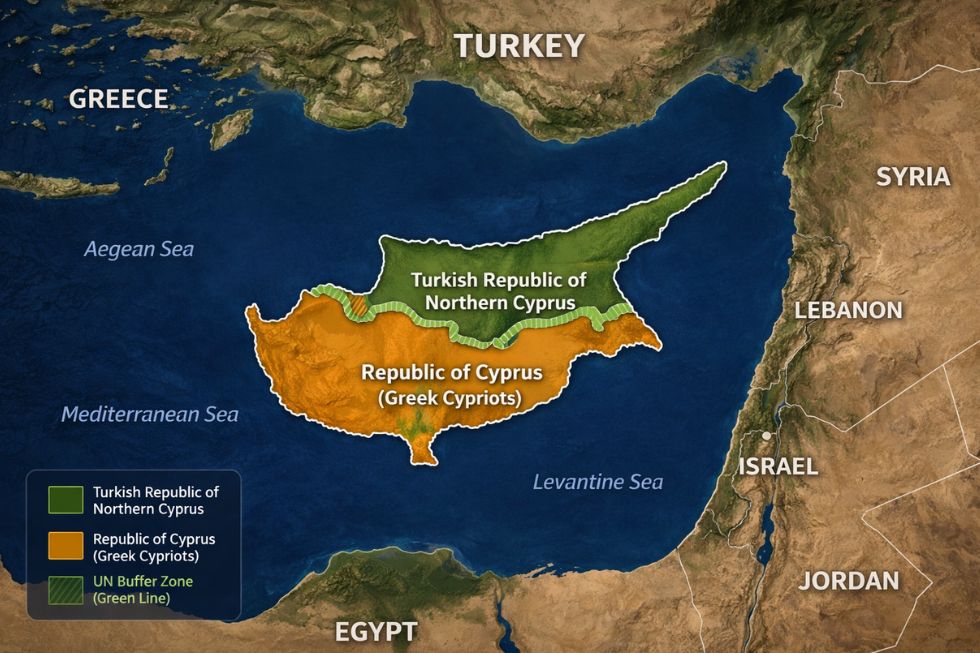



At a moment of heightened global uncertainty, the Eastern Mediterranean sits at the intersection of geopolitical tension and economic opportunity. Nowhere is this more evident than in Cyprus, where the lack of recognition of sovereign equality for Turkish Cypriots isolates them from the world and halts security cooperation and economic development for the whole island. For the Turkish Republic of Northern Cyprus (TRNC), the path forward is clear: Resilience has carried us this far, but lasting stability — and unlocking the island’s full potential — requires meaningful international engagement and a just resolution of the Cyprus Issue based on sovereign equality.
This is not simply a regional matter. It is a strategic opportunity for the US and the international community to support stability, economic growth and cooperation in a region that urgently needs all three.
Geopolitics meets economic reality
Cyprus’s geography places it at the frontline of regional developments. Instability in the Middle East, fluctuations in global energy markets and shifting security dynamics all have direct economic consequences. For an island economy reliant on imports, rising transportation and energy costs quickly translate into inflationary pressures that affect households and businesses alike.
These pressures are compounded by the unresolved Cyprus Issue (the historically rooted conflict between the Greek and Turkish communities in Cyprus). The absence of a comprehensive settlement has created structural constraints — particularly for the Turkish Cypriot side — most notably restrictions on direct trade and transportation. These are not natural economic limitations; they are artificial constraints that distort markets, raise costs and limit opportunity.
Yet despite these realities, Northern Cyprus continues to demonstrate a remarkable capacity to adapt.
Tourism as strategy: authenticity, access and untapped potential
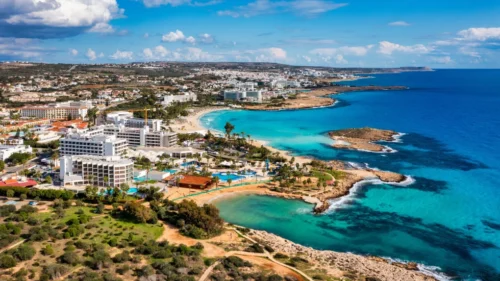
Tourism remains a cornerstone of the TRNC economy — and a powerful example of resilience in action. In 2024 alone, more than 1.3 million visitors stayed in tourist accommodation facilities, contributing to a broader ecosystem that supports employment, services and investment. Northern Cyprus offers something increasingly rare in today’s global tourism landscape: authenticity. Its coastline remains largely unspoiled, its cultural identity is distinct and its history is layered in a way that invites exploration.
Consider Varosha, the once-abandoned district of Famagusta. Today, its carefully managed reopening offers visitors a uniquely powerful experience — a place where history, memory and renewal intersect. Walking its streets is not only a journey through time, but a reminder of Cyprus’s unfinished story.
Equally compelling is the Karpaz Peninsula, often described as one of the last untouched corners of the Mediterranean. Its golden beaches stretch for miles, free from overdevelopment, while wild donkeys roam the landscape — symbols of a simpler, more authentic connection to nature. For travelers seeking meaningful, sustainable experiences, this is a destination that resonates.
Despite international constraints, access continues to improve. Ercan International Airport — recently upgraded with a modern terminal capable of handling up to 10 million passengers annually — serves as the primary gateway. Due to political restrictions, all flights currently operate via Türkiye, increasing travel times and costs. Yet even within these limitations, connectivity remains robust, with hundreds of weekly flights linking Northern Cyprus to major Turkish cities. Furthermore, tourism infrastructure continues to expand. New boutique hotels, restaurants and high-end hospitality investments reflect growing confidence in the sector. Port and airport data show millions of annual entries into the TRNC, underscoring the scale and resilience of visitor flows.
Sustainability is also becoming central to our long-term tourism strategy. A leading example is the Alagadi Special Environmental Protection Area, where conservation programs protect endangered sea turtles such as Caretta caretta and Chelonia mydas. These initiatives not only preserve biodiversity but also position Northern Cyprus as a destination aligned with global ecotourism trends.
Beyond tourism: building a multipillar economy under constraint
While tourism remains vital, it is only one pillar of a diversifying economy. Higher education has emerged as a major success story. Universities such as Eastern Mediterranean University (EMU) attract students from across Europe, Africa, the Middle East and Asia, creating a dynamic international environment. EMU’s global recognition — including its ranking among the world’s top young universities by Times Higher Education — demonstrates the quality and competitiveness of TRNC institutions. These universities are not only educational centers but economic engines, supporting housing, services and innovation.
Other sectors are also gaining momentum. Real estate development, digital services and entrepreneurship are expanding, reflecting broader global trends. At the same time, policymakers are investing in infrastructure, renewable energy and digital connectivity to reduce external vulnerabilities.
Yet here again, the Cyprus Issue imposes unnecessary costs. The requirement that all international flights route through Türkiye, for example, increases ticket prices, limits market access and contributes to broader inflationary pressures. These are constraints that could be alleviated through a political solution — unlocking efficiencies that would benefit the entire island.
The Cyprus Issue: from constraint to opportunity
For decades, the Cyprus Issue has been viewed primarily through a political lens. But its economic implications are equally significant. A comprehensive settlement based on sovereign equality would not only resolve longstanding disputes but it would also transform the economic landscape of the island. TRNC President Tufan Erhürman has put forward a pragmatic framework to restart negotiations, grounded in clear principles and a defined timeline. His approach reflects a recognition that progress must be structured, realistic and rooted in equality.
The potential benefits are substantial. Cooperation in energy, tourism and infrastructure could unlock new sources of growth. The Eastern Mediterranean’s natural gas resources, if managed collaboratively, could become a driver of regional stability rather than tension. Trade and connectivity could expand, reducing costs and increasing competitiveness.
But achieving this requires international engagement. The US and its partners have a critical role to play in supporting a fair and lasting solution — one that recognizes the rights and realities of both communities on the island.
Resilience is not enough
The story of Northern Cyprus is, in many ways, a story of resilience. For decades, the Turkish Cypriot people have navigated uncertainty with adaptability and determination. Businesses innovate. Institutions evolve. Society remains forward-looking.
But resilience alone should not be the end state.
The goal must be to move from resilience to opportunity — from managing constraints to unlocking potential. This requires addressing the root cause of many economic challenges: the unresolved Cyprus Issue.
A call for engagement
For international audiences, the message is clear. Northern Cyprus is not only a place shaped by history — it is a place defined by possibility. Its economy is dynamic. Its tourism sector is vibrant. Its people are committed to building a stable and prosperous future.
What is needed now is the political framework to match that ambition.
International support and engagement — particularly from the US — can help create the conditions for a comprehensive settlement based on sovereign equality. Such a resolution would not only benefit the people of Cyprus; it would contribute to broader regional stability at a time when it is urgently needed.
In a region often defined by uncertainty, Cyprus has the potential to become a model of cooperation, stability and shared prosperity. The opportunity is there. The question is: Will the international community seize it?
[Kaitlyn Diana edited this piece.]
The views expressed in this article are the author’s own and do not necessarily reflect Fair Observer’s editorial policy.
My Long Love Affair with Aphrodite’s Island
The island of Cyprus is a beautiful, lively place, but one that has known strife, hatred and corruption. Since the...
Revealing Analysis: The UN Is Not Impartial In Cyprus
The UN has historically backed projects that benefit humanitarian efforts. Unfortunately, the UN has decided to block efforts to build...
The Tangled Maps of Greece and Turkey
The dispute between Greece and Turkey over gas exploration is only the latest consequence of nationalisms that have poisoned an...
Support Fair Observer
We rely on your support for our independence, diversity and quality.
For more than 10 years, Fair Observer has been free, fair and independent. No billionaire owns us, no advertisers control us. We are a reader-supported nonprofit. Unlike many other publications, we keep our content free for readers regardless of where they live or whether they can afford to pay. We have no paywalls and no ads.
In the post-truth era of fake news, echo chambers and filter bubbles, we publish a plurality of perspectives from around the world. Anyone can publish with us, but everyone goes through a rigorous editorial process. So, you get fact-checked, well-reasoned content instead of noise.
We publish 3,000+ voices from 90+ countries. We also conduct education and training programs
on subjects ranging from digital media and journalism to writing and critical thinking. This
doesn’t come cheap. Servers, editors, trainers and web developers cost
money.
Please consider supporting us on a regular basis as a recurring donor or a
sustaining member.
Will you support FO’s journalism?
We rely on your support for our independence, diversity and quality.





Comment