





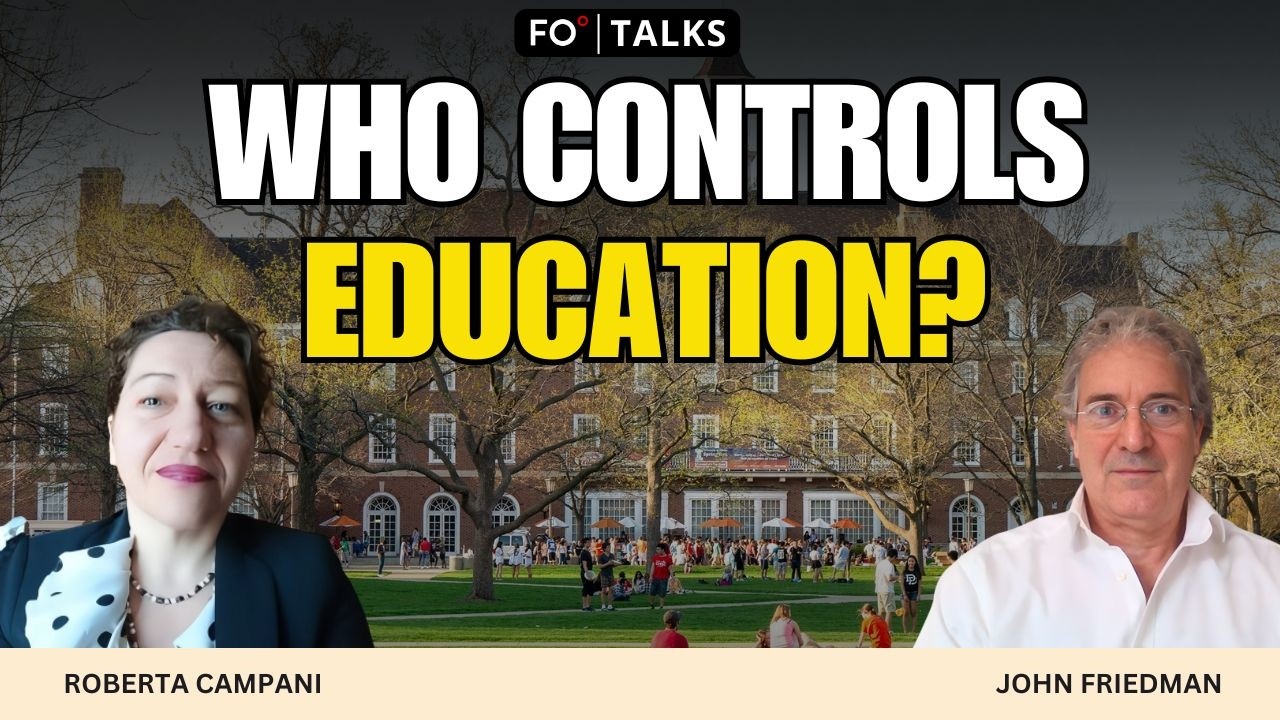
Fair Observer’s Communications and Outreach officer, Roberta Campani, speaks with renowned educator Esther Wojcicki about the deepening mental health crisis among young people and the social forces shaping it. Drawing on her childhood as the daughter of immigrants, her decades as a journalism teacher at Palo Alto High School and her Parenting TRICK framework, Wojcicki argues that fear-based parenting and political instability are undermining children’s confidence. Her solution is to use trust, responsibility and critical thinking as foundations for resilience.
Childhood lessons and the making of an educator
Wojcicki traces her philosophy back to her early years. Born in New York City to parents from Ukraine and Siberia, she grew up navigating multiple languages and cultures before her family relocated to Los Angeles. School quickly became a site of tension. She recalls being punished for helping classmates with their work, behavior that teachers labeled cheating. After repeated paddlings and being forced to sit under a teacher’s desk, she remembers making a quiet promise to herself: “When I grow up, I’m going to change everything.”
That childhood vow shaped her career. After graduating from UC Berkeley and earning a journalism degree in the 1960s and 1970s, she encountered a profession largely closed to women outside the “women’s section.” She refused to confine herself to writing about cooking or cosmetics, and so she pivoted to education. In 1984, she launched a journalism program at Palo Alto High School, creating a classroom built on student agency rather than rigid obedience.
Wojcicki considers early childhood experiences to be formative. Personality and confidence, she argues, are shaped from the earliest years, not in adulthood.
The TRICK framework: trust over control
At the center of the conversation is Wojcicki’s parenting TRICK model: Trust, Respect, Independence, Collaboration and Kindness. Through her app and advisory work, she encourages parents worldwide to adopt these principles.
Trust means believing children are capable of responsibility. Respect involves listening seriously to their ideas. Independence requires allowing them to attempt tasks on their own. Collaboration replaces dictation with dialogue. Kindness frames all interactions. These principles, she contends, are not ideological but developmental. Regardless of political orientation, parents want children who function well, think critically and adapt creatively.
Wojcicki insists the method works, pointing to her three daughters and generations of students as evidence. More importantly, she sees TRICK as a preventive response to what she calls a growing epidemic of anxiety and depression. Excessive control breeds fragility. When parents micromanage children’s lives, those children struggle to manage themselves.
Depression, politics and a culture of fear
The discussion turns stark when Wojcicki cites a troubling statistic: 54% of US college freshmen are clinically depressed. To her, this reflects a deficit in coping skills. “[They] aren’t deficient in some kind of pill,” she says. “[They] just don’t know how to cope with life.” Medication may have its place, but she believes it cannot substitute for resilience built through experience and responsibility.
Campani raises structural pressures: accelerated university timelines, economic precarity and a culture obsessed with efficiency. Wojcicki widens the lens further, pointing to global political instability, rising authoritarian rhetoric and social polarization. Young people, she argues, absorb the anxiety around them. When leaders challenge democratic norms and public discourse turns hostile, the future appears uncertain. Students question whether education leads to opportunity or whether climate change and political turmoil will override their efforts.
Wojcicki believes that fear has seeped into everyday parenting. Where she once walked a mile to kindergarten alone, many parents today drive children to school and escort them into their classrooms. Campani recounts a similar experience she had in Switzerland, where she was told her child could not walk a short distance to school independently. This pattern reveals a self-perpetuating “monster” of fear that feeds on itself.
Responsibility as resilience
Wojcicki returns to practical measures. If adults are anxious, they must resist transmitting that anxiety. Granting children meaningful responsibility, even small chores, builds competence and self-esteem. Trust communicates belief. Independence communicates capability.
She emphasizes that children who are allowed to navigate manageable risks develop confidence. Those constantly shielded may feel protected but often internalize doubt about their own abilities. The rise of food delivery services and digital convenience has further reduced opportunities for self-reliance. Teaching teenagers to cook, manage money and move through the world independently becomes a quiet act of empowerment.
TRICK is not naïve optimism. It is a strategy for raising emotionally strong individuals in unstable times. In a world she describes as turbulent and, at times, frightening, the answer is deeper trust. By fostering critical thinking, collaboration and kindness, parents and educators can equip the next generation not only to endure uncertainty but to reshape it.
[Lee Thompson-Kolar edited this piece.]
The views expressed in this article/video are the author’s own and do not necessarily reflect Fair Observer’s editorial policy.








































Comment