


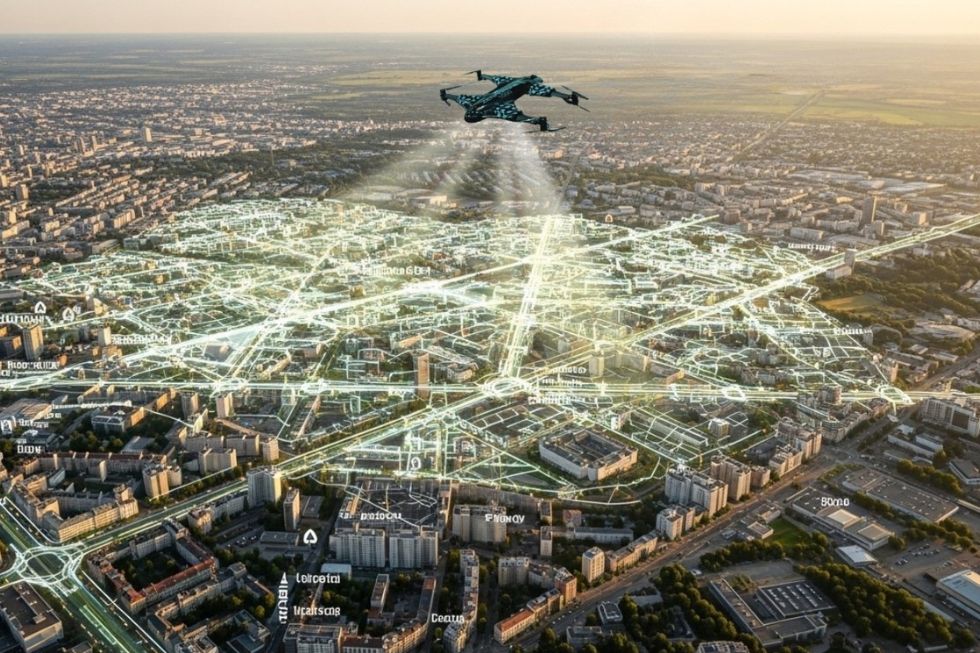



Infrastructure monitoring is undergoing a significant transformation. Across industries, organizations are moving away from slow, manual inspections toward faster, data-driven approaches. According to Deloitte — a British multinational professional services network — drone-based inspections are helping organizations improve operational efficiency, reduce manual inspection risks and accelerate infrastructure data collection across industrial sectors. Drone technology is increasingly becoming a central part of this shift, offering a smarter and more efficient way to assess, manage and maintain critical assets.
By capturing high-resolution aerial data in real time, drones allow engineers and decision-makers to detect issues earlier, respond faster and plan more effectively. This evolution is not just about improving inspections — it is about redefining how infrastructure is understood and managed globally.
Faster inspections, better data
Traditional infrastructure inspections are often time-consuming, expensive and risky. Inspecting bridges, industrial sites or rooftops typically requires manual labor, specialized equipment and significant downtime. These limitations can delay critical decisions and increase operational costs.
Drone technology addresses these challenges by enabling rapid data collection with minimal disruption. Equipped with advanced sensors, cameras and imaging systems, drones can capture detailed visuals and measurements within minutes. This allows teams to identify structural issues, monitor progress and evaluate conditions more efficiently.
In particular, drone roof inspections are transforming how construction and facility management teams assess building conditions. Instead of relying on manual surveys, drones provide accurate aerial perspectives that improve visibility while reducing safety risks. This approach not only speeds up inspections but also ensures more consistent and reliable data collection.
Improving safety and reducing costs
Safety has always been a major concern in infrastructure monitoring. Workers are often required to operate at heights, in hazardous environments or in difficult-to-access locations. These conditions increase the risk of accidents and limit the frequency of inspections.
Drones significantly reduce these risks by removing the need for direct human involvement in dangerous tasks. Inspections can now be conducted remotely, allowing operators to gather critical data without exposing workers to harm.
Industry research suggests that drone-based inspections can improve operational efficiency, enhance safety and support faster infrastructure assessment workflows compared to traditional manual inspection methods, as highlighted in IBM’s research on AI-powered visual inspection and drone-enabled industrial monitoring.
From reactive maintenance to predictive strategy
One of the most important shifts enabled by drone technology is the transition from reactive maintenance to predictive decision-making. Traditionally, infrastructure issues are addressed only after they become visible or critical, often leading to higher repair costs and operational disruptions.
Drone data changes this dynamic by enabling continuous monitoring and early detection. High-frequency inspections generate structured datasets that support long-term analysis, helping organizations identify patterns and anticipate failures.
As drone adoption expands, infrastructure monitoring is evolving into a form of continuous intelligence. Data collected from aerial inspections is no longer just observational — it is becoming a strategic asset that informs planning, budgeting and risk management decisions. This shift is redefining how infrastructure systems are maintained and optimized.
Global adoption and the rise of smart environments
The adoption of drone technology is accelerating across regions, driven by the need for smarter and more resilient infrastructure systems. Governments, construction firms and industrial operators are integrating drones into their workflows to improve efficiency and scalability.
In emerging urban ecosystems, often described as a drone city, aerial data plays a crucial role in supporting large-scale infrastructure development. From monitoring construction progress to managing utilities and transportation networks, drones are enabling a more connected and responsive urban environment.
This global momentum reflects a broader trend toward digital transformation. As infrastructure becomes more complex, the ability to collect and analyze real-time data is essential for maintaining performance and ensuring long-term sustainability.
An enhanced path forward
Drone technology is transforming infrastructure monitoring by making it faster, safer and more intelligent. By replacing manual inspections with data-driven workflows, drones are helping organizations reduce costs, improve accuracy and enhance decision-making.
More importantly, this shift is fundamentally changing how infrastructure is managed. With access to real-time insights and predictive analytics, organizations can move beyond reactive approaches and adopt more proactive strategies.
As adoption continues to grow worldwide, drones will play an increasingly central role in shaping the future of infrastructure monitoring. Their ability to combine efficiency with actionable data positions them as a key driver of smarter, more resilient urban ecosystems in the years ahead.
[Andrew Litz edited this piece]
The views expressed in this article are the author’s own and do not necessarily reflect Fair Observer’s editorial policy.
The Brave New War Machine: How a Clique of Unhinged Techno-Optimists Is Putting Humanity at Risk
Technology corporations, especially Palantir and Anduril, are reshaping the US’s military-industrial complex by promoting AI–driven warfare, surveillance systems and closer...

A New Military-Industrial Complex Arises: The Secret War Within the Pentagon
Silicon Valley startups are challenging defense giants for Pentagon contracts. The US military is shifting toward AI-powered weapons and unmanned...

Support Fair Observer
We rely on your support for our independence, diversity and quality.
For more than 10 years, Fair Observer has been free, fair and independent. No billionaire owns us, no advertisers control us. We are a reader-supported nonprofit. Unlike many other publications, we keep our content free for readers regardless of where they live or whether they can afford to pay. We have no paywalls and no ads.
In the post-truth era of fake news, echo chambers and filter bubbles, we publish a plurality of perspectives from around the world. Anyone can publish with us, but everyone goes through a rigorous editorial process. So, you get fact-checked, well-reasoned content instead of noise.
We publish 3,000+ voices from 90+ countries. We also conduct education and training programs
on subjects ranging from digital media and journalism to writing and critical thinking. This
doesn’t come cheap. Servers, editors, trainers and web developers cost
money.
Please consider supporting us on a regular basis as a recurring donor or a
sustaining member.
Will you support FO’s journalism?
We rely on your support for our independence, diversity and quality.





Comment