






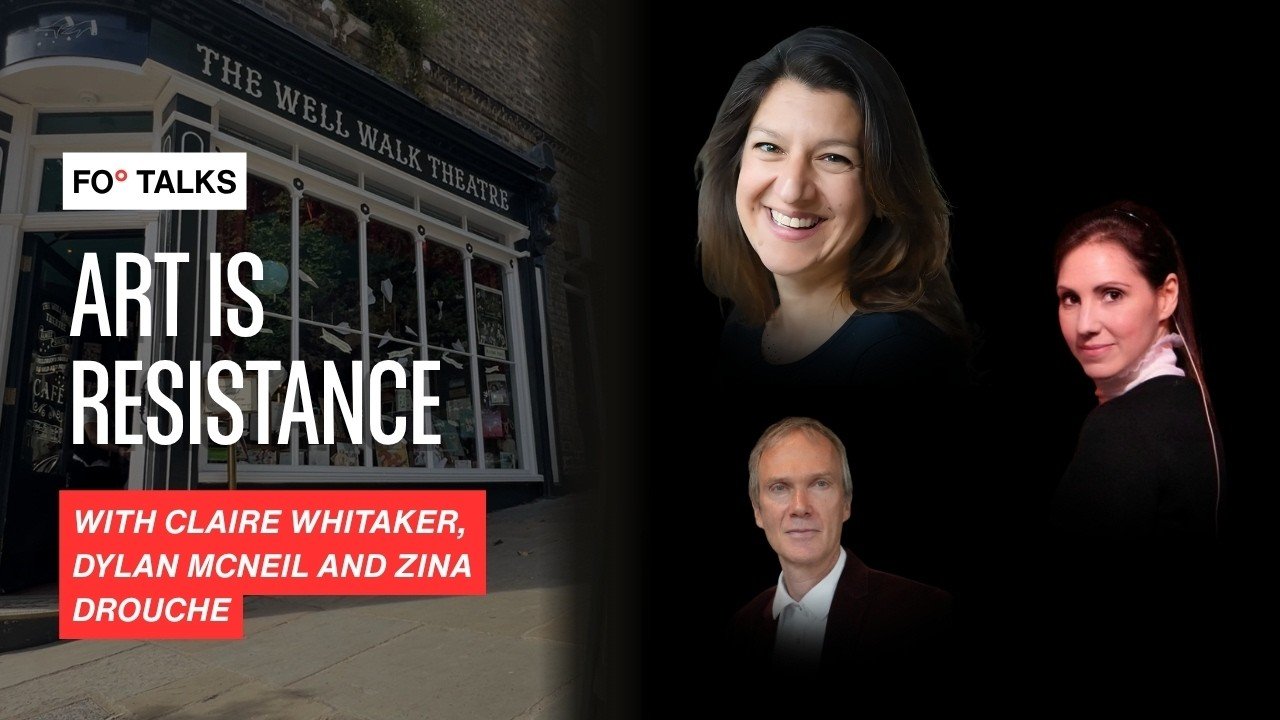
Fair Observer Chair Claire Whitaker visits London’s Well Walk Theatre to meet founders Zina Drouche and Dylan McNeil. The French couple have transformed a birthday puppet show into a magical venue in the heart of Hampstead, which combines performances, books and food. Their story explores how handmade entertainment can bring generations together, and what it takes to sustain an independent cultural institution.
From a birthday to a basement
Drouche worked backstage in Paris, making costumes and dressing actors before moving to London and raising two children. At home, storytelling and dressing up remained part of family life. For her daughter’s fourth birthday, she wrote a puppet show in one week and made its characters from papier-mâché.
Drawing on childhood memories of French Guignol performances, she created Petit Pierre. His first adventure took him from France to London to meet the Queen and offer her Camembert from Normandy. A friend accompanied the performance on piano while children and parents gathered around an improvised stage.
The response persuaded Drouche that she had found something worth developing. McNeil remembers parents enjoying its humor and handmade simplicity. References to cinema, music and art helped the stories engage adults alongside children.
A friend subsequently offered a basement beneath a Hampstead children’s clothing shop. Seven spectators became around 20 the following week, then sold-out audiences of 40 or 50. Word spread without a website, sometimes bringing visitors from across London and prompting additional performances.
A building shapes the vision
Drouche and McNeil sought a permanent home for their performances. They found a former pottery shop in a Victorian building dating to 1895, which had served as a corner grocery until 1957.
The building offered an ideal layout: a theater downstairs, with a bookshop and café above. Drouche’s memories of independent Parisian shops, their distinctive smells and familiar craftspeople, informed the atmosphere she wanted to create.
An adjacent space offered room for a studio, workshop and office. Formerly stables for the museum opposite, the annex allows the team to make costumes, puppets and scenery beyond the small auditorium.
These spaces connect through storytelling. Visitors can discover a book, watch a performance, meet its performers and linger over a snack.
Handmade culture as resistance
McNeil describes the venue as an alternative to corporate uniformity. The team creates its own productions, puppets, costumes and sets, occasionally hosting other companies. The team carefully selects books for the bookshop while a pastry chef prepares food fresh each morning, including low-sugar cakes. McNeil wants children to discover flavors and craftsmanship beyond mass-produced snacks.
For Drouche, the greatest achievement is bringing children, parents, grandparents and neighbors together. Shared artistic experiences offer a practical way to strengthen the community against the anxiety generated by the news.
McNeil calls this “beauty as an act of resistance.” Creating something beautiful, he believes, demonstrates that a disrupted world still contains possibilities worth handing to future generations.
Sustaining the theater without losing its intimacy
Whitaker asks how the couple keep the venue financially viable in a city as expensive as London. McNeil stresses financial discipline and sustained audience support. The theater has celebrated its second anniversary and presented roughly 400 performances, with consistently full houses.
The theater has also earned industry recognition. The founders describe winning The Stage’s theater building award in their first year. A production using the Czech black theater tradition, with performers’ illuminated hands depicting the universe and evolution, also appeared among The Stage’s top 50 UK shows of 2025.
Behind those achievements lie long working days and a persistent belief in their vision. The couple plan to host more workshops as well as evening events, giving both adults and children opportunities to imagine and create.
Drouche resists expanding the auditorium beyond its intimate 50-seat scale. Proximity to performers and the meticulously decorated surroundings are central to the experience.
The couple have declined an opportunity to replicate the venue elsewhere in London. A future sister theater in Montmartre, where both grew up, remains appealing, though time and energy constrain that ambition.
Their priority is building an institution that can outlast them. That requires supporting the team and maintaining a loyal audience. The couple must balance artistic integrity with financial stability so future generations can enjoy the performances and the community they have built.
[Lee Thompson-Kolar edited this piece.]
The views expressed in this article/video are the author’s own and do not necessarily reflect Fair Observer’s editorial policy.






































Comment