

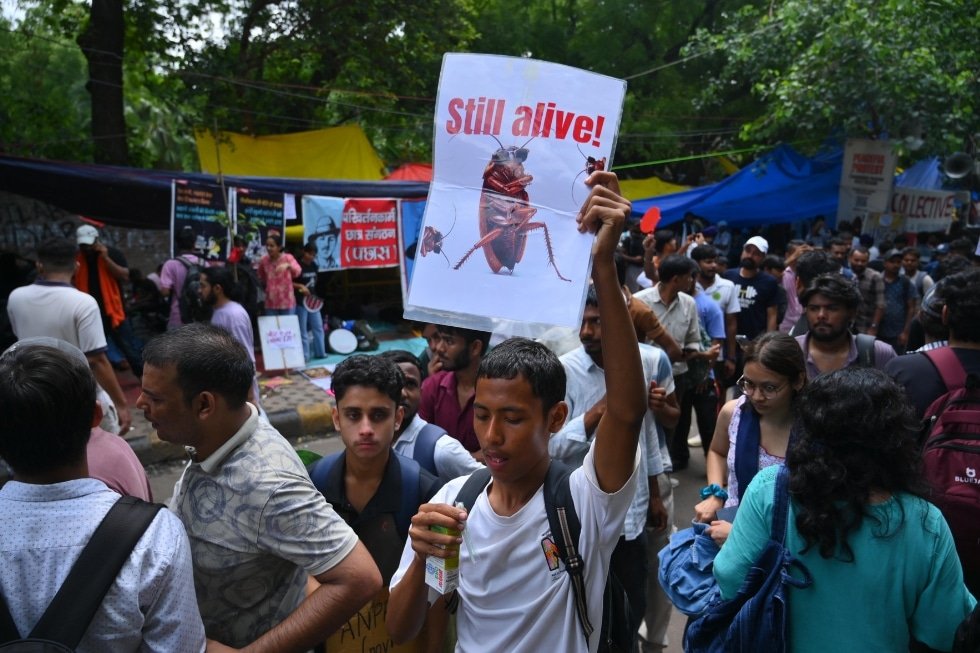



A cockroach survives where other creatures perish. It is despised, hunted and crushed, yet it returns. There is something unsettling about this small creature, something that speaks to a generation that feels unwanted by the institutions meant to protect it. In India, the cockroach has become a political symbol. What began as an insult has acquired a voice.
That voice has found expression in the Cockroach Janta Party (CJP), a youth-led political movement founded by Abhijeet Dipke. Emerging from growing frustration with unemployment, political exclusion and the perceived erosion of democratic accountability, the CJP has transformed a symbol of contempt into an assertion of political identity. Its message is simple but unsettling for those in power: A generation dismissed as insignificant is demanding to be heard.
The cockroach is an unusual political emblem. It carries none of the lion’s grandeur or the eagle’s nobility. It does not promise victory. It promises survival. For young Indians who feel reduced to statistics in employment reports and inconveniences in public debate, the insult has become a declaration: If society considers us disposable, we will make ourselves impossible to ignore.
The emergence of the CJP exposes a deeper crisis in India’s democratic compact. The movement is not merely a protest against unemployment or political exclusion; it raises a fundamental question about whether the world’s largest democracy can accommodate a generation increasingly disillusioned with its institutions. How the Indian establishment responds to these young voices will test not only the resilience of India’s democracy but also its political stability, regional influence and credibility as a strategic partner. A democracy is ultimately measured not by its ability to silence dissent, but by its willingness to hear those who challenge its authority.
A generation losing faith
Across Delhi, Paris, Milan, Tirana and other cities, young people have taken to the streets over unemployment, the cost of living, education and governments increasingly distant from ordinary life. These protests follow a broader global trend of youth protests, especially in South Asia. Sri Lanka witnessed a popular uprising that overthrew its president in 2022. Bangladesh and Nepal subsequently experienced their own upheavals. An Indian professor of political science at the University of Madras warned me that India should not be excluded from this possibility. It could happen here, too.
India’s extraordinary size makes a comparable upheaval difficult to imagine, but size is not immunity. Resentment can accumulate beneath the surface of a powerful state until an apparently insignificant event gives it a name.
The anger has a material foundation. Examination controversies, recruitment disputes, unemployment and limited economic opportunities have weakened the promise that education and hard work lead to a better life. When examination results and recruitment processes become sources of uncertainty, the injury extends beyond a lost opportunity. It erodes young people’s faith that hard work can secure a better future.
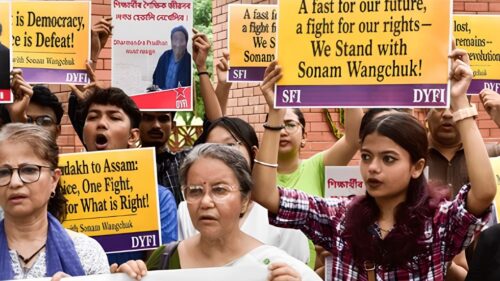
In July, Education Minister Dharmendra Pradhan resigned following weeks of student protests over examination irregularities, including the National Eligibility cum Entrance Test (NEET-UG) controversy. For the movement, his departure demonstrated that collective action could compel the establishment to respond.
Dipke was born into a Dalit family in Aurangabad, Maharashtra. His background adds another dimension to a movement emerging in a society where caste continues to shape opportunity and dignity. Booker Prize-winning writer Arundhati Roy has argued that the movement has punctured the carefully constructed image of Prime Minister Narendra Modi, sustained in part by corporate-owned media and the ruling Bharatiya Janata Party’s (BJP) influence over social media.
Roy has a point. During my recent visit to the Dubai Global Future Leaders conference, an Observer Research Foundation (ORF) event was unfolding in neighboring Abu Dhabi, attended by India’s External Affairs Minister. An Indian interlocutor expressed concern about the concentration of India’s strategic discourse within institutions perceived to be close to the establishment. The question remains: Is there sufficient space for independent voices to challenge the prevailing narrative?
Electoral integrity and the right to dissent
The movement’s demands have since widened from economic opportunity and institutional accountability to electoral integrity. More than 130 million names were reportedly removed during electoral-roll revisions. The Election Commission has cited deaths, duplication, relocation and untraceable voters as reasons for deletions, while critics fear it has also excluded eligible citizens. The scale demands transparency, independent scrutiny and accessible appeals. The number alone does not establish deliberate disenfranchisement; the essential question is whether every eligible citizen can exercise the right to vote.
On October 16, police detained Dipke ahead of the “Lehra Do Tiranga” rally demanding Chief Election Commissioner Gyanesh Kumar’s resignation. Police reportedly detained more than 100 protesters during the demonstrations, citing restrictions on public gatherings and the absence of permission. Police later released Dipke, while fellow activists Saurav Das and Ashutosh Ranka faced judicial custody after an earlier protest-related incident.
Every state has a responsibility to maintain public order. But order is not the same as silence. Restrictions on assembly must be lawful, necessary and proportionate. When detention becomes the first response to dissent, the state risks deepening the distrust it seeks to contain.
The national flag makes this confrontation especially revealing. Lehra Do Tiranga — “let the tricolor fly” — is more than a rallying cry. It challenges the assumption that patriotism belongs exclusively to those who govern. Citizens demanding electoral transparency may not be challenging the nation; they may be asking it to honor its own promises.
India’s democratic institutions will be tested not by whether young people question authority, but by whether those in power can withstand their questions.
India’s democratic credibility and regional influence
These developments raise questions about the institutional conditions in which the movement has emerged. The Economic Crime and Geopolitics Index (ECGI) — which summarizes a country’s risks from corruption, economic crime, public response and geopolitical influence — gave India a score of 73.2, meaning that it is at high risk, in April 2026. This is up 2.43 points from November 2025, signaling elevated risk across its assessed dimensions. The increase reflects growing vulnerabilities, raising concerns about India’s institutional resilience.
Conversely, Freedom House, which tracks political rights and civil liberties worldwide, rated India “Partly Free,” with a score of 62 out of 100 in its 2026 assessment. Its report raised concerns about the use of government institutions against political opponents and discrimination affecting Muslims and marginalized communities, including Dalits. These indicators do not predict revolution, but they do reveal a growing disconnect between citizens and the institutions meant to serve them. For many, especially young people, the erosion of trust is compounded by the sense that patience and adherence to democratic norms no longer yield tangible rewards.
The implications extend beyond India’s borders. The country’s treatment of dissent at home mirrors its exercise of power over smaller neighbors abroad, which raises a pressing question: Can democratic accountability restrain political power?
For example, concerns about Indian influence in Sri Lanka have come into sharper focus. An intelligence chief revealed to me that six Rashtriya Swayamsevak Sangh (a Hindu nationalist volunteer organization [RSS])-linked movements were operating in the country. These developments coincide with high-profile diplomatic engagements: Indian Prime Minister Narendra Modi’s visit in April 2025 and Defence Minister Rajnath Singh’s visit in September 2026, both of which resulted in the signing of defense memoranda of understanding (MoUs). The question arises: Was Colombo pressured to sign these agreements, or did strategic necessity outweigh concerns about sovereignty? For a smaller state, such as Sri Lanka, the challenge is preserving strategic autonomy without becoming an arena for a larger neighbor’s ambitions.
Across South Asia, young citizens have challenged political arrangements once considered immovable. For Washington, India remains an important Indo-Pacific partner amid competition with China. But strategic cooperation should not make democratic principles or India’s own political stability optional. A country’s international influence depends not only on its power, but also on the credibility of its institutions.
The political future of the cockroach generation
In my 2024 article, “Undemocratic Rule of Modi’s India,” I questioned the distance between India’s democratic promise and its political reality. The Cockroach Generation brings that question into the streets. It is no longer merely a debate among scholars and diplomats. It concerns who can vote, who can assemble and who has the right to be heard.
The movement’s future remains uncertain. Street demonstrations and online visibility do not automatically produce a durable political organization. The CJP will need a coherent program and the capacity to sustain engagement beyond a single controversy. Yet its significance also lies in the questions it has forced into public debate: Who gets opportunity, who can vote and who has the freedom to protest?
A cockroach has no grand theory of the republic. It only knows how to survive. Perhaps that is why its arrival should trouble the powerful. When a generation adopts the name of a creature society despises, it reveals something about the society that gave it the insult.
Perhaps 2026 will be remembered as a year when young people, from Delhi to cities across the world, refused to accept a future defined by uncertainty, exclusion and unaccountable power. Their demands may differ, but their underlying question is the same: Can the present generation offer them a better tomorrow?
[Kaitlyn Diana edited this piece.]
The views expressed in this article are the author’s own and do not necessarily reflect Fair Observer’s editorial policy.
FO Podcasts: Cockroach Chronicles — Making Sense of the CJP
In this episode of FO Podcasts, Ranjani Iyer Mohanty and Barun Mohanty examine how exam irregularities, limited educational opportunities and...
The Duty to Mock: How India’s CJP is Reviving Accountability Through Satire
As press freedom declines in India and questioning the government risks being labeled anti-national, the Cockroach Janata Party has mobilized...
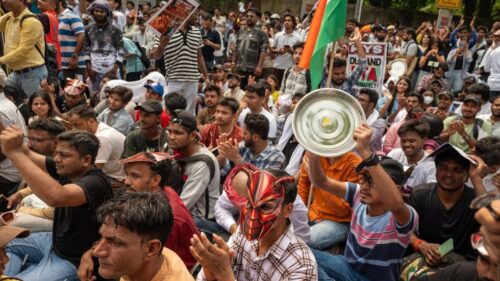
Will the Gen Z-Fueled CJP Achieve What It Set Out To Do?
Education reform campaigner Sonam Wangchuk’s 20-day hunger strike and forceful evacuation by Delhi police have further catalyzed the Cockroach Janta...
Support Fair Observer
We rely on your support for our independence, diversity and quality.
For more than 10 years, Fair Observer has been free, fair and independent. No billionaire owns us, no advertisers control us. We are a reader-supported nonprofit. Unlike many other publications, we keep our content free for readers regardless of where they live or whether they can afford to pay. We have no paywalls and no ads.
In the post-truth era of fake news, echo chambers and filter bubbles, we publish a plurality of perspectives from around the world. Anyone can publish with us, but everyone goes through a rigorous editorial process. So, you get fact-checked, well-reasoned content instead of noise.
We publish 3,000+ voices from 90+ countries. We also conduct education and training programs
on subjects ranging from digital media and journalism to writing and critical thinking. This
doesn’t come cheap. Servers, editors, trainers and web developers cost
money.
Please consider supporting us on a regular basis as a recurring donor or a
sustaining member.
Will you support FO’s journalism?
We rely on your support for our independence, diversity and quality.




Comment