





The year 1940 stands out as perhaps the most dramatic in the modern history of France. If you have any doubts, I suggest you seize the first opportunity to watch the pair of spectacular films by Antonin Baudry, La Bataille De Gaulle. These movies present a breathtaking panorama of the events that surrounded French General Charles De Gaulle’s struggle to resist, in military and political terms, not only Hitler’s Germany, but also, in the second film, US President Franklin Roosevelt’s ambitions to casually redraw the boundaries of Europe while militarily occupying vast portions of it. This included a radically truncated version of France.
Baudry’s films offer a colorful cast of characters, mostly historical, with a few fictional creations who serve to highlight the cultural and ideological stakes of the geopolitical drama. One fascinating historical character, who does not appear in either of Baudry’s films, is the diplomat Raymond Brugère, who played a significant role in the resistance before being arrested and imprisoned by the Gestapo. The victorious De Gaulle in 1944 appointed him Secretary-General of the Foreign Ministry.
Brugère entered the Foreign Ministry in 1911, serving in many countries across Europe and Asia before being appointed French Minister Plenipotentiary to Yugoslavia in 1937. From his vantage point in Belgrade, with growing alarm, he observed Adolf Hitler’s May 10 launch of the “Fall Gelb” (Case Yellow) campaign, the simultaneous invasion of France, Belgium, the Netherlands and Luxembourg. A month later, as the Nazi forces closed in on Paris, the French government panicked and fled first to Tours and then to the less vulnerable haven of Bordeaux.
Following Prime Minister Paul Reynaud’s resignation on June 16, President Albert Lebrun tasked Marshal Philippe Pétain with forming a new government. That led the following day to Brugère’s announcing in a telegram to the Ministry of Foreign Affairs:
« Ma résolution est prise : je refuse de servir un gouvernement, fût-il présidé par le vainqueur de Verdun, qui signerait la capitulation de la France. »
(My mind is made up: I refuse to serve a government, even if headed by the victor of Verdun, that would sign the capitulation of France.)
Brugère was the only serving member of the diplomatic corps to resign after the debacle that led to the installation of the Vichy regime allied with Germany. In 1953, Brugère published his memoir: Veni, Vidi, Vichy, whose witty title I shamelessly borrowed for this piece. In the book, Brugère documented the inner workings, ideological roots and betrayal of the French state under the Vichy regime during World War II.
History’s repeating patterns
So, why am I citing Brugère today? Not only because he first thought of the pun on Vichy. It’s because the description of events in his book provides a disturbing parallel to what is happening today in France and more broadly in the West.
Brugère made the case that France’s military collapse and the establishment of the Vichy regime were not accidental, nor even the result of failing to prepare for the worst or misreading Hitler’s intention. Rather, he describes a series of events orchestrated by reactionary political, financial and industrial elites who preferred a fascist state to republican governance. Our history teachers want us to believe that only a fanatical fringe adhered to fascist ideology. Responsible people, we were told to believe, resisted fascism as a form of extremism. But, in the midst of the Depression, the ideology had become tacitly adopted as the only “rational” solution by many among the economic elite. The political class resisted only to the extent that the more honest politicians understood the risk of contradiction between belief in authoritarian efficiency and voters’ inculcated preference for the messiness of democracy.
France was not alone to cultivate a political and economic elite that saw fascism as a source of stability in a world that had become unstable. This pattern played out across many nations in the period known as entre deux guerres. The United States was no exception. Though it has been pretty thoroughly erased from the official account of the nation’s political history, in 1933, a plan to overturn democracy and install a fascist regime nearly succeeded. The operation known as the “Business Plot” had the money to operate but was foiled when Smedley Butler, the military leader the conspirators had chosen as the figurehead of a movement to dethrone Franklin Roosevelt, indignantly denounced the plot.
Two years later, Butler penned a pamphlet, War is a Racket, in which he denounced the US foreign policy that had led him to participate valiantly and at great cost in wars on three continents (including twice in China) as being at the service not of the American people, but of capitalist interests. A new edition of Butler’s text appeared last month, with a substantial introduction by Kristofer Goldsmith, an Iraq veteran, bringing Butler’s message up to date. I’ll quote one passage from Goldsmith’s text: “This last war made over 6,000 millionaires. Today those fellows won’t help pay the bill.”
What Brugère described as the prelude to the French capitulation and the installation of the Vichy government under Petain was not dissimilar to logic behind the Business Plot. The economy had endured a crisis with the Wall Street crash of 1929 that produced a permanent economic disorder for which there was no cure. Mere reforms would only prolong the agony. For those whose assets were still intact and who felt they had access to levers of power, the situation required dramatic action by people with the financial means and the formal authority to restore order. The oligarchs behind the Business Plot failed because without Butler’s commitment, they had a basis for claiming moral authority. The new Vichy elite succeeded because they could claim that Hitler’s military success left them no choice.
Eighty years on, the pattern appears to be reemerging dramatically not only in France, but also elsewhere in the West. For decades, a new business and political elite built and consolidated its power in Western democracies and demonstrated a certain talent for managing growing inequality, the erosion of democratic institutions and the alienation of entire segments of their citizenries. The crash of 2008 was better managed than 1929, but the papered-over features of a broken system remained present.
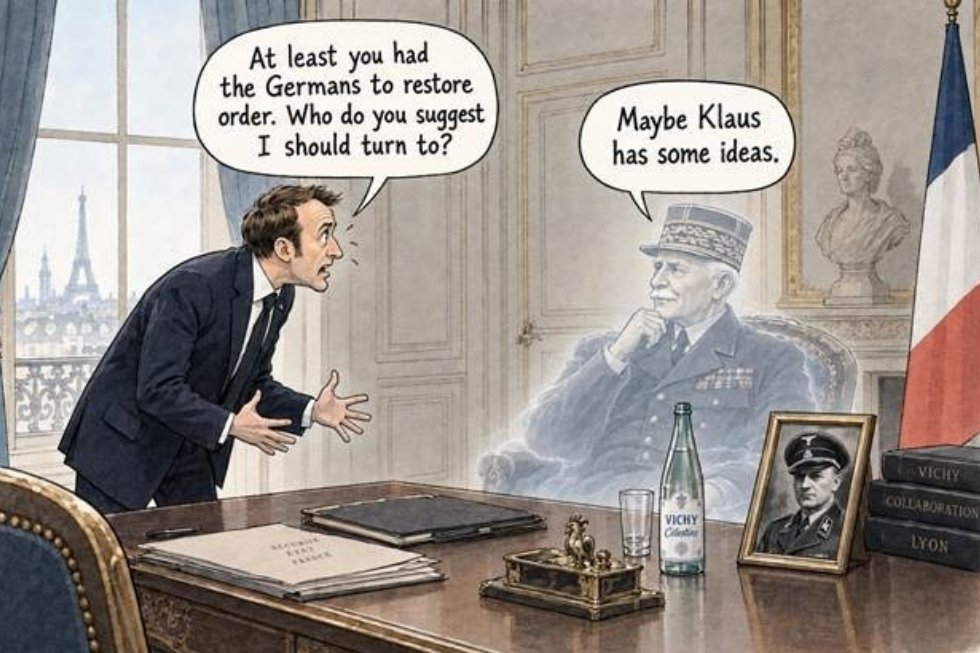
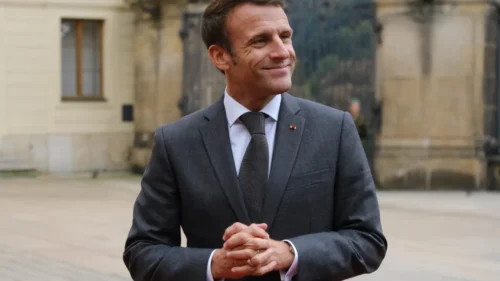
The Macron government came into being thanks not to its own vision — it had none — but to the collapse of France’s traditional political families. At best, Emmanuel Macron embodied a spirit of technocratic management in the digital age, built not just on a monetary policy of quantitative easing, but also on a philosophical and political stance of qualitative easing. As the financial system tended towards the aberration of negative interest rates, our leaders and political strategists tended towards a moral system of negative accountability, embodied in the Thatcher-Reagan doctrine that society doesn’t exist and markets make decisions.
Macron’s response to the chaos unleashed over the past month first by the lycéen student revolt, followed by the disorder, violence and looting of October 17, with Act II planned for this Saturday, has been to place all the blame on a party — left-wing La France Insoumise (France Unbowed) — that even Macronist insiders anonymously admit is not to blame at all. Refusing to accept the massive security failure that led to Saturday’s violence, Macron’s ministers are calling for the same kind of violent military-style repression recommended by right-wing leader (and leading presidential candidate) Marine Le Pen.
The perils of polls and prognostication
The Elysée Palace (France’s White House) is in a state of unprecedented radical panic. Analysts are left wondering what Macron and his friends in the parties that surround his “extreme center” may be trying to cook up as they seek to protect their political interests and save what appears to be a fatally discredited legacy. Declaring a state of emergency or even a state of exception cannot be ruled out. But after the events of October 17, even members of the president’s inner circle conclude that his credibility is so diminished the public would refuse to trust him as the leader of a gouvernement de salut public (government of public safety), if that was required.
Most analysts believe that even if Le Pen wins the election, she will not only fail to obtain a parliamentary majority, but she will personally lack the political standing that might allow her to install a truly authoritative Vichy-style regime. Were she to try, more chaos would ensue, eventually paving the way either for a true neo-fascist regime in which Business Plot-type organizers could seize control of the state or replacement by a left-wing government that might appear as a “white knight.”
Given the current state of confusion, no commentator dares to make any prediction with even a modicum of confidence. Rather than a prediction, this Devil’s Advocate would signal that there are multiple demonic forces at work and they’re likely to use whatever weapons they have to capture what they mistakenly see as an advantage. They will do nothing more than clarify some of the random features of the chaos.
Today’s consensus seems to be that Macron himself is cooked and his system will collapse. The runoff election will be between LFI’s Jean-Luc Mélenchon and National Rally’s Marine Le Pen. But there’s many a slip twixt cup and lip and I believe there may be some serious surprises. Macron himself has little margin of maneuver. He might decide to resign, but that would be inconsistent with his well-established narcissism. He could call a snap election, but that would make things beyond unmanageable and achieve nothing. He has no choice but to endure six months of psychological torture, especially for those who surround him.
What a spectacle Macron has offered to what Guy Debord 60 years ago called “la société du spectacle,” where he described a stage in the declining culture of France! In the coming months, this Devil’s Advocate, sitting in the upper balcony in the company of “les enfants du paradis” will continue to observe from a safe distance the creative intrigues of the demonic tribe who will ensure that no one risks getting bored.
Final reminder: Act II is scheduled for tomorrow. It may prove less spectacular, but this appears to be at least a five-act play (Shakespearean style).
*[The Devil’s Advocate pursues the tradition Fair Observer began in 2017 with the launch of our “Devil’s Dictionary.” It does so with a slight change of focus, moving from language itself — political and journalistic rhetoric — to the substantial issues in the news. Read more of the Fair Observer Devil’s Dictionary. The news we consume deserves to be seen from an outsider’s point of view. And who could be more outside official discourse than Old Nick himself?]
[Lee Thompson-Kolar edited this piece.]
The views expressed in this article are the author’s own and do not necessarily reflect Fair Observer’s editorial policy.
Are Europe’s Cast of Fallen Angels Preparing the Apocalypse?
The Devil’s Advocate conducts a canonization inquiry in reverse, applying it to today’s political leaders. Marco Rubio’s Athens speech, read...
Mediawatch: French Students Demand School Funding as Police Crack Down
Civil turmoil in France intensifies this month, culminating in the largest student protest in decades and state violence against minors....
Is Europe a Possessed Continent?
Europe’s crisis runs deeper than economics or politics — it’s both an identity crisis and a spiritual collapse. Its leaders...

Macron’s Leisurely Fishing Trip in a Sinking Boat
Le Monde reported on Tuesday that Emmanuel Macron is “playing the clock” as he surveys the waters looking for the...
Support Fair Observer
We rely on your support for our independence, diversity and quality.
For more than 10 years, Fair Observer has been free, fair and independent. No billionaire owns us, no advertisers control us. We are a reader-supported nonprofit. Unlike many other publications, we keep our content free for readers regardless of where they live or whether they can afford to pay. We have no paywalls and no ads.
In the post-truth era of fake news, echo chambers and filter bubbles, we publish a plurality of perspectives from around the world. Anyone can publish with us, but everyone goes through a rigorous editorial process. So, you get fact-checked, well-reasoned content instead of noise.
We publish 3,000+ voices from 90+ countries. We also conduct education and training programs
on subjects ranging from digital media and journalism to writing and critical thinking. This
doesn’t come cheap. Servers, editors, trainers and web developers cost
money.
Please consider supporting us on a regular basis as a recurring donor or a
sustaining member.
Will you support FO’s journalism?
We rely on your support for our independence, diversity and quality.





Comment