

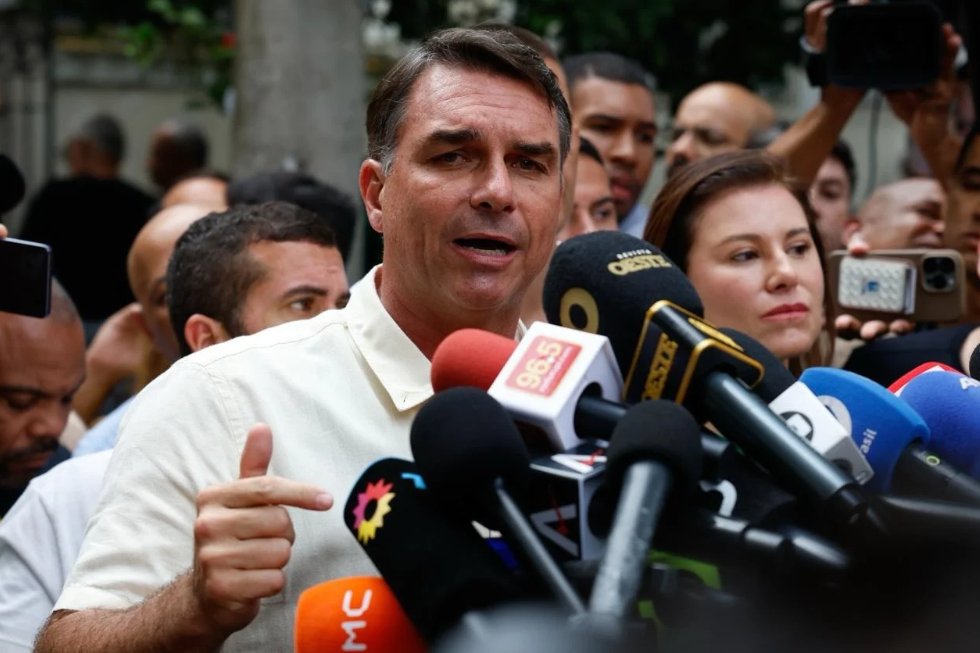



Brazilians went to the polls on October 4 to elect a president, governors, members of the Chamber of Deputies and two-thirds of the Federal Senate. Only a few hours after polling stations closed, the election produced its biggest surprise. Contrary to major polls published in the final days of the campaign, Senator Flávio Bolsonaro of the Liberal Party (PL) finished the first round ahead of incumbent President Luiz Inácio Lula da Silva of the Workers’ Party (PT). Bolsonaro received 47.03% of valid votes, or 56.1 million votes, against Lula’s 45.16%, or 53.9 million — a difference of approximately 2.2 million votes. The two candidates will meet again in the runoff on October 25.
The result capped a campaign that had been marked by intense polarization but also considerable political fatigue. The two leading candidates concentrated heavily on mobilizing their respective bases, leaving increasingly little electoral space outside the two camps. Yet one in every five registered voters stayed home. Abstention reached 21.08% — approximately 33.4 million voters — the highest first-round abstention rate in a Brazilian presidential election since the return to direct elections in 1989, according to Tribunal Superior Eleitoral (TSE) data. It continues a longer-term trend of declining electoral participation.
The campaign revolved principally around economic conditions, social policy, public security and corruption. Lula emphasized social programs, household economic pressures, environmental protection and measures against violence toward women, while Flávio stressed crime, corruption, fiscal discipline and a more market-oriented economic agenda. Foreign policy also acquired unusual prominence. Lula portrayed his resistance to tariffs and political pressure from the Trump administration as a defense of Brazilian sovereignty, while Flávio advocated closer relations with Washington and greater alignment with the conservative turn elsewhere in the Americas.
The first-round result nevertheless revealed something larger than an unexpectedly strong performance by a presidential challenger. Conservative candidates simultaneously advanced in congressional and gubernatorial elections. Markets responded positively, with the Ibovespa (the main performance indicator of stocks traded on B3 and a major index of the Brazilian capital market) jumping 7.7% and the real appreciating sharply. Investors appeared to welcome the prospect of a more market-oriented government, though other factors may also have contributed.
The broader message of October 4 was becoming clear: Brazil’s political center of gravity had moved further right, and Bolsonarism showed it could survive without President Jair Bolsonaro himself on the presidential ballot. Bolsonarism here refers to the political coalition, ideological discourse and institutional project associated with Bolsonaro but increasingly reproduced through other political actors and organizations.
Flávio Bolsonaro: the main winner
Flávio’s first-place finish provided the clearest evidence of Bolsonarism’s resilience. Rather than fragmenting in the absence of Jair Bolsonaro as a presidential candidate, the movement transferred much of its electoral strength to his son while simultaneously expanding its representation in Congress and state governments. Flávio’s 47% marked the Bolsonarist/PL camp’s strongest first-round performance in a presidential election.
His performance was particularly striking because he entered the final weeks of the campaign under the shadow of the Banco Master scandal. The investigation into the failed bank and its former owner, Daniel Vorcaro, exposed an extensive network of relationships involving political, business and judicial figures. Flávio himself came under investigation over alleged corruption connected to the case, accusations he denied. At the same time, revelations drew attention to personal and professional connections between Vorcaro’s network and members of the Supreme Federal Court (STF).
Paradoxically, however, the scandal appears to have created greater political difficulties for Lula than for Flávio. Survey evidence shortly before the election suggested that voters initially associated the Banco Master affair more strongly with the left, despite the involvement of figures from across the political spectrum. The controversy surrounding STF members was especially consequential because some of these justices — most notably Alexandre de Moraes — had played prominent roles in proceedings against Jair Bolsonaro and his allies.
The scandal thus intersected with a narrative that Bolsonarism had cultivated for years: that the Supreme Court was politically biased and insufficiently accountable. Flávio’s own exposure to the investigation did not prevent him from consolidating support among an electorate already strongly opposed to the PT and deeply critical of the STF.
A more conservative Congress
The congressional elections provide perhaps stronger evidence than the presidential vote that October 4 represented a broader rightward movement. The PL emerged as the largest political force in both houses of Congress. In the Chamber of Deputies, it won 121 seats, nearly one-quarter of the chamber and substantially more than the 99 seats it held previously. Two PL candidates — Nikolas Ferreira in Minas Gerais and Lucas Pavanato in São Paulo — each received more than three million votes, establishing extraordinary individual vote totals.
The shift was even more consequential in the Senate, where 54 of 81 seats were contested. The PL won 19 of them and will enter the new legislature with 28 senators — more than one-third of the chamber. The result gives the party considerable influence over the Senate’s agenda and could reshape relations between Congress and the Supreme Court. Several successful right-wing candidates explicitly campaigned for stronger congressional checks on the STF, while some advocated impeachment proceedings against individual justices. The institutional consequences of the election may extend well beyond ordinary legislative politics.
With the new Congress, the center-right parties will control approximately 57% of the Chamber and 62% of the Senate. In the latter, their combined 50 seats exceed the three-fifths threshold required to approve constitutional amendments by just one vote. These figures do not imply automatic legislative majorities, since parties remain fragmented and the political center continues to play a decisive role in coalition formation. Nevertheless, they suggest a more favorable congressional environment for fiscal restraint, administrative reform and market-oriented economic policies.
The right advances in the states
The gubernatorial elections reinforced the same tendency. Twenty governors were elected outright in the first round, and 12 belonged to right- or center-right parties. Conservative candidates performed particularly strongly in the South, Center-West and parts of the North. The PL won all three Southern governorships in the first round.
The results in Brazil’s two largest electoral states were particularly relevant. In São Paulo, Tarcísio de Freitas was reelected with 62.65% of the vote, while Fernando Haddad received 36.42%. Haddad, Lula’s finance minister during the past four years, had previously been the PT’s presidential candidate against Jair Bolsonaro in 2018. In Minas Gerais, Cleitinho Azevedo won outright with about 55%, while the PT’s Patrus Ananias received only around 26%.
Yet these results did not eliminate one of the most persistent features of Brazilian electoral politics: territorial polarization. Lula won all nine states of the Northeast, together with Amazonas, Pará and Amapá. Flávio won every state in the South, Southeast and Center-West, as well as the Federal District and four Northern states. Lula’s strongest performance came in Piauí, where he received approximately 71%; Flávio reached a similar percentage in Roraima. Rather than disappearing, Brazil’s familiar electoral geography was reproduced, although the right demonstrated strength across a larger portion of the national territory.
Polarization creates a difficult runoff for Lula
The presidential election also revealed the continuing erosion of a viable electoral center. Candidates outside the Lula-Bolsonaro contest collectively received less than 8% of valid votes. Augusto Cury received 2.89%, Renan Santos 2.24%, Ronaldo Caiado 2.18% and Romeu Zema only 0.27%. Together, Lula and Flávio captured more than 92% of valid votes, confirming the extraordinary resilience of the country’s bipolar competition.
This creates an asymmetric strategic challenge in the runoff. Most defeated candidates and their electorates are ideologically closer to the right than to Lula, although their votes cannot simply be assumed to transfer to Flávio. Zema has already indicated his support for Bolsonaro, while Cury and Renan initially declined to endorse either finalist. Nevertheless, several of the defeated candidates competed primarily for conservative, center-right or anti-PT voters. Lula has no equivalent pool of organized center-left voters from which to draw substantial additional support.
The historical record adds another challenge for Lula. Since Brazil returned to direct presidential elections, no candidate who finished second in the first round has won the runoff. However, 2026 differs from previous contests in two important respects. The 1.87-percentage-point gap between Flávio and Lula is the smallest first-round margin between the two leading candidates since redemocratization, while about 33.4 million registered voters — 21.08% of the electorate — abstained. With such a narrow margin and such a large pool of non-voters whose participation could alter the electoral balance, historical precedent provides only a weak guide to the run. If Lula wins on October 25, he will become the first second-place finisher in Brazil’s contemporary democratic period to reverse the first-round ordering.
The first-round result also transformed perceptions of the race. Prediction markets moved sharply toward Flávio after his unexpected lead, with Polymarket prices at one point implying a probability above 80% for his victory and around 16% for Lula. Such prices are not opinion polls and should not be interpreted as Brazilian public opinion. They nevertheless illustrate how dramatically expectations changed after October 4.
The institutionalization of the radical right
The October 4 results ultimately suggest something broader than a presidential upset. Brazil moved further to the political right at several levels simultaneously. Flávio finished ahead of Lula; the PL substantially expanded its presence in both houses of Congress; and right and center-right candidates captured governorships across much of the South, Southeast, Center-West and North. Yet older patterns survived, particularly the territorial divide between the PT’s stronghold in the Northeast and the predominantly conservative South and Center-West.
The more consequential development may be the consolidation of Bolsonarism as a political force capable of surviving beyond Jair Bolsonaro himself. Political movements organized around charismatic leaders frequently encounter problems of succession when their founders can no longer compete for office. So far, the 2026 election has provided little evidence of such fragmentation. Instead, much of Jair Bolsonaro’s electorate transferred its support to his son, while candidates associated with the broader Bolsonarist camp strengthened their positions in Congress and state governments. Flávio’s 47% is particularly significant because it exceeded his father’s first-round performance in both 2018 and 2022.
This does not mean that Brazil has become uniformly right-wing, nor should every victory by a conventional center-right candidate be classified as Bolsonarist. Lula and the PT retain a formidable electoral constituency, particularly in the Northeast, and the presidential election remains unresolved. What October 4 demonstrated instead was a shift in the balance of political forces. The broader right has expanded its control of elected institutions, while its Bolsonarist wing now combines a mass electoral constituency with an increasingly substantial presence in Congress and state politics.
The election’s relevance extends beyond who occupies the presidency after October 25. A Lula victory would leave him confronting a more conservative Congress, powerful right-wing governors and an opposition capable of mobilizing voters without Jair Bolsonaro at the top of the ticket. A Flávio victory would combine those institutional gains with control of the presidency. Whatever the runoff outcome, Bolsonarism can no longer be understood simply as Jair Bolsonaro’s electoral vehicle. It has become an enduring and increasingly institutionalized component of Brazil’s party system.
[Kaitlyn Diana edited this piece.]
The views expressed in this article are the author’s own and do not necessarily reflect Fair Observer’s editorial policy.
Brazil Is the Country of the Devil — and God Knows Who the “Believers” Are
Brazil’s first-round election results illustrate how many citizens choose their politician not based on who’s best for the country, but...
FO Talks: Lula vs Another Bolsonaro — Brazil’s 2026 Election
In this episode of FO Talks, Roberta Campani and Helder Ferreira do Vale examine Brazil’s presidential election between incumbent President...

Brazilian 2026 Election: Lula’s Soft Power Skills Threatened by a Hard-Power World
Brazil’s October election matches the polarized 2022 election, with incumbent Brazilian President Lula da Silva polling ahead of Senator Flávio...

Support Fair Observer
We rely on your support for our independence, diversity and quality.
For more than 10 years, Fair Observer has been free, fair and independent. No billionaire owns us, no advertisers control us. We are a reader-supported nonprofit. Unlike many other publications, we keep our content free for readers regardless of where they live or whether they can afford to pay. We have no paywalls and no ads.
In the post-truth era of fake news, echo chambers and filter bubbles, we publish a plurality of perspectives from around the world. Anyone can publish with us, but everyone goes through a rigorous editorial process. So, you get fact-checked, well-reasoned content instead of noise.
We publish 3,000+ voices from 90+ countries. We also conduct education and training programs
on subjects ranging from digital media and journalism to writing and critical thinking. This
doesn’t come cheap. Servers, editors, trainers and web developers cost
money.
Please consider supporting us on a regular basis as a recurring donor or a
sustaining member.
Will you support FO’s journalism?
We rely on your support for our independence, diversity and quality.




Comment