

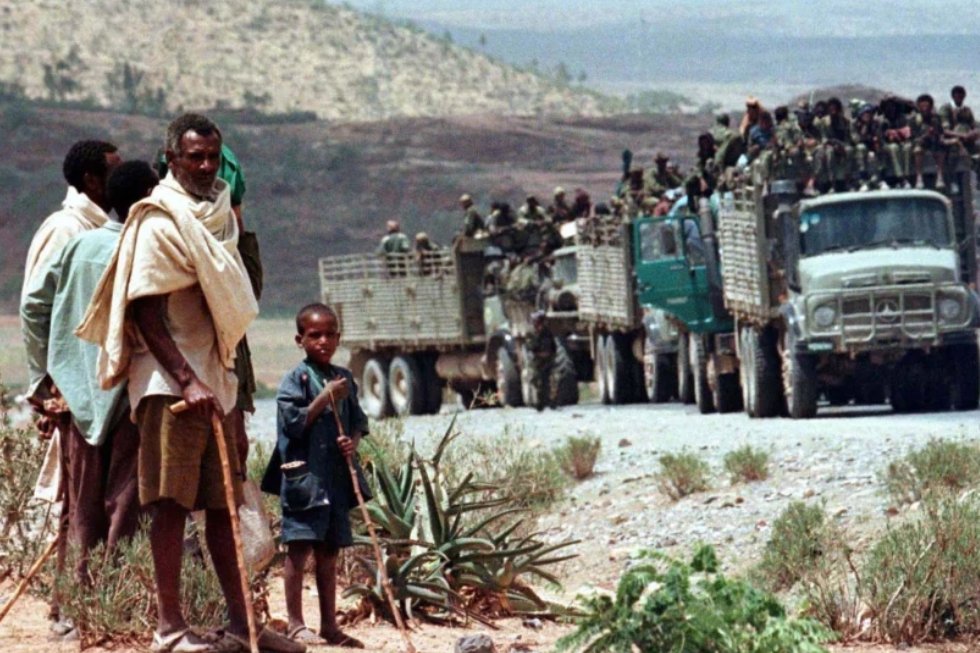



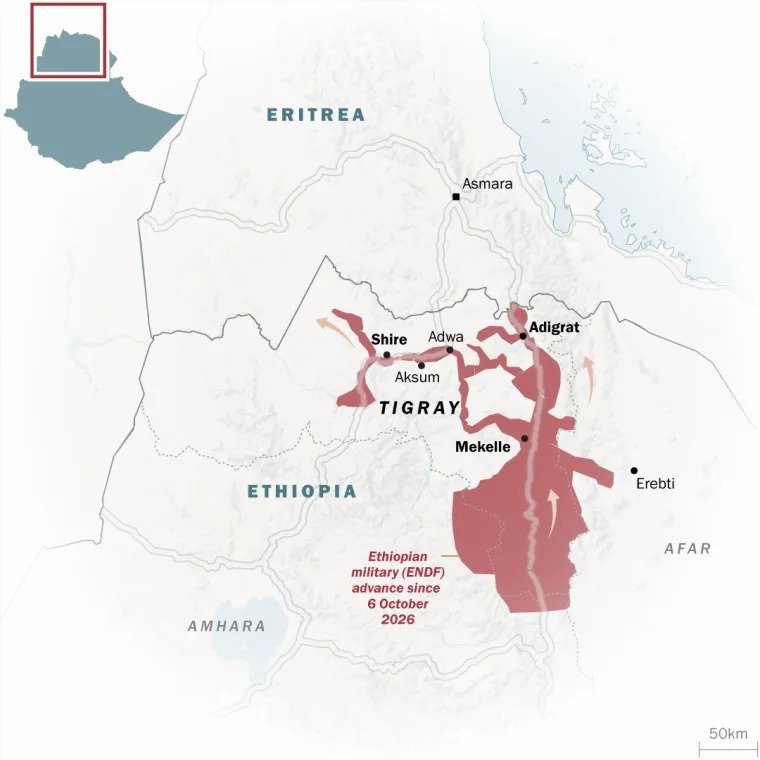
With Ethiopian forces having taken the northern town of Zalambessa, bordering on Eritrea, the region is at a crossroads. To put it simply: Will Ethiopian Prime Minister Abiy Ahmed send his troops, supported by the Tigray Peace Force (TPF), into the neighboring nation?
The decision is critical. If Ethiopia decides to invade Eritrea, as it did during the border war of 1998–2000, regional geopolitics will be threatened. Few doubt that the Ethiopians and their allies are capable of doing so. If they do invade, a number of key elements could come into play.
Eritrea has been an aggressive neighbor. Apart from its war with Ethiopia, the nation has involved itself in no fewer than six wars since independence in 1993.
Fifteen years ago, a UN Monitoring Group report alleged that Eritrean intelligence had planned an attack on the Ethiopian capital of Addis Ababa in January 2011. The unrealized attack allegedly intended to disrupt the African Union summit.
The UN report claimed the plan involved:
- A car bomb at the African Union headquarters
- Explosives near the Ethiopian prime minister’s office and the Sheraton Hotel, where visiting leaders stayed
- An attack on the Merkato market
- And the use of Oromo Liberation Front operatives allegedly recruited, trained and directed by Eritrean intelligence.
The report concluded that Eritrea’s government had “conceived, planned, organized and directed” the failed operation, which, if carried out, could have caused mass civilian casualties and disrupted the summit.
Given this history, it is hardly surprising that Ethiopia is wary of its neighbor. However, the Ethiopians also have aggressive intentions. Abiy has repeatedly indicated that he wishes to have access to the Red Sea, via Eritrean ports Massawa and Assab. The aim is to reestablish the Ethiopian navy. As long ago as 2018, the prime minister said that Ethiopia had “built one of the strongest ground and air force in Africa… we should build our naval force capacity in the future.”
Unresolved tensions and a warning
The nations have not resolved these tensions. Eritrea and Ethiopia, who fought as allies during the 2020–2022 war in Tigray, are now at daggers drawn. The unresolved situation in Tigray exploded into full scale war on September 22, 2026, with drone attacks on Tigrayan towns. It now threatens to tip the region into conflict. With Ethiopian forces having advanced to the country’s border with Eritrea, Abiy could drive deeper into Eritrea to seize the Red Sea port that he has so long desired.
Taking notice of the crisis, the Trump administration has warned Ethiopian and Eritrean troops not to cross their mutual border:
Increasing cross-border tensions between Ethiopia and Eritrea have the potential to affect the entire region. The Horn of Africa cannot sustain another military conflict and humanitarian crisis. A conflict jeopardizes ongoing U.S. collaboration on shared interests with both countries. We strongly urge Ethiopia and Eritrea to respect the sovereignty and territorial integrity of their neighbors, exercise maximum restraint and return to dialogue and cooperation as agreed in their 2018 peace framework. Peace through dialogue is the only path toward sustainable security, economic growth, and prosperity.
What problems would an invasion of Eritrea pose for Ethiopia?
- Any invasion would be illegal. Since 1993, the African Union and the United Nations have recognized Eritrea. Ethiopian President Meles visited its capital, Asmara, at the time, cementing Eritrea’s recognition by Ethiopia. Of course, it is also true that Eritrean President Isaias Afwerki has repeatedly interfered in Ethiopian affairs, arming dissidents and attempting to shape Ethiopia to Eritrea’s will. But this would take matters to an entirely different level.
- Abiy knows that even now, his supply lines are long and hard to maintain. Ethiopian forces would be stretched if they attempted to capture Eritrea (or parts of Eritrea) while facing attacks in their rear from the Tigray Defense Forces (TDF), which remained loyal to the Tigray People’s Liberation Front. The TDF did not face defeat in Ethiopia’s Mekelle, instead withdrawing to the mountains, as they had done before. They have hidden supplies and equipment and could easily mount a fierce guerrilla campaign against Ethiopian and TPF troops.
- Eritrea’s military is no match for the Ethiopian armed forces. Estimates say that Eritrea can field an army 350,000 strong, yet has just seven working aircraft and not a single operational fighter jet. Much of the rest of its kit dates from the 1998–2000 border war, and a $219 million defense budget only goes so far against a neighbor that has been acquiring, and even producing, the drones Eritrea lacks.
- So far the Alliance for Survival the Tigrayans forged with Oromo, Amhara and other ethnic groups does not appear to have paid dividends. Attempts to establish a united military strategy to attack Ethiopian forces would not seem to have yielded results so far. It may be that this is, as was previously predicted, because of earlier problems of disunity. However, fighting is already taking place in several areas of Ethiopia away from Tigray and this could escalate, testing the Ethiopian military’s ability to subjugate Eritrea, as well as Tigray.
- How might Ethiopia’s allies react? Abiy relies heavily on the United Arab Emirates for finances and equipment, in return allowing the Middle Eastern nation to supply its Rapid Support Forces (RSF) allies, the Janjaweed, in western Ethiopia. Equally, Ethiopia relies on Türkiye for the drones that it used to turn the last war with Tigray (2020–2022) in its favor. The French News Agency reported recently that “Ethiopia has been manufacturing drones at two factories since last year and is now thought to have a fleet of thousands, analysts say, giving the government an edge against its multiple insurgent enemies.”
- Simultaneously, Eritrea has worked hard to win allies in Egypt and with the Sudanese Armed Forces, as well as mend fences with some of its Arab neighbors. US President Donald Trump, desperate to escape from the war that he launched against Iran, has moved to improve relations with Asmara. Reuters reported in May, citing an internal US government document, that Washington was preparing to lift the Eritrea sanctions amid renewed focus on the Red Sea and Eritrea’s strategic location. Eritrea has powerful friends today, including Egypt and the Sudanese Armed Forces that now control Khartoum and much of eastern Sudan. These relations have been strengthened in recent months. Saudi Arabia, already fighting the Houthis in Yemen, is unlikely to wish to see further turmoil in the region. They are all likely to pressure Addis Ababa to not attempt to seize an Eritrean port, nor to overthrow the Eritrean regime.
- Any invasion of Eritrea would unite the majority of its people behind President Isaias, in the country and the diaspora. Even his enemies would, for the most part, oppose an external threat to their nation.
What advantages might an invasion of Eritrea provide to Ethiopia?
- Abiy wants a port on the Red Sea. He argued that it is an existential question for Ethiopia. Having its own port would secure Ethiopia’s route to the outside world, instead of depending on Djibouti for its access to the sea. He explained that Ethiopia’s rights and claims of access to the port are rooted in geographic, historic, ethnic or economic realities. He has not ruled out taking a port by force.
- Ethiopians have urged him to act, stating: “Ethiopia’s modern naval history took shape in the aftermath of the Second World War. In 1948, the Imperial Ethiopian Navy was formally established, with its first naval base set up at the port of Massawa… Now, as Ethiopia seeks to strengthen its economic and strategic links with the Red Sea, the horizon is once again part of its national conversation. From Red Sea waters to a new strategic era, Ethiopia’s maritime journey is increasingly becoming a story not only of recovering what was lost, but of building the capability and partnerships needed to shape what comes next.”
- If Ethiopian forces could capture Asmara and take the remainder of Eritrea, new opportunities would open up for them. It would allow Abiy to settle once and for all which nation was supreme in the Horn of Africa. He could either establish a puppet government in Eritrea or (less likely) attempt to reverse its declaration of independence, and reabsorb Eritrea into Ethiopia. For someone with the ambitions of Abiy, both must appear tempting prospects. At the same time, he cannot ignore the fact that Eritreans fought 30 years for their independence. They would not roll over and accept Addis’s rule.
- Eliminating Eritrea as a competitor would leave the Ethiopian prime minister in a much more powerful position vis-à-vis Sudan. He could bolster his support for the RSF and turn the Sudanese civil war in their favor. Might the UAE be quietly egging him on for precisely this reason?
- Hubris and religious beliefs should not be overlooked. Prime Minister Abiy considers that he is advised by God. There are reports that he has told fellow believers that God called him to become prime minister, and that he regards his leadership as divinely selected. During the Tigray conflict, a leaked recording reportedly captured a prophetess telling him that God wanted him to defeat the Tigrayan forces. Abiy’s reported response was “Amen,” though this demonstrates his receptiveness to such claims more clearly than it proves a systematic belief that God personally dictates every policy.
Other factors are, of course, in play. However, these are some that appear to be shaping this critical decision: to invade or not to invade. We will have to wait to see the outcome of Abiy’s deliberations and ambitions.
[Lee Thompson-Kolar edited this piece.]
The views expressed in this article are the author’s own and do not necessarily reflect Fair Observer’s editorial policy.






Join the conversation
Share your perspective
Log in to share your thoughts and take part in the discussion.