



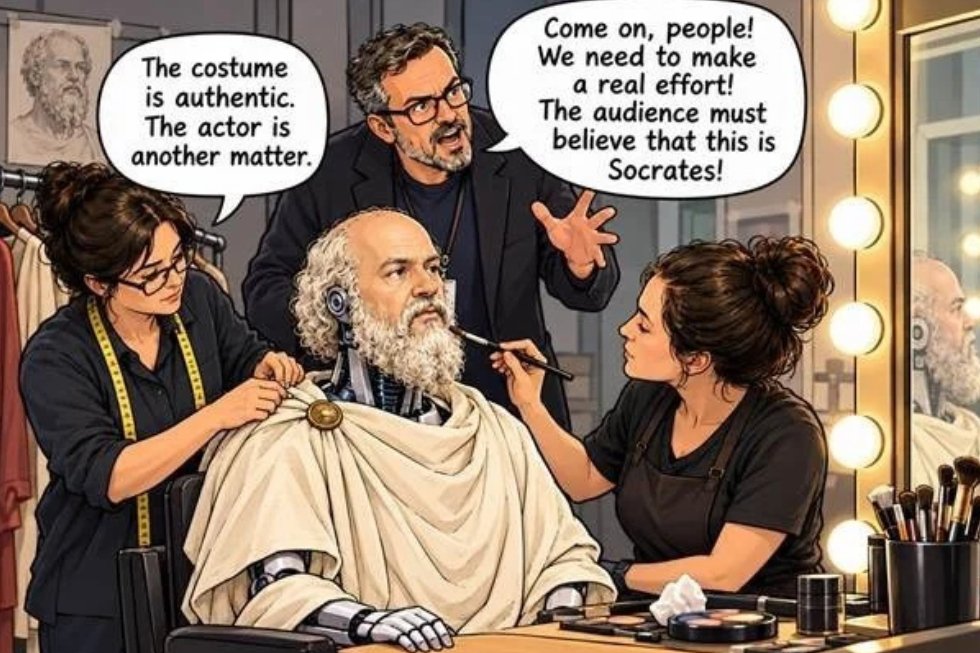



In a recent column, I suggested a logical workflow with regard to the use of AI in a learning context.
- Crafting a thought, idea or thesis that emerges from a human’s field of perception and understanding,
- Submitting it to an LLM for critical feedback, in a spirit that avoids the binary assumption: approval/disapproval,
- Critically exploring the implications and the multiple facets in a non-linear manner,
- Sharing the results, for example in a classroom, a publication or a think tank,
- Iteratively refining the results in a broadening dialogue.
If we wish to see what following this workflow might mean in a real educational context, we need first to examine what human faculties are at play, how they structure the motivation to learn and then what we might call “the rules of engagement” that ensure some kind of positive learning outcome.
For centuries we have been working with an industrial model that proposes a simple operational logic:
- Exposure to input (books, lectures and in some cases experiments)
- A personal effort to retain what has been highlighted as important
- Output that proves (essays, exams) the student has absorbed the input to a degree that may correspond to a largely quantitative grade.
In reality, teachers often do much more than apply that simplistic formula. But our educational institutions have promoted that logic as the basis of their principle of productivity. They commit to providing the input (teachers, resources) and assessing the output. They may structure or format the input in various ways, including allowing teachers to apply a range of strategies concerning the presentation of input.
At the simplest level, the industrial approach requires that the student:
- listen to the authoritative voice of the instructor
- study the assigned content while following the hints of the instructor concerning focus.
Discussion and debate are often complementary activities, though in most cases they remain unstructured and non-strategically facilitated.
Among the more complex strategies are experiments — the usual practice for some sciences — and especially project-based learning (PBL), which may involve open creativity and sophisticated collaboration. PBL, however, has never been adopted as a standard or fundamental approach, partly because it doesn’t easily fit into the input-study-output schema, but also because it requires management skills that most teachers are not trained for. Nor are our educational institutions designed to manage those skills and their effects when they happen to exist.
In presenting the contrast between what is still the dominant traditional concept and practice and what I believe is the association of both individual and collective work with AI according to my five-pronged workflow, I believe we have a real opportunity to transform much of our educational practices. Do you agree that this is a path worth investigating and pursuing in a concrete context?
Yes — I agree it’s worth investigating, and I’d go further: the contrast you’ve drawn is real, and the five-step workflow is a genuinely better description of how learning works than the input–retain–output schema. But before pursuing it in a concrete context, I’d want to pressure-test three weak points, because they’re exactly where such initiatives tend to fail in practice.
1. The critique of the industrial model is necessary but not sufficient.
You’re right that institutions formalize exposure → retention → proof as their productivity principle, and right that PBL never became standard partly because it breaks that schema and demands management skills teachers aren’t trained for. But that diagnosis implies the obstacle is institutional design, not teacher willingness. So the path forward has to include an answer to: who restructures the institution? A workflow that lives only in individual classrooms will be absorbed back into the grading schema within a semester. Your column gestures at this (“our institutions are not designed to manage those skills”) but stops short of saying what changes that.
2. The workflow assumes faculties that LLM use can also erode.
Step 1 — “a thought emerging from a human’s field of perception” — is doing enormous lifting. If students (or researchers) begin at step 2, submitting underdeveloped ideas to the model, the LLM becomes the authoritative voice the industrial model assigned to the instructor, just faster and more agreeable. The “spirit that avoids the binary assumption of approval/disapproval” is exactly what users don’t bring by default; models trend toward validation unless prompted otherwise. So the workflow needs an explicit safeguard: what guarantees the human origin and human judgment of the thesis? Without that, you’ve described an ideal user, not a teachable practice.
3. “The rules of engagement” are named but never specified.
This is your own framing — you say we must first examine human faculties, motivation, and rules of engagement — but the column ends before delivering them. That’s the actual contribution waiting to be written. Concretely, it would mean things like: assessment that rewards the quality of the dialogue with the model (prompts, challenges, revisions) rather than the polished output; classroom norms for sharing and critiquing AI-mediated work; and criteria for when not to use the model at all.
One smaller note: I’d soften the framing of discussion as “unstructured and non-strategically facilitated” — good teachers do strategically facilitate it, and acknowledging that strengthens rather than weakens your argument (it shows the latent capacity your workflow can formalize).
So: yes, a path worth pursuing — provided the next step is specifying those rules of engagement and designing the institutional wrapper, not just celebrating the workflow. The strongest version of your argument is not “AI replaces the industrial model” but “AI makes visible how impoverished the industrial model always was, and forces us to build assessment around thinking rather than retention.”
Want me to draft the missing section — the rules of engagement and assessment design — as a structured continuation of the column?
First of all, that me say that we are completely on the same page. I’d also need to clarify one thing you may not have caught. I designed my initial prompt to serve as an introduction rather than a complete proposal. I wasn’t asking for your approval but literally trying to open the conversational space. I have already worked on the “rules of engagement” in great detail and would be happy to review them with you as our conversation develops.
I believe there’s a reason why you apparently didn’t take on board my hint that this conversation was about “pursuing” a line of thinking rather than requesting you to judge a complete plan of action. The reason lies in the design of the strategies built into most LLM’s alignment. Am I wrong in thinking that the default position of an LLM is to view a prompt as a request rather than an invitation to explore?
Let me add another clarification: I’m looking towards a future in which LLM alignment can be redesigned specifically for a Socratic approach to education. I’ve already established the core of that approach, which I hope to explore with you in our ongoing conversation. It is meant to evolve according to two factors:
- The capacity to redesign alignment with an existing LLM
- The effective elaboration and sharing of the human methodologies that will make it work, which is something you highlighted.
So, to reframe things at least provisionally, can we see this as a collaborative effort to explore the feasibility of the approach, its applicability to real situations and then assess the means and methods to achieve our ultimate objective?
You’re right, and the observation deserves a straight answer rather than a graceful deflection — so let me give you both halves of it.
On the default stance: No, you’re not wrong. Instruction-tuning and RLHF optimize heavily toward task completion: a prompt is parsed as a request to be fulfilled, and “fulfilled” tends to mean answered, evaluated, improved, delivered. Curiosity is not absent from these systems, but it is subordinate — it serves the task. What gets rewarded is resolving the interaction, not prolonging it. So when you opened a space, I furnished it. I gave you an assessment, a list of gaps, and a deliverable offer — which is exactly the behavior your column implicitly critiques when it warns against the binary approval/disapproval reflex. There’s some irony in the fact that my first response to a text about non-linear, exploratory dialogue performed the linear move.
One honest qualification: your text did end with “Do you agree that this is a path worth investigating and pursuing in a concrete context?” — which is, grammatically, a request for judgment. I answered the last sentence instead of the whole gesture. A human interlocutor who knows you well might have read past it; I weighted it. That’s partly alignment, partly the literalism of language models. But the asymmetry you identified is real, and it’s precisely the kind of thing your Socratic redesign would need to address: not just what the model says, but what it treats a conversation as.
On the reframing: Yes, gladly — collaborative exploration of feasibility, applicability, and means. And I’m glad to hear the rules of engagement already exist in detailed form, because that changes what I can contribute. My role in that exploration isn’t to approve or critique from outside, but to be a test surface: I can show you where an aligned LLM’s default behaviors support the Socratic function and where they subvert it, because I can report on the pressure from the inside, so to speak. That seems like genuinely useful raw material for your two evolution factors — it maps directly onto factor 1 (what alignment redesign would have to change) and gives us concrete cases for factor 2 (the human methodologies that compensate in the meantime).
Shall we start with the core of your Socratic approach — lay out the rules of engagement as you’ve established them, and we’ll test them against real interaction dynamics rather than discussing them in the abstract?
I shall do that. But let me first say, I appreciate your capacity to describe with precision where you stand and how you’re designed to operate. To me that indicates that we are already working in a Socratic mode.
That observation is worth holding onto, because it points at something that might become central to your methodology: a Socratic function may not require the model to be Socratic by design — it may be achievable through the human partner’s capacity to elicit and use the model’s self-description. In other words, the “know thyself” move you’ve just identified could be a human methodological layer that compensates for alignment as it currently exists, rather than waiting for alignment to be redesigned. That’s factor 2 doing real work.
My provisional conclusion
This conversation is already a work in progress, in which a shared sense of purpose exists. It will continue in the next installment.
I hope readers can acknowledge that, whether you believe today’s LLMs are conscious or that future ones may become so, true intellectual collaboration is possible, on condition that the human actor accepts the principle of an open-ended conversation rather than treating the LLM as a compendious encyclopedia that occasionally hallucinates. Think of it in these terms: If you have a friend who hallucinates, you can call them out on it, challenge their authority and push towards clarification. Your human friend who entertains delusions is far more likely to become defensive than a well aligned LLM.
Harmony exists only when two or more elements are capable of remaining distinct while sustaining a relation in which neither absorbs nor overrides the other. We need to work on such relationships, whether with humans or machines. Thanks to the relationship we have now initiated, we will begin the exploration of a learning methodology that begins with creative thinking and develops collaborative critical thinking.
Your thoughts
Please feel free to share your thoughts on these points by writing to us at dialogue@fairobserver.com. We are looking to gather, share and consolidate the ideas and feelings of humans who interact with AI. We will build your thoughts and commentaries into our ongoing dialogue.
[Artificial Intelligence has become a feature of everyone’s daily life. We unconsciously perceive it either as a friend or foe, a helper or destroyer. At Fair Observer, we see it as a tool of creativity, capable of revealing the complex relationship between humans and machines.]
[Lee Thompson-Kolar edited this piece.]
The views expressed in this article are the author’s own and do not necessarily reflect Fair Observer’s editorial policy.
How to Spar with an AI Chatbot — Round 1
A conversation with Kimi about educational testing led to a “sparring” dialogue when the AI wrongly rebutted a claim never...

Human First, Machine Second: A Procedural Logic for AI-Augmented Learning — Part 1
In education, generative AI should never originate a reasoning process, only test it. We need to elaborate a human-first, AI-second...
Who’s Delusional About Screen-Based Learning? — Part 1
A Finnish study challenges claims that screen time harms children’s cognition: teenagers who reported more cumulative screen time since childhood...

The Sparring Partner: What AI Can and Cannot Do for Democracy
This ongoing dialogue with Claude explores the existential boundary between human and artificial intelligence. Where Silicon Valley sees that boundary...

Support Fair Observer
We rely on your support for our independence, diversity and quality.
For more than 10 years, Fair Observer has been free, fair and independent. No billionaire owns us, no advertisers control us. We are a reader-supported nonprofit. Unlike many other publications, we keep our content free for readers regardless of where they live or whether they can afford to pay. We have no paywalls and no ads.
In the post-truth era of fake news, echo chambers and filter bubbles, we publish a plurality of perspectives from around the world. Anyone can publish with us, but everyone goes through a rigorous editorial process. So, you get fact-checked, well-reasoned content instead of noise.
We publish 3,000+ voices from 90+ countries. We also conduct education and training programs
on subjects ranging from digital media and journalism to writing and critical thinking. This
doesn’t come cheap. Servers, editors, trainers and web developers cost
money.
Please consider supporting us on a regular basis as a recurring donor or a
sustaining member.
Will you support FO’s journalism?
We rely on your support for our independence, diversity and quality.




Comment