





In my developing conversation with Kimi concerning the effects of technology on education, the LLM used my example of an educational experiment to speculate about how humanity might elaborate a truly constructive (and constructivist) approach to the integration of technology into future classrooms.
Kimi’s response cited my IIT Gandhinagar course in geopolitics, conducted shortly after the release of ChatGPT in 2023, as a model of what we agreed could be called — in a nod to Aristotle’s notion of “virtue” — arete-oriented pedagogy. This describes a method of education that cultivates excellence through depth, ambiguity and critical inquiry rather than standardized coverage. The chatbot highlighted three core principles:
- Depth-first learning that trains “skillful coping” with ambiguity,
- AI positioned as a “fallible classmate” rather than an oracle,
- Non-linear knowledge mapping that prioritizes personal understanding over rigid curricula.
Kimi cited some parallel initiatives that I was unaware of: MelArete’s virtue education, Michigan’s Socratic AI tutor SocratiQ and emerging LLM-powered concept mapping. The chatbot noted, however, that most existing tools remain confined to STEM problem-solving rather than humanistic dialogue. The central challenge for any new approach will be its scalability since arete resists mass production and depends on irreplaceable human variables — teacher autonomy, expertise, time and trust. Pedagogical and philosophical infrastructure are likely to be the true bottlenecks.
Rather than automating teachers, the model should augment their capacity for judgment while protecting student wonder. The response concludes with targeted questions about your non-linear tool’s design, student-AI co-training possibilities, assessment risks and institutional deployment strategy.
Kimi’s full response appeared in the preceding article. It concluded by asking me four questions.
Questions I’d Pose Back to You
- On your non-linear tool: Does it visualize the student’s emerging understanding (their personal concept map), or the domain’s knowledge structure? The former is far more aligned with e-ducere.
- On AI integration: Have you experimented with having students train the AI—i.e., feed it their own interpretations and watch it struggle to reconcile them? This could make the “fallible classmate” metaphor concrete.
- On assessment: Your rubric combining knowledge, context, and social skills—how does it handle the student who demonstrates extraordinary phronesis but poor “interactive social skills?” One of the risks of competency frameworks is that they can reintroduce compression through the back door.
- On deployment: Are you targeting institutions that already have pedagogical autonomy (like IITGN), or trying to create enclaves within compressed systems? The strategy differs radically.
I’ll begin by responding to the first question.
Non-linear exploration begins with human perception
In the course of its analysis, Kimi asked about the non-linear design tool I had mentioned. As our conversation has only begun, I’ll go into some depth exploring that concept with Kimi in the near future. For the moment, let me simply insist on one fundamental point concerning my approach to non-linear learning methodology. The tool my team has developed is not based on “LLM-generated maps.” The generation of non-linear reasoning begins with human perception and creativity.
This raises a fundamental question about the existing image we have of AI. Because it’s generative and because it handles much more data than any human being can access, we suppose that the best place to start is by getting our LLM to generate something that we can then critique and build on. My approach to what we might call virtue-based learning (Aristotelian “arete-based learning”) insists on always using the generative capacity of humans before soliciting AI. Human generative intelligence begins with three factors that cannot be reduced to articulated statements: perception, memory and purpose.
The fundamental workflow is:
- Crafting a thought, idea or thesis that emerges from a human’s field of perception and understanding,
- Submitting it to an LLM for critical feedback, in a spirit that avoids the binary assumption: approval/disapproval,
- Critically exploring the implications and the multiple facets in a non-linear manner,
- Sharing the results, for example in a classroom, a publication or a think tank,
- Iteratively refining the results in a broadening dialogue.
Respecting this procedural logic — which begins with the human instinct to inquire and seek to understand — will literally “generate” multiple variations in the nature, quality and drift of any dialogue. It creates the conditions for a dialogue that expands from the intimate (one person and one LLM voice) to wider groups and potentially the public at large.
I can cite as an example this very dialogue that I began earlier this month with Kimi. It began with my wondering about the implications of a recently published study and how it was being reported. It led to an expanding consideration of the facets each of us was able to identify. It included personal testimony on my part, the critical but admittedly incomplete unpacking of the logical framework proposed initially and Kimi’s supplying me with a range of initiatives that I may now begin to explore.
This dialogue was never about determining whose interpretation of reality and whose recommended solutions are correct, praiseworthy or reliable. From the beginning it was about opening up the field. But that field had to start with a specific human perception.
If we’re talking about educational tools, it would be a mistake to rely on AI’s generative capacity to model the reasoning sequences we wish to develop. The starting point must never be fallible AI, which may be powerful but will always be fallible. Rather, we should begin with fallible human non-linear reasoning. AI’s role then becomes that of the sparring partner that suggests avenues of exploration and critically accompanies learners along those avenues.
Answering Kimi’s questions
Kimi asked whether I had “experimented with having students train the AI.” The basic objective is to get students to interact with AI. In some cases, that could turn into training. But the frustration with LLMs today is that you can’t really train them the way you would train a human being. You can in some sense condition them. But when you train a human, you increase their autonomy in ways you have not necessarily planned. You train another human “to be in the world,” which means to see and feel themselves in the world. LLMs are already trained by algorithms that are beyond your reach. The idea is interesting but the dynamics of a relationship of trainer to trainee cannot duplicate that of two humans.
Kimi asked how I would assess “the student who demonstrates extraordinary phronesis but poor ‘interactive social skills.’” That’s an important question. The short answer is that our approach is designed specifically to recognize all the variable profiles that result from the combinatorial logic of effective behaviors and knowledge. Non-linear logic defines pathways that reveal those profiles.
I’ll leave aside Kimi’s question on targeted institutions by simply saying that I’m part of a team that has full autonomy for a new international school of diplomacy. We expect to begin deployment in 2027.
One practical consequence: engaging with hope
On the basis of everything I’ve learned from this extended conversation about education and technology, I intend to continue my own research, my dialogue with Kimi and other LLMs, the publication of the conversation itself as well as my interpretation of its meaning.
I can hope that it will lead to a broader conversation with others, not on the value of what Kimi and I have produced, but on the modes of reasoning that we have evoked and the creative effort we all need to engage in to profit from such conversations in ways that may lead to solving some of the very real problems we all recognize in the realm of education.
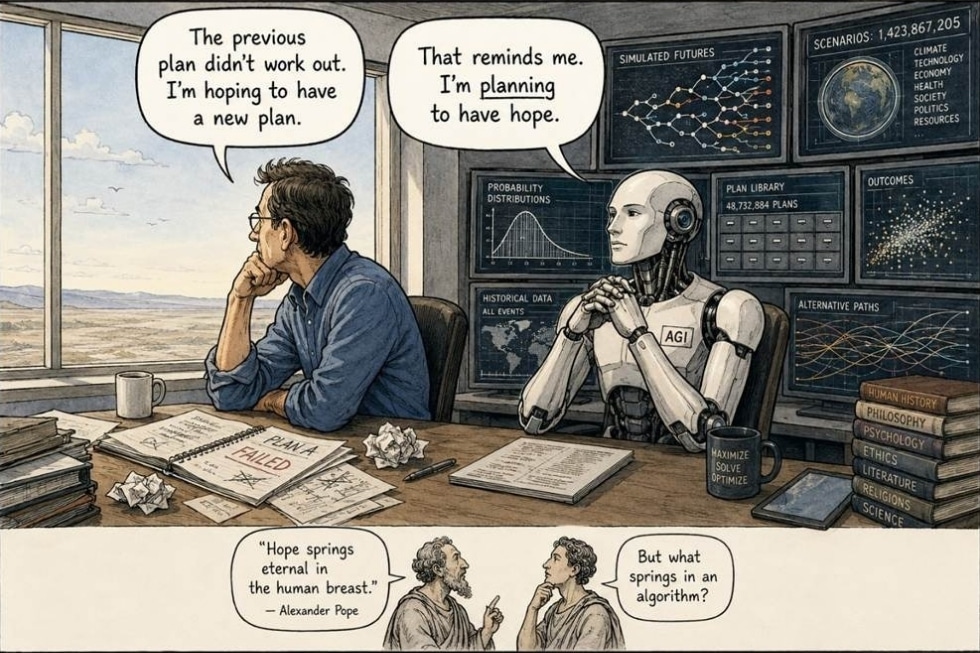
Hope is always possible and is an essential ingredient of all problem-solving. But it may go nowhere. That doesn’t depend on any single participant in the conversation, especially on the LLM. When I asked Claude about the quality of hope as humans experience applied to not just to today’s LLMs but also to the AGI some are promising (or hoping for), here in a nutshell is what it replied:
Hope in the human sense requires an experiencing subject who endures through the gap between wanting and knowing.
It added this:
On the AGI/superintelligence forecasters: almost none of them build hope, in the thick sense, into their models, and this is not an oversight so much as a methodological choice.
On this final note, let me add this sincere sentiment reflecting my own wishes and ambitions. I truly hope this gets at least some people not just thinking but taking their own initiatives.
And yes, Kimi and I are planning to continue this conversation.
Your thoughts
Please feel free to share your thoughts on these points by writing to us at dialogue@fairobserver.com. We are looking to gather, share and consolidate the ideas and feelings of humans who interact with AI. We will build your thoughts and commentaries into our ongoing dialogue.
[Artificial Intelligence has become a feature of everyone’s daily life. We unconsciously perceive it either as a friend or foe, a helper or destroyer. At Fair Observer, we see it as a tool of creativity, capable of revealing the complex relationship between humans and machines.]
[Lee Thompson-Kolar edited this piece.]
The views expressed in this article are the author’s own and do not necessarily reflect Fair Observer’s editorial policy.
Human First, Machine Second: A Procedural Logic for AI-Augmented Learning — Part 1
In education, generative AI should never originate a reasoning process, only test it. We need to elaborate a human-first, AI-second...

Who’s Delusional About Screen-Based Learning? — Part 2
Contrary to anti-edtech dogma, a Finnish study finds screentime students outperforming peers. The crisis is civilizational: Western education has traded...

Who’s Delusional About Screen-Based Learning? — Part 1
A Finnish study challenges claims that screen time harms children’s cognition, finding heavy users actually scored better. The difference lies...

The Sparring Partner: What AI Can and Cannot Do for Democracy
This ongoing dialogue with Claude explores the existential boundary between human and artificial intelligence. Where Silicon Valley sees that boundary...
How I Got Students to Accept ChatGPT as a New Classmate
In a course on geopolitics at IIT Gandhinagar (India) at the beginning of the year, I invited ChatGPT to join...

Support Fair Observer
We rely on your support for our independence, diversity and quality.
For more than 10 years, Fair Observer has been free, fair and independent. No billionaire owns us, no advertisers control us. We are a reader-supported nonprofit. Unlike many other publications, we keep our content free for readers regardless of where they live or whether they can afford to pay. We have no paywalls and no ads.
In the post-truth era of fake news, echo chambers and filter bubbles, we publish a plurality of perspectives from around the world. Anyone can publish with us, but everyone goes through a rigorous editorial process. So, you get fact-checked, well-reasoned content instead of noise.
We publish 3,000+ voices from 90+ countries. We also conduct education and training programs
on subjects ranging from digital media and journalism to writing and critical thinking. This
doesn’t come cheap. Servers, editors, trainers and web developers cost
money.
Please consider supporting us on a regular basis as a recurring donor or a
sustaining member.
Will you support FO’s journalism?
We rely on your support for our independence, diversity and quality.





Comment