





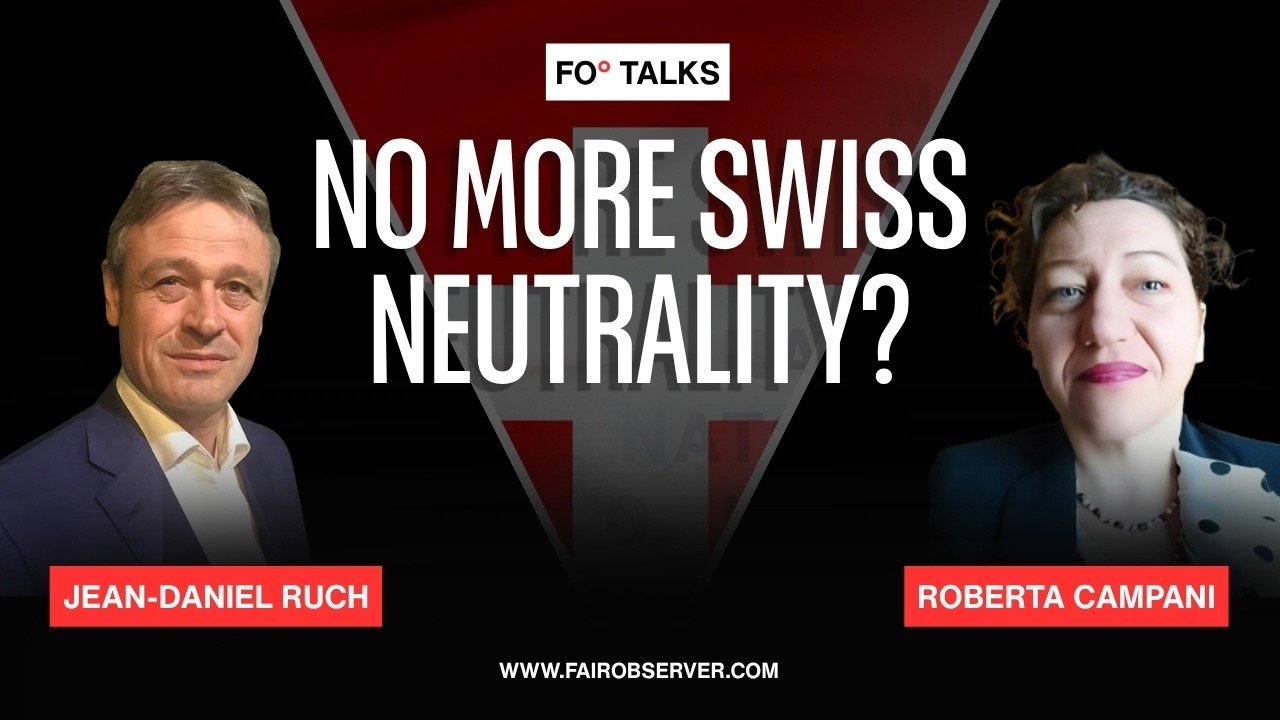
Fair Observer’s Communications and Outreach officer, Roberta Campani, speaks with former Swiss diplomat Jean-Daniel Ruch about Switzerland’s rejection of the Neutrality Initiative. Ruch interprets the result as resistance to a stricter definition of neutrality, rather than abandonment of the principle. They examine sanctions against Russia, closer cooperation with NATO, controversial weapons purchases and the relationship between national independence and freedom of expression.
Voters reject rigidity, not neutrality
Switzerland’s direct democracy allows citizens to propose constitutional amendments by collecting 100,000 signatures. Adoption requires both a nationwide popular majority and a majority of cantonal votes. Only about 8% of popular initiatives have succeeded since the system began in 1891.
The neutrality proposal lost by approximately 70%–30%. Every canton rejected it, although Ticino’s result was narrow. Ruch contrasts that defeat with continuing public support for neutrality, which he places above 80%.
The initiative sought to restrict cooperation with military alliances, prohibit sanctions against belligerents unless authorized by the UN Security Council and strengthen Switzerland’s mediation role. Its rejection leaves policymakers greater flexibility over sanctions and NATO relations.
Ruch credits direct democracy with encouraging responsibility but acknowledges its susceptibility to emotional campaigns. The vote banning new minarets in 2009 illustrated how fear can influence decisions within an otherwise stable democratic system.
Russia sanctions expose competing definitions
Russia’s invasion of Ukraine in February 2022 triggered the initiative. Ruch considers the invasion an aggression under international law. He recalls that Switzerland initially intended to retain its earlier approach: preventing sanctions from being circumvented through Swiss territory without adopting them itself. Within days, the government changed its mind and adopted EU sanctions.
For Ruch, this reversal damaged Switzerland’s credibility as a mediator. Moscow classified Switzerland as hostile, while Washington welcomed its alignment with Western policy. He argues that perceived impartiality matters beyond Europe, including in the Middle East.
The Swiss People’s Party and Pro-Swiss backed the initiative, while mainstream parties across the center and left opposed it. Campani raises concerns about relations with the EU. Ruch acknowledges those considerations but places greater weight on campaign messaging linking approval to Putin and polarizing Swiss politician Christoph Blocher.
He also challenges sanctions’ effectiveness, arguing that their economic costs can fall on European households and strengthen parties such as Germany’s Alternative for Germany. This is his interpretation of their political consequences.
Ruch’s broader objection concerns consistency. He criticizes sanctioning Russia while avoiding comparable measures against the United States or Israel for actions he also regards as aggression. Since Switzerland depends on major trading partners, he favors withholding such sanctions rather than applying them selectively.
NATO cooperation tests neutrality’s limits
Campani and Ruch distinguish formal NATO membership from increasingly extensive military cooperation. Ruch describes a September 2026 Swiss security strategy proposing cooperation across roughly 15 to 20 areas, including exercises involving collective defense scenarios under NATO’s Article 5.
He questions why Swiss conscripts would rehearse responses to an attack on a NATO member if Switzerland intends to remain outside the alliance’s wars. Such training risks creating practical integration without formally accepting membership obligations. The distinction matters for Switzerland’s freedom of military action.
Security officials see cooperation as a response to Russia and Switzerland’s limited capacity to defend itself alone. Ruch nevertheless wants parliament to establish clearer boundaries. Rejecting the initiative does not, in his view, settle how far military alignment should extend.
Weapons purchases demand public scrutiny
Defense procurement gives that debate immediate financial stakes. Ruch recounts assurances that 36 American F-35 aircraft would cost a fixed six billion Swiss francs. He describes a parliamentary investigation finding that the contract did not guarantee that price and accuses the government of “lying to the people and to the parliament.”
His criticism also covers Patriot missiles and Israeli drones. He estimates that Switzerland has spent roughly three billion francs without receiving the expected operational equipment. These allegations underpin his demand for accountability rather than treating the referendum as endorsement of existing procurement practices.
Ruch praises Defense Minister Martin Pfister’s support for domestic drone production, space capabilities and digital sovereignty. Campani’s questions about data security reinforce the importance of examining dependence on foreign suppliers.
Independence requires freedom to question policy
Drawing on journalist Raphael Lutz’s investigation, Ruch describes arms industry funding flowing into security think tanks whose recommendations influence defense policy. This can reinforce demands for larger budgets and closer NATO cooperation.
He also fears that proposed cooperation with foreign intelligence services against disinformation could suppress legitimate criticism. Citing EU sanctions against Swiss intelligence analyst Jacques Baud and Cameroonian-Swiss activist Nathalie Yamb, he alleges inadequate opportunities to defend themselves and warns that punitive measures encourage self-censorship.
For Ruch, neutrality’s future depends on democratic scrutiny as well as diplomatic choices. Citizens must retain the ability to question security policy, spending and foreign influence without fearing punishment.
[Lee Thompson-Kolar edited this piece.]
The views expressed in this article/video are the author’s own and do not necessarily reflect Fair Observer’s editorial policy.


































Comment