Dear FO Reader,
It has been some time since I last wrote to you. The heat has been blistering here in Georgia; it is currently 84 °F (96 °F with the humidity) as I write this. So, as you can imagine, being outside is not optimal. Thankfully, I enjoy staying at home in the air conditioning. As I sit inside, I spend time scrolling on social media, as most people probably do. While scrolling, I came across a TikTok video about the US citizenship test. It was very straightforward: Can you pass? The requirements are simple; you just need to answer 12 of 20 questions correctly. Now, I myself did not get all 20 questions correct. I missed two of them and only successfully guessed one, but I wasn’t sure I was right until the answer was revealed. However, I still passed with a score of 18/20.
The reason I bring this up is that, if you click on that video and look at the comments, you’ll see a concerning number of people who claim to have been born and raised in the US who failed the test. “[C]hrist I‘ve been here 64 years and now I’m getting deported”; “I was born here and got deported after I took this test”; “Did I even get an education ?!”; “I got none and I have lived here my whole life.” This should set off alarm bells for anyone who has taken sixth-grade civics or government (which all students in the US are required to take). Now, I am not here to shame or judge the people who failed. Rather, I want to raise awareness that the US has an education crisis, and has for some time.
No Child Left Behind
This crisis extends beyond just failing a sample US citizenship test. It is evident in the literacy crisis, where high school students can’t even write a paragraph,
60%
of students can’t read at their reading level and
54%
of Americans aged 16–74 read below a sixth-grade level. I have seen this crisis firsthand.
Before joining
Fair Observer
as an intern, I worked at a company called
Ignite Reading
. Their mission was to teach grade-school children to read. It followed the science of reading and included lessons spanning reading skills from pre-kindergarten through second grade. The program admitted students from kindergarten to the eighth grade. Let that sink in for a second. They were teaching children in the
eighth grade
how to read at a
second-grade level
. I had a fifth grader who could not even use letter sounds to form words. I had third graders who did not even know their letter sounds.
Of course, the problem goes
beyond
just the literacy crisis:
[According to t]he latest NAEP data [which] looks at math and reading skills amongst 12th graders and science skills for 8th graders. The results reveal record low scores for 12th graders in both reading and math, while science scores for 8th graders also declined to their lowest level since 2009. Crucially, 45% of 12th graders failed to demonstrate even a basic level of math knowledge and 32% failed to demonstrate a basic level of reading skills. Amongst 8th graders, 38% failed to demonstrate a basic level of science knowledge.
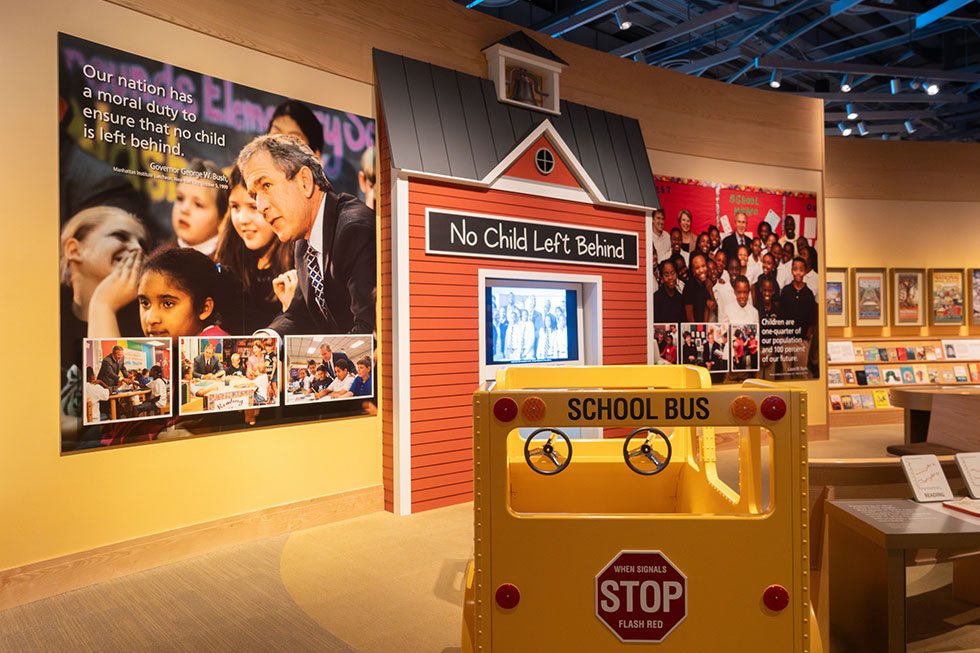
For full transparency, I place most of the blame for this on former US President George W. Bush and his No Child Left Behind Act (
NCLB
). This act reauthorized the 1965 Elementary and Secondary Education
Act
(which provided needs-based funding for K-12 education, emphasizing equal access, high standards and accountability). Under NCLB, states had to create and administer assessments to all students at select grade levels to receive funding. The thought was that setting high standards and establishing measurable goals could improve individual educational outcomes. But the reality is that the testing system has done more harm than good. No Child Left Behind has actually left many children behind.
 via shutterstock
Let me give you a personal example. My brother falls behind the learning curve. He does not retain information at the pace expected of the average student. However, he also doesn’t need special education, as he retains information too quickly. So, where does that leave him? It leaves him failing classes he could pass with the proper time. But because of NCLB and the focus on passing tests over real learning, he wasn’t given that time. To ensure he could graduate high school, my mother decided to homeschool him, so he
could
learn at his own pace. Unfortunately, my brother is only one example of a student the system has failed.
Every school year, more and more students are being forced to accept being average. They do not
fail
, but they are not
passing
, either. They, like my brother, are somewhere in the middle. Thanks to the prioritization of test grades, students who perform at the “average” can still move on to the next grade; they will not be “left behind” by their classmates. All of this to say, it is more important to push children into the next grade than to ensure they have fully learned the material. “Cs get degrees,” as they say.
That
is why NCLB isn’t actually effective: It’s all about numbers rather than what is best for every individual student.
Better education comes with better funding
Funding also plays a huge role in the current education crisis. Because most school funding comes from local taxes, poorer areas provide less money to schools. And thanks to generational poverty, most of those areas tend to be home to
marginalized communities
: “On average, school districts serving the highest proportions of students of color receive $2,700 less per student in state and local funding compared to those with the fewest students of color.”
The education system is built to uplift students with financial (and racial) privilege. The schools with more funding have access to better resources such as textbooks, school supplies, teachers and support programs. When you give students the tools to succeed, they achieve higher goals. But when entire school districts are given less funding, thousands of students are left behind.
I’ll share another personal example. I grew up in one of those poorer neighborhoods and went to schools with less funding. Now, I have to preface this by saying that I always performed well academically. I was a Gifted kid (meaning Gifted and Talented Education), and in high school, I joined the International Baccalaureate Program (IB). So, I received a very good education. However, that doesn’t mean there were no challenges or that the schools I went to did not have limited access to resources. My textbooks were worn and outdated, and there weren’t enough for each student to have their own. The classrooms were full of old furniture. Not to mention the portable classrooms (some with holes in the floors and ceilings), because the schools didn’t have enough money to expand to accommodate the influx of students. My senior year, my English class was in a portable, and there were several soft spots on the floor that you had to be careful to avoid, lest you break the floor.
 via shutterstock
How well do you expect students to learn when their classrooms are falling apart and their textbooks are outdated and scarce? The answer is that you don’t. Which is why students in lower-income areas
experience
“lower test scores and decreased college enrollment rates.”
Other schools in my city had significantly more funding. Thanks to that funding, they had access to better textbooks, classrooms and tools. One school had two tracks, a swimming pool, a soccer field, a football field, a 3-D printer and nicer facilities. Now most of those things might seem superfluous to education, but physical activity and extracurricular activities are also major proponents of student success. So, when you have a school that fosters students both academically and physically, you set them up for success. When you don’t, you set them up for failure.
Shifting the blame
What I find equally concerning is that much of the blame for people’s lack of education falls on them rather than on the system that failed them. Often, I see people treat students who can’t perform at the expected level as if they are lesser or should be ashamed of what they don’t know. Even as adults, people are blamed for their lack of education. And while there is a certain amount of blame that you take on as you get older and still choose not to educate yourself, there is a big difference between someone who never learned certain skills and someone who is ignorant.
If we want to fix the education crisis on a social level, we have to start uplifting people that the system failed. Stop blaming the eighth grader for not knowing how to read and write, and instead help them learn. Stop treating people as the cause of the problem, and start treating them as victims of the system — which they are. Read to your kids, help them with their homework, stop blaming their teachers when your child fails, and instead help them learn the material and, finally, help your child’s teachers (buy them the supplies they need to help your children learn, work with them rather than against them). Education does not start and end with the school day. It continues when your child gets home. Learning never ends, and if you place all of the burden on your child’s (underpaid and overworked) teacher, you’ll find that there are gaps in their education. This isn’t because teachers can’t do their jobs, but because, as I said,
real
learning is a continuous process.
Obviously, this is only a partial solution. It doesn’t erase the lack of funding, the overimportance of test scores or the lack of teachers. US President Donald Trump and his administration believe
dismantling
the Department of Education will solve these problems. However, this is not a decision he can make without Congress, so for now the Department still exists, even if the Trump administration has “moved aggressively to shrink the Department and, in some ways, its influence.” Regardless, it is not yet proven that this is an effective solution.
Whatever the answer is, it needs to come from the higher powers, and not the students themselves. We need to hold the people who created this system accountable and force them to fix it rather than directing all of the blame at those who suffer under it. If we do not, America will fall further into crisis. We need to help our fellow Americans today, not sometime in the future.
Until next time,
Kaitlyn Diana
Editorial Chief of Staff
















Comment