






There are moments in Brazil’s history when the country’s affairs become almost impossible to explain to a foreigner without sounding as if you had invented part of it. This is one of them.
We are less than a month away from the first round of a presidential election that will also renew the Chamber of Deputies and part of the Senate. The country has spent the last few years arguing about whether democracy survived the last election; whether the institutions that defended it have gone too far in doing so; whether Former President Jair Bolsonaro should be in prison; whether incumbent President Lula da Silva should serve another term; whether the Supreme Court has accumulated too much power; whether social media is destroying political debate and, increasingly, whether anyone can still tell the difference between an authentic political movement and a highly efficient digital operation.
Now add a failed bank, a Supreme Court fight, a former president’s son running, a self-help writer suddenly climbing the polls and a young political operator whose career was built almost entirely on the Internet. That is roughly where we are.
The Brazilian presidential election will take place on October 4, with a runoff scheduled for October 25 if no candidate receives more than half of the valid votes. Brazilians will also choose all 513 members of the Chamber of Deputies, 27 senators and the governors of the states and the Federal District.
It is difficult to think of a more consequential election since the country returned to democracy in 1985. And yet the strangest thing about the 2026 campaign may be that the candidates are not the most interesting part of it — the distribution is.
For someone watching Brazil from London, New York or Lisbon, a little historical context is necessary. The country spent 21 years under military dictatorship after the 1964 coup. Democracy returned gradually, with the first civilian president taking office in 1985 and the first direct presidential election in almost three decades taking place in 1989. Since then, Brazilian democracy has survived impeachment, corruption scandals, economic crises, political realignments and a remarkable number of television debates in which candidates promise to fix everything by Monday.
The 2022 election was different. Lula defeated Bolsonaro by a margin of just over two million votes, the narrowest presidential victory in Brazilian history at the time. Bolsonaro refused to concede in the conventional political language expected of a defeated candidate, and his supporters spent weeks questioning the voting system. On January 8, 2023, thousands of his followers invaded the Congress, the Supreme Court and the presidential palace in Brasília.
It was Brazil’s version of the post-election assault on democratic institutions, with its own characters, its own history and, inevitably, its own tropical absurdity. The institutions survived. The argument over what they did to survive has not ended. And now Brazil is preparing to vote again.
The bank in the middle of the election
The most extraordinary political story of the moment may have begun with something that sounds entirely unrelated to an election: Banco Master, a private bank based in São Paulo.
Its former owner, Daniel Vorcaro, became the central figure in an investigation involving alleged financial crimes and a web of relationships reaching into politics and the country’s institutions. Among the people whose names have appeared in the material surrounding the case is Senator Flávio Bolsonaro, Jair Bolsonaro’s eldest son and now a presidential candidate. Flávio has acknowledged receiving money from Vorcaro in connection with a film about his father.
The film itself, titled Dark Horse, almost perfectly serves as a symbol of Brazilian politics in 2026. A former president is imprisoned after being convicted over a coup plot; his son is running to replace the political leader who defeated him; and a banker connected to the Bolsonaro family becomes one of the protagonists of a financial scandal that is now colliding with the Supreme Court. The Court has not been spared.
Justice Alexandre de Moraes asked Chief Justice Edson Fachin to investigate Justice André Mendonça over allegations connected to the handling of the Banco Master investigations. Mendonça had authorized the disclosure of a Federal Police report containing allegations involving Moraes and people around him. The dispute has become a judicial argument about judicial power itself.
This matters because Brazilians are going into an election in which one of the central questions is institutional credibility. The people who will decide whether the political game was played fairly are themselves being pulled into the game.
That is not necessarily a sign that democracy is collapsing. Democratic institutions are not supposed to be free of conflict. But there is a difference between institutions being contested and institutions losing the capacity to persuade citizens that their decisions are legitimate. Brazil is getting uncomfortably close to that distinction.
Meanwhile, Flávio is trying to turn his father’s political inheritance into a presidential campaign. Lula, at 80, is seeking another term after a political life that already contains enough reversals for several biographies. He was imprisoned in 2018 after corruption convictions, released in 2019, he returned to the presidency in 2023 after Fachin annulled his convictions and he defeated Bolsonaro in the 2022 election.
The Brazilian voter, in other words, is being asked to choose between candidates whose political biographies already feel like sequels. Then two new characters walked into the story.
Renan Santos and the politics of provocation
Renan Santos is difficult to understand if you think of Brazilian politics as something that happens mainly inside Congress. His real political career happened online. He became one of the leading figures of the Movimento Brasil Livre (Free Brazil Movement, or MBL), which emerged during the demonstrations that helped impeach President Dilma Rousseff in 2016. The movement began with a liberal agenda, developed an unusually sophisticated communication operation and eventually turned itself into a political party, Missão (Mission Party), registered in 2025. Renan is now its presidential candidate.
The British magazine The Economist, prior to editing the piece, called him a “dark horse presidential candidate.” The expression reveals a great deal because Renan does not fit the traditional Brazilian definition of a presidential candidate; he is not a governor, a former minister, a television celebrity or the heir to a political dynasty. He is a creature of the Internet.
His political communication has always understood something that traditional politicians were slow to learn: Attention does not have to be earned by becoming more reasonable. Sometimes the fastest way to become visible is to become impossible to ignore.
Renan’s rhetoric against “wokeism,” his emphasis on masculinity and his proximity to parts of the so-called manosphere place him inside an international digital phenomenon that has found fertile ground among young men who experience cultural change less as liberation than as loss. There is nothing uniquely Brazilian about that. What is Brazilian is the speed with which this imported political language gets mixed with our own culture of spectacle, confrontation and personalism.
Renan also carries controversies that would normally require a candidate to spend quite a lot of time explaining himself. In August, the Federal Public Prosecutor’s Office filed a civil action against him and the MBL over publications concerning Indigenous peoples in the Lower Tapajós region. A federal judge ordered the removal of the material on an interim basis.
Then came a wonderfully circular episode. Dias Toffoli, a justice of Brazil’s Supreme Electoral Court, temporarily suspended Renan’s Internet campaign after finding that social-media profiles used by the campaign had not been properly reported to electoral authorities. The decision also affected access to electoral funds and his participation in debates. Renan’s party argued that the problem was technical and subsequently complied with part of the court’s requirements, leading Toffoli to restore the campaign’s online activity.
There is something almost literary about it. A candidate whose principal political asset is his command of digital communication found himself temporarily unable to campaign because of a dispute over the way his digital communication had been reported to the electoral authorities. It is the sort of story that would sound contrived if it were written as fiction.
But Renan is not the most curious case. That would be Augusto Cury.
From self-help to the presidency
Cury spent decades doing something that Brazilian politics has always admired but never quite known how to classify: He built a personal brand enormous enough to function almost independently of the institutions around him.
He wrote tons of books. He gave lectures. He created courses. He built a vocabulary around anxiety, emotional intelligence, human relationships and personal development. His Theory of Multifocal Intelligence became his intellectual signature, although specialists have questioned its scientific basis. Cury rejects those criticisms.
For most of his career, none of this had anything to do with presidential politics. Then, almost overnight, it did. A BTG/Nexus poll showed Cury rising from 2% to 11% of voting intentions. An AtlasIntel/Bloomberg poll showed him moving from 1.6% to 7.8%. That would already be remarkable.
Then came Instagram. Between August 16 and 29, Cury gained roughly 2.5 million followers, reaching around 10.8 million. On Thursday, August 27, he reportedly added approximately 1.2 million. For comparison, Flávio gained a little more than 71,000 followers over the same period. Lula gained around 11,000.
I have spent enough time looking at digital metrics to know that numbers like these deserve curiosity rather than applause. My first reaction was admittedly less scientific. I imagined Cury going to sleep with eight million followers and waking up with nine million, like a Brazilian version of a science-fiction movie in which Instagram has finally discovered cellular reproduction.
The joke, however, hides a serious question. What exactly does “organic” mean anymore?
The word organic has become suspiciously flexible
Cury’s sudden growth coincided with an equally sudden appearance of influencers endorsing him. They came from different areas of the Internet. Some had little apparent relationship to politics. Videos appeared presenting Cury as an alternative to the country’s polarized political establishment. Opponents questioned whether some of this activity could have involved paid influence, which would raise electoral-law issues. Cury’s campaign denied wrongdoing and described the phenomenon as spontaneous support generated by an innovative digital strategy.
There exists a crucial distinction between the two explanations. Suspicion is not evidence. A sudden increase in followers is not proof of manipulation. An influencer supporting a candidate is not proof that the influencer was paid.
But the opposite assumption is equally naive. In 2026, calling something “organic” is not an explanation. It is often the beginning of the question. The Internet has made spontaneity almost impossible to observe directly. We see the result — millions of views, thousands of comments, a sudden rise in followers — but rarely see the architecture that produced it.
That architecture matters. A candidate can appear to be gaining momentum because people are genuinely excited about him. He can also gain momentum because a network of accounts has decided to amplify him. Both things can happen at the same time. One can cause the other. A campaign can provide the spark and the audience can provide the oxygen.
At some point, the distinction between campaign and culture becomes almost impossible to draw. This is precisely where the politics of the algorithm begins.
What happens when attention becomes legitimacy?
There is a line I have been carrying around for years because of my work on digital platforms: The most important thing an algorithm does is not decide what we think. It decides what gets the opportunity to become something we think about.
That sounds like a small distinction, but it isn’t. If a candidate appears in front of you 20 times in a week while another appears twice, the first candidate acquires something that has nothing to do with his political program.
First comes familiarity, then recognition and eventually relevance. Once a candidate becomes relevant, people start talking about him; the conversation becomes news and the news becomes yet another mechanism for distribution. At some point, the candidate begins showing up in polls. The poll itself becomes news, the news becomes content and the content generates even more visibility. Before long, everyone is looking at the numbers and saying that the candidate has “grown,” when part of that growth may have begun simply with the fact that people started seeing him everywhere.
Of course he grew. We have been feeding him.
This is why the rise of Cury interests me more than the question of whether every new follower is authentic. The deeper change is that a preexisting personal audience can now be converted into political relevance at a speed that traditional political organizations cannot easily reproduce. Cury spent decades building the raw material. The campaign discovered how to reassemble it.
That is a very different form of political power from the one that existed when television was the great political machine.
Brazil’s strange talent for turning embarrassment into narrative
There is a Brazilian trait that becomes especially visible during political crises: our peculiar relationship with transgression. The old malandro — the clever character who knows how to bend the rules and survive the consequences — has always occupied an ambiguous place in Brazilian culture. We disapprove of him and admire him simultaneously. The rule-breaker can become charismatic. The accused can become persecuted. The person who was caught can become the person who “had the courage to do what nobody else would.”
Digital politics has industrialized this ambiguity. A controversy generates attention. Attention creates followers. Followers create the appearance of social proof. Social proof makes the controversy more valuable. The candidate can then tell his supporters that the establishment is attacking him because he threatens it. The accusation becomes evidence of relevance.
This does not mean that every accusation is true, or that every accused politician is guilty, or that every controversial figure is exploiting the system deliberately. It means that the information environment has changed the economic value of controversy. That is a much more uncomfortable proposition. Because once controversy becomes an asset, avoiding it may actually be a competitive disadvantage.
The candidate as a distribution problem
This is where Santos and Cury unexpectedly meet. Their politics are not the same. Their biographies are not the same. Their audiences are not the same. Their routes into the election are almost opposites. Renan accumulated attention through political confrontation. Cury accumulated it through a decades-long personal brand.
Yet both have arrived at the same contemporary political problem: how to convert attention into legitimacy. That conversion is not automatic. A million followers do not equal a million votes. But neither is the opposite true: followers are not politically irrelevant. They are infrastructure. They provide distribution, recognition, access to audiences, volunteers, donors, influencers, journalists and, perhaps most importantly, a sense that other people are already paying attention.
This is why I find the phrase “social media campaign” increasingly inadequate. For a long time, social media was treated as one channel among many. A television campaign had television, radio, newspapers, rallies and, eventually, social media. That hierarchy is disappearing. The campaign is becoming the distribution network itself. And whoever controls distribution has an extraordinary political advantage: the ability to make a candidate appear larger than his current electoral support. That can eventually change the electoral support.
This is the loop. Not necessarily manipulation, not necessarily conspiracy. A feedback loop. Visibility produces relevance, relevance produces visibility, and somewhere inside that loop an electorate begins to form.
The danger is not the algorithm
This is where I return to what I have learned from studying platforms. I used to be more interested in what algorithms were doing to us; now I am more interested in what we do once we understand how they work. Once we realize that outrage travels faster than nuance, we become more willing to express outrage; once we see that certainty performs better than doubt, we become more certain of ourselves; and once we understand that personal conflict generates engagement, we start turning politics into personal conflict, often without even noticing that we are adapting ourselves to the logic of the platform.
Politicians eventually learn the same lesson and begin producing, deliberately, the kind of behavior that the algorithm rewards. Journalists respond to the politicians, influencers respond to the journalists, audiences respond to the influencers and politicians respond again to the audiences. What emerges is a feedback loop in which the machine is no longer something operating outside us. We have become part of its operating system, adjusting our language, our behavior and even our political identities to whatever keeps us visible.
That, to me, is the real political transformation. And it is why the 2026 election deserves attention beyond the question of who will eventually occupy the Planalto Palace. Brazil is testing, in real time, a new form of political legitimacy — one in which being seen often enough can begin to look remarkably similar to being important.
Lula represents the old political architecture at its most resilient: party, unions, government, history, television, personal charisma and an enormous institutional memory. Flávio represents another powerful Brazilian tradition: family, ideological identity, conservative mobilization and the political inheritance of a movement that was itself amplified by digital media. Santos represents politics after the Internet became a political environment rather than a communications channel. Cury represents something newer still: the conversion of a preexisting celebrity, built outside politics, into electoral capital through the same attention economy that transformed influencers into media companies.
Whether any of them wins is almost secondary to what happens next. Because the machine remains. The next candidate will inherit it. The next campaign will understand it a little better. The next controversy will travel a little faster. And the next election will probably begin before anyone has officially announced that it has started.
Brazil is still a democracy. It still has elections, courts, parties, voters and institutions capable of stopping political actors when they cross legal boundaries. But democracy increasingly takes place inside a commercial distribution system whose objective is not democratic deliberation.
Its objective is attention. That distinction is becoming impossible to ignore. And perhaps that is the most important lesson of the Brazilian election of 2026. The political battle is no longer fought only over what people believe. It is increasingly fought over what people get to see often enough to believe that it matters.
Before conquering the country, a candidate may first have to conquer the machine that decides what the country sees.
[Lee Thompson–Kolar edited this piece.]
The views expressed in this article are the author’s own and do not necessarily reflect Fair Observer’s editorial policy.
Brazilian 2026 Election: Lula’s Soft Power Skills Threatened by a Hard-Power World
Brazil’s October election matches the polarized 2022 election, with incumbent Brazilian President Lula da Silva polling ahead of Senator Flávio...

Brazil at a Crossroads: The Farce of Amnesty and the Battle for Democracy
Supporters of former President Jair Bolsonaro demand amnesty for the January 8 rioters, while civil society rallies against it and...
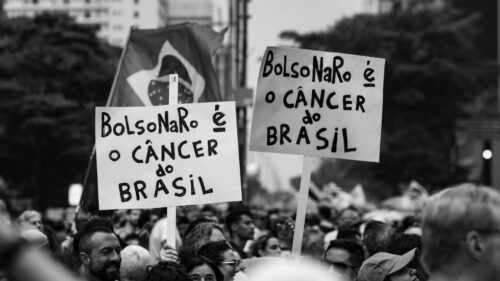
The Trial of Jair Bolsonaro: The Future of Brazilian Democracy
The Supreme Federal Court in Brazil judges former President Jair Bolsonaro and other officials accused of planning a coup and...
Trump’s Gordian Knot: Brazil is Under Threat Thanks to Bolsonaro and Big Tech Lobbying
US President Donald Trump has threatened to impose a 50% tariff on Brazilian exports unless Brazil grants amnesty to former...
Brazil, Football, God, Trump and Bolsonaro
US President Donald Trump has defended former Brazilian President Jair Bolsonaro as Brazil's top court weighs charges against the former...
Support Fair Observer
We rely on your support for our independence, diversity and quality.
For more than 10 years, Fair Observer has been free, fair and independent. No billionaire owns us, no advertisers control us. We are a reader-supported nonprofit. Unlike many other publications, we keep our content free for readers regardless of where they live or whether they can afford to pay. We have no paywalls and no ads.
In the post-truth era of fake news, echo chambers and filter bubbles, we publish a plurality of perspectives from around the world. Anyone can publish with us, but everyone goes through a rigorous editorial process. So, you get fact-checked, well-reasoned content instead of noise.
We publish 3,000+ voices from 90+ countries. We also conduct education and training programs
on subjects ranging from digital media and journalism to writing and critical thinking. This
doesn’t come cheap. Servers, editors, trainers and web developers cost
money.
Please consider supporting us on a regular basis as a recurring donor or a
sustaining member.
Will you support FO’s journalism?
We rely on your support for our independence, diversity and quality.





Comment