




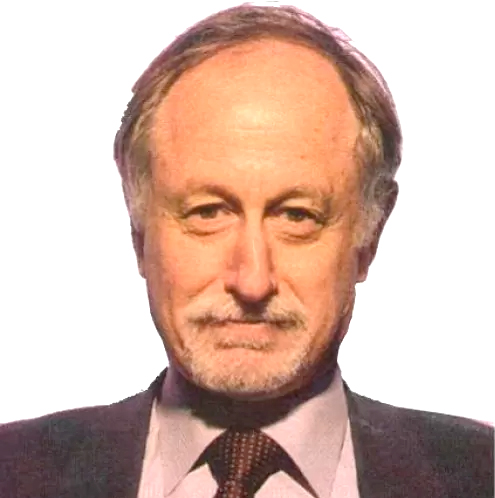
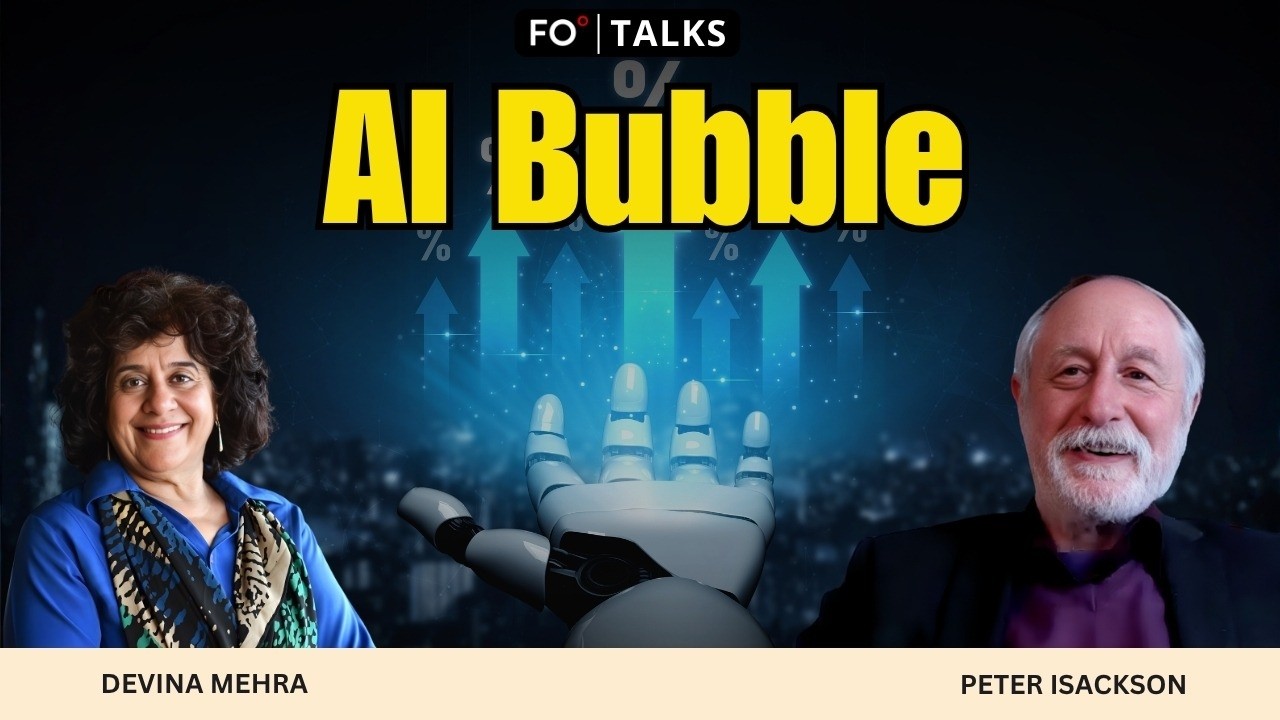
Fair Observer’s Chief Strategy Officer Peter Isackson and Devina Mehra, Founder and Chairperson of First Global, discuss whether artificial intelligence is creating a dangerous investment bubble. Mehra draws parallels between today’s AI boom and earlier periods of speculation, from the South Sea bubble to the dot-com crash and the rise of environmental, social and governance investing. She argues that transformative technologies can reshape society while still destroying investors’ wealth through overinvestment, debt and unrealistic valuations.
Why investors repeat their mistakes
Mehra says financial markets quickly forget their history. First Global expanded internationally in 1999, shortly before the dot-com crash, partly in response to the Asian financial crisis. Falling markets and currencies had produced dollar-denominated losses ranging from 50% in Taiwan to 90% in Indonesia. After the dot-com bubble burst, the Nasdaq took 15 years to surpass its peak from 2000.
Such episodes have not prevented investors from repeating familiar mistakes. Mehra compares enthusiasm for Elon Musk’s SpaceX with the South Sea bubble, in which Sir Isaac Newton lost much of his fortune in 1720. Newton initially recognized the bubble and sold his shares, but rising prices tempted him to buy back near the peak.
Investor psychology makes this pattern difficult to escape. Mehra cites research showing that depressed market sentiment often precedes above-average returns, while widespread optimism predicts weaker returns. Investors nevertheless tend to buy after prices rise and sell after they fall. As Mehra puts it, “Learning the numbers part in markets is the easy part; keeping control of your mind is always the harder part.”
Success stories hide widespread failure
Isackson asks whether modern investment has shifted from seeking profits to financing companies capable of dominating entire industries. Mehra accepts that network effects protect platforms such as YouTube and WhatsApp, but says this model does not apply to every business.
Venture capital has made funding widely available to companies seeking rapid expansion. However, its economics assumes that most investments will fail while a handful generate exceptional returns. Investors then remember Amazon, Apple and other survivors while forgetting the many companies that pursued similar strategies and collapsed.
Even today’s giants once faced severe uncertainty. First Global recommended Amazon in early 2001 after its improving cashflow reduced the threat of bankruptcy. Apple produced almost no return during its first 20 years as a public company, while its stock remained stagnant for years after Steve Jobs returned. Neither company’s later success was inevitable.
A revolutionary technology can be a terrible investment
Mehra believes AI may transform daily life, but transformation does not guarantee investment returns. Railways, automobiles, aviation and the Internet profoundly changed society while bankrupting numerous companies and investors.
AI hyperscalers now plan annual capital expenditure estimated at $800 billion to $1 trillion, compared with roughly $150 billion several years ago. Much of this money is flowing into semiconductors and data centers whose equipment depreciates rapidly. Unlike railways or undersea cables, obsolete computing hardware may have little recoverable value.
The economics of AI services also remain uncertain. Mehra notes that AI-assisted searches consume substantially more energy than conventional searches, while businesses have questioned whether advanced models justify their cost. Constant changes in leading models and regulatory restrictions create additional risks.
Circular finance and the next bubble
Isackson suggests that AI companies, semiconductor manufacturers and data center providers increasingly finance and purchase from one another. Mehra agrees that this circular structure is a characteristic of bubbles. A company may invest in another business that then uses the money to buy its products, creating reported revenue without proving sustainable external demand.
Debt increases the danger. Mehra says the AI expansion may have generated around $1 trillion in borrowing, including liabilities raised through smaller companies building facilities for major technology groups. Leverage can magnify gains during a boom but rapidly multiply losses when prices fall.
She compares AI enthusiasm with the earlier Environmental, Social and Governance (ESG) investment boom. Thousands of ESG funds later closed, merged or abandoned the label. Mehra argues that much of asset management is an “asset-gathering industry” that launches fashionable funds when public interest is near its peak, ensuring management fees while investors bear the losses.
Risks are rising, but timing is impossible
Mehra declines predicting whether the AI bubble will burst within months. Bubbles often continue longer than skeptics expect, while market shocks frequently come from risks investors have overlooked.
She nevertheless sees growing fragility in AI spending, corporate borrowing, leveraged semiconductor investments and illiquid private-credit funds. Simultaneously, market performance is already broadening beyond technology. Smaller companies and traditional industries have outperformed the S&P 500 this year, while several major technology stocks have weakened.
AI may revolutionize society without rewarding today’s most enthusiastic investors. For Mehra, the crucial distinction is between correctly identifying a transformative technology and paying a price that can produce sustainable returns.
[Lee Thompson-Kolar edited this piece.]
The views expressed in this article/video are the author’s own and do not necessarily reflect Fair Observer’s editorial policy.






























Comment