


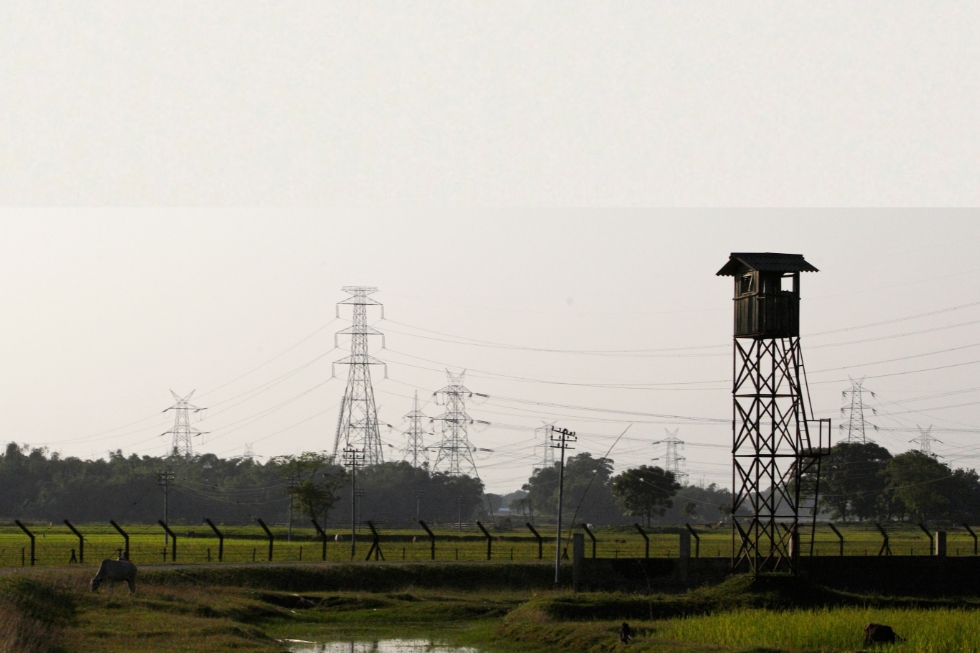



On 24 June, the Naogaon Battalion (16 BGB) of the Border Guard Bangladesh (BGB) prevented the Indian Border Security Force (BSF) from inserting nine individuals, including women and children, into Bangladeshi territory. This is the latest attempt by the BSF to conduct a “push-in” of people into Bangladesh, which has continued since early May 2025. “Push-in” refers to the process in which Indian border guards forcibly escort alleged Bangladeshi “infiltrators” living in India to the Indo-Bangladeshi border and expel them into Bangladeshi territory. It has strained diplomatic relations between Dhaka and New Delhi and has created an unmitigated humanitarian catastrophe for those who have been “pushed-in.”
Overview of the crisis
Irregular migration of Bangladeshi citizens to India has long been a source of friction between the two South Asian states and a highly sensitive political issue in the Indian internal political landscape. During the Bangladeshi War of Independence in 1971, approximately 9.9 million people from Bangladesh took shelter in India, but according to the UN and other international institutions, more than 9 million refugees returned to Bangladesh by February 1972.
The Indian government estimated that only 60,000 Bangladeshi refugees remained in India by March 25, 1972, adding that none of them would be allowed to stay in India permanently. However, many Indians, particularly in the border states of West Bengal, Assam and Tripura, continued to believe that most Bangladeshi refugees did not return in 1971–1972 and stayed in India, terming it a “demographic invasion.” Moreover, according to the Indian government, hundreds of thousands of Bangladeshis have irregularly immigrated to India since 1972, and as many as 20 million Bangladeshi irregular immigrants live in India.
However, these claims are factually incorrect and politically motivated. The UN, other international institutions and the Indian government have confirmed the repatriation of the overwhelming majority of the Bangladeshi refugees from India into Bangladesh in 1971–1972. Moreover, the Indian government has repeatedly admitted that it does not possess accurate data on the number of irregular immigrants from Bangladesh, thus making the claim about “20 million Bangladeshi immigrants” unverifiable and extremely suspect. In fact, irregular migration from Bangladesh to India occurs owing to a host of socioeconomic factors, but the number is much lower than the greatly exaggerated ones cited by Indian politicians without evidence.
Notwithstanding the reality on the ground, many Indian political organizations and media outlets have turned the issue of irregular migration from Bangladesh into a core political concern, and anti-immigrant and anti-Bangladeshi sentiments have been neatly incorporated into the Hindu nationalist and Islamophobic rhetoric of the ruling Bharatiya Janata Party (BJP).
For instance, in September 2022, Indian Minister of Home Affairs Amit Shah likened irregular Bangladeshi immigrants to “termites” during a public meeting in New Delhi and an electoral rally in Rajasthan. In September 2024, he promised to “hang every Bangladeshi infiltrator upside down” during an electoral rally in Jharkhand. In February 2026, the official social media account of the BJP published a video clip titled “Point Blank Shot,” in which Chief Minister of Assam Himanta Biswa Sarma appeared to fire at the images of two Muslim men, overlaid with the phrases “No Mercy” and “Foreigner Free Assam.”
This dehumanizing rhetoric about irregular Bangladeshi immigrants has been complemented by the expulsion of thousands of alleged Bangladeshi immigrants from India since May 2025. The “push-in” serves two purposes for the BJP-led Indian government: It boosts the BJP’s popularity and credibility among its support base and simultaneously exerts pressure on Bangladesh. However, these “push-ins” have created a humanitarian disaster for the victims, as Bangladesh refuses to accept them and they are often stranded in the “no man’s land” between Bangladesh and India.
International legal perspective on push-in
Under international law, states have the sovereign right to regulate the presence of foreigners on their territory and to expel irregular immigrants. However, the process of the expulsion of irregular immigrants should follow due procedures stipulated by international human rights law, and India’s actions are largely inconsistent with them.
For instance, according to Article 22 of the 1990 International Convention on the Protection of the Rights of All Migrant Workers and Members of Their Families, migrant workers and members of their families must not be subjected to collective expulsion, and each case of expulsion should be examined and decided individually. Similarly, according to Article 4 of Protocol No. 4 to the 1950 European Convention on Human Rights, Article 22 of the 1969 American Convention on Human Rights, and Article 12 of the 1981 African Charter on Human and Peoples’ Rights, the collective expulsion of aliens or non-nationals is prohibited. In the case of “push-ins” from India to Bangladesh, the alleged “Bangladeshi immigrants” are collectively and arbitrarily expelled into the “no man’s land” without any due process. This constitutes a serious violation of international law.
Moreover, Article 23 of the Convention on the Protection of the Rights of All Migrant Workers posits that in cases of expulsion, migrants have the right to seek protection and assistance from the diplomatic and consular missions of their country of origin. However, this procedure is not followed for “push-ins.” The alleged Bangladeshi immigrants are not allowed to seek assistance from Bangladeshi diplomatic missions in India. Instead, they are arbitrarily expelled from Indian territory. This contravenes the rights of the alleged immigrants.
In many cases, the persons expelled from India are in fact not Bangladeshi citizens, but rather Indian citizens who happen to be Bengali Muslims. For instance, in a recent incident, people with Indian Aadhaar cards were pushed by the BSF into the “no man’s land.” In another incident, an Indian woman and her two minor children were reportedly deported to Bangladesh after she failed to pay a bribe to the BSF. This is not only a violation of Indian law but also of international law. According to Article 12(4) of the 1966 International Covenant on Civil and Political Rights (ICCPR), Article 3(1) of the Protocol No. 4 of the European Convention on Human Rights and Article 22(5) of the American Convention on Human Rights, a state must not expel its own citizens. Hence, the expulsion of Indian citizens into Bangladesh contravenes international law.
It should be noted that India is a party to the ICCPR but not to the other aforementioned international treaties. So, unless an international court imposes penalties on India for violations of the ICCPR (which is very unlikely), it cannot be held accountable for its “push-in” policy. This emboldens India to pursue this policy with impunity. Still, as a member of the international community, it is duty-bound to adhere to established international norms. So, by collectively expelling alleged Bangladeshi irregular immigrants, some of whom are Indian citizens, New Delhi is condoning a serious violation of international human rights law.
The way forward
The ongoing “push-in” of alleged Bangladeshi migrants by India has transformed a long-standing migration dispute into a serious humanitarian and legal crisis. While every sovereign state has the right to regulate irregular migration and remove foreign nationals in accordance with its domestic laws, such actions must comply with established norms and principles of international human rights law, including due process, individual determination of nationality and protection against arbitrary or collective expulsion.
Reports indicating that Indian citizens have also been expelled across the border raise additional concerns regarding violations of both Indian constitutional guarantees and international legal norms protecting the right to enter one’s own country. Beyond its legal implications, the continuation of these practices risks further eroding bilateral trust between Bangladesh and India, undermining border stability and exposing vulnerable individuals — including women and children — to prolonged insecurity.
A cooperative, rules-based approach remains essential to addressing irregular migration while safeguarding human dignity and preserving constructive bilateral relations. Bangladesh and India should establish a transparent joint verification mechanism to determine nationality before any repatriation, ensuring that all removals comply with due process and internationally recognized human rights standards. In particular, Indian institutions, including its national and state legislatures, should investigate the cases in which Indian citizens have been deported to Bangladesh. Moreover, Dhaka and New Delhi should strengthen diplomatic coordination and border-level communication to facilitate orderly repatriation, prevent humanitarian crises in border areas and avoid unilateral actions that could escalate bilateral tensions.
[Patrick Bodovitz edited this piece]
The views expressed in this article are the author’s own and do not necessarily reflect Fair Observer’s editorial policy.
From Reflection to Action: A Mandate for Protection, Peace and Displaced-Led Solutions
World Refugee Day came and went this year, but that does not mean we should forget its importance and keep...
Property Dispossession and the Exodus of Hindus in Bangladesh
The enduring injustice of property dispossession and the failure to ensure effective restitution more than five decades after independence call...
Full Compartmentalization in Indo–Bangladeshi Relations?
Following Bangladesh’s 2024 political transition, ties with India weakened due to visa, trade and diplomatic strains, alongside hostile media. However,...

Support Fair Observer
We rely on your support for our independence, diversity and quality.
For more than 10 years, Fair Observer has been free, fair and independent. No billionaire owns us, no advertisers control us. We are a reader-supported nonprofit. Unlike many other publications, we keep our content free for readers regardless of where they live or whether they can afford to pay. We have no paywalls and no ads.
In the post-truth era of fake news, echo chambers and filter bubbles, we publish a plurality of perspectives from around the world. Anyone can publish with us, but everyone goes through a rigorous editorial process. So, you get fact-checked, well-reasoned content instead of noise.
We publish 3,000+ voices from 90+ countries. We also conduct education and training programs
on subjects ranging from digital media and journalism to writing and critical thinking. This
doesn’t come cheap. Servers, editors, trainers and web developers cost
money.
Please consider supporting us on a regular basis as a recurring donor or a
sustaining member.
Will you support FO’s journalism?
We rely on your support for our independence, diversity and quality.





Comment