

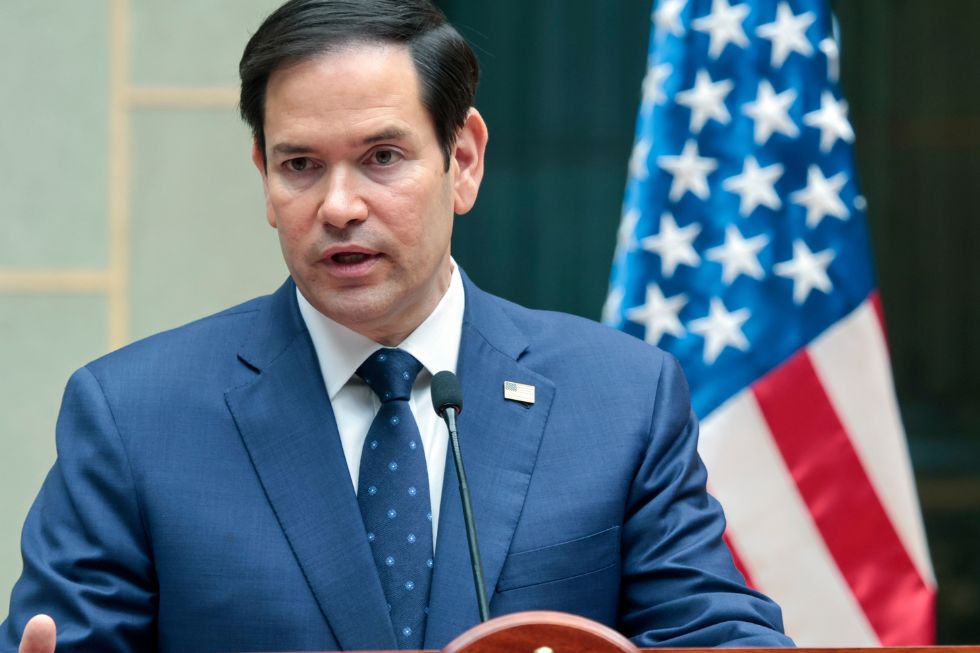



US Secretary of State Marco Rubio landed in Kolkata on the morning of May 23. Bypassing the usual trade officials and military attaches, he traveled straight to the Mother House, the headquarters of the Missionaries of Charity, accompanied by US Ambassador Sergio Gor. He spent an hour paying his respects at the tomb of Saint Mother Teresa before touring the nearby Nirmala Shishu Bhavan orphanage. His arrival ended a 14-year gap since a US secretary visited the city, dating back to Secretary of State Hillary Clinton in 2012.
Diplomatic itineraries communicate exactly what a government considers most important. By opening his very first visit to India at a foreign-funded religious organization facing regulatory scrutiny, Rubio elevated the operational freedom of a Catholic charity above standard statecraft. He did so hours before heading to New Delhi for critical Quad meetings. This deliberate choice immediately reignited the intense international debate surrounding India’s Foreign Contribution Regulation Act (FCRA).
The FCRA is an Indian law enacted to regulate the acceptance and utilization of foreign funds or hospitality by individuals, associations and companies. Administered by the Ministry of Home Affairs, it ensures that foreign contributions do not adversely affect the national interest, elections, or democratic values.
The core contradiction lies in how the United States treats religion at home versus abroad. The US government strictly bars itself from funding, endorsing or entangling its operations with religion domestically. The First Amendment Establishment Clause — a provision in the US Constitution that prohibits the government from establishing any official national religion or from providing funding or official support to any particular religion — is explicit and vigorously enforced. Yet the United States simultaneously operates a statutory foreign policy apparatus whose entire purpose is to advocate for religious organizations inside the jurisdictions of other nations.
Secularism is strictly a domestic rule. It does not cross the border. When that extraterritorial religious advocacy collides directly with India’s sovereign right to police foreign capital flows under the FCRA, it hits a solid wall. No diplomatic visit changes this reality. The Supreme Court of India has already upheld the provisions of the FCRA in Noel Harper v Union of India.
The domestic wall
The Establishment Clause has generated over two centuries of jurisprudence insisting the American state stay out of religious affairs. The government cannot fund a church, endorse a faith or grant religious actors special exemptions from laws binding every other citizen. The Supreme Court made this clear in the 1990 ruling of Employment Division v. Smith. If a law is neutral and generally applicable, religious organizations must comply without exception. No amount of sincere belief earns an automatic exemption from civil law.
Some legal scholars argue that recent decisions have shifted toward structural preferentialism, in which religious groups occasionally win exemptions from regulatory burdens they find inconvenient. But the foundational rule remains intact. The federal government has no business funding religious expansionism within its borders. The Internal Revenue Service (IRS) scrutinizes domestic non-profit groups, religious or secular, without apologies.
Where that wall ends
That rule abruptly stops at the coastline. In 1998, President Bill Clinton signed the International Religious Freedom Act (IRFA). This legislation did something the Establishment Clause explicitly forbids domestically by making the US government an institutional champion of religion abroad. The law created the Ambassador at Large for International Religious Freedom. It mandated annual State Department reports grading every country on its treatment of religious groups. It empowered the formal designation of Countries of Particular Concern and imposed severe economic sanctions on those designated. The American state now runs a taxpayer-funded bureaucracy dedicated to monitoring religious conditions inside sovereign nations and pressing those nations to alter their internal laws.
The contradiction is massive. Domestically, the Establishment Clause exists precisely to stop the government from taking sides on religious questions. Internationally, this legislation requires the government to take sides constantly, globally and at considerable taxpayer expense.
When US asylum adjudicators evaluate religious persecution claims, they must actively assess whether an applicant holds a sincere faith, and may allow religious organizations to certify the applicant’s faith on behalf of the state. The secular state begins functioning like a church. The legal scholars who have identified this pattern domestically have not fully accounted for how aggressively the same logic operates when American foreign policy targets countries like India.
The State Department has criticized India’s financial compliance laws for years. Their recent reports specifically flagged the rule capping the administrative use of foreign funds at 20% and the absolute ban on subgranting as major impediments to religious operations. US Embassy officials regularly press Indian parliamentarians on the operating conditions for faith-based groups. US Representative Chris Smith published a detailed opinion piece in the Washington Examiner just before Rubio arrived in Kolkata. He strongly urged the State Department to pressure New Delhi over proposed FCRA amendments tabled for the upcoming Monsoon Session of Parliament.
Smith warned the amendments would allow immediate asset seizures over minor accounting errors, including the potential nationalization of entire dioceses based on a single small foreign donation processed incorrectly. He compared the provisions to communist expropriation of churches in Russia and China. This reflects a consistent pattern where American lawmakers read Indian financial compliance law entirely through the lens of religious persecution, stripping it completely of its domestic regulatory logic. The exact same US government demanding India loosen its strict controls on foreign-funded charities makes no equivalent demand of its own tax agencies.
A law older than the IRFA
India has regulated foreign contributions since 1976, when Parliament enacted the FCRA during the Emergency period. The exact origins of the law matter tremendously because they prove it is not a recent political invention or a malicious scheme targeting a specific community. It reflects a durable, cross-party judgment about the severe risks posed by unaccountable foreign money operating within domestic civil society.
Successive governments across decades have only tightened these regulations. The 2010 Act repealed and replaced the original statute, and the 2020 amendments went much further still. Parliament passed them in September 2020 within days of introduction.
Three specific changes defined the entire overhaul. Section seven bans subgranting entirely. An organization receiving foreign funds cannot pass them to another entity under any circumstances whatsoever. Section 12A requires passport or national identity details for every director and key functionary of any registered organization, effectively eliminating the anonymity that allowed shell directorships to evade financial accountability for years. The amended sections also require that all foreign contributions enter India through a single designated account at the State Bank of India’s main branch in New Delhi before being disbursed elsewhere. The state gets a single, real-time view of all incoming foreign capital without freezing how those organizations spend it domestically.
These strict rules apply to absolutely everyone. Oxfam India lost its operating license. So did Jamia Millia Islamia, a prominent Muslim university. The Tuberculosis Association of India faced the exact same consequence. The law draws no legal distinctions based on faith, ideology or social purpose.
The constitutional challenge against these changes arrived quickly. Noel Harper and Nigel Mills, trustees of the Care and Share Charitable Trust, joined by several other non-profit representatives, filed writ petitions arguing the amendments violated basic constitutional rights. They claimed the new laws infringed upon the right to equality, freedom of association, freedom of profession and personal liberty guaranteed under the Indian Constitution.
On April 8, 2022, a three-judge bench led by Justice A.M. Khanwilkar, alongside Justices Dinesh Maheshwari and C.T. Ravikumar, upheld the amendments in their absolute entirety in the case of Noel Harper v. Union of India. The final judgment ran to 132 pages. Its central holding was extremely direct. No citizen or entity holds a fundamental right to receive foreign contributions, and protections covering the freedom to form associations do not extend to an unconditional entitlement to fund those associations with foreign money.
The state holds a legitimate interest in tracking foreign capital for national security and public order, falling squarely within the permissible restrictions the Constitution already recognizes. The Court applied the proportionality standard from the famous privacy judgment and found the amendments passed easily. The bench noted in passing that India’s domestic development goals should rest on the hard work of its own citizens rather than perpetual foreign dependency. Critics argued the judgment framed the legal dispute strictly from the government’s vantage point, severely underweighting civil liberties. That critique deserves serious engagement, but it does not alter the absolute legal position as it stands today.
What the numbers actually show
American critics constantly point to Ministry of Home Affairs data from January 2022 to prove discrimination. That data showed that out of the 2,257 religious category groups whose certificates lapsed, 1,626 were Christian organizations, accounting for roughly 72%. Hindu groups accounted for about 11%, and Muslim groups roughly 8%. American critics treat this statistical disparity as undeniable proof of targeted discrimination, but it is not. It only proves that Christian charities operating in India had built the most complex, multi-layered foreign-funding networks in the country.
Drawing massive sums from American donors, European churches and wealthy Vatican-connected foundations, these operations were vast and highly complex. They were naturally the most exposed when the state centralized entry accounts, banned subgranting and imposed strict individual biometric accountability on directors. A tighter regulatory net naturally catches the biggest fish. The entities with the highest levels of opacity simply faced the highest levels of structural disruption.
The asset question
Representative Smith issued a strong warning about the proposed asset vesting provisions, and that specific point deserves a direct answer. When a private entity builds large hospitals, schools or orphanages using foreign capital received under a highly conditional sovereign license, and that license is later canceled for clear statutory violations, the state faces a totally legitimate question. What exactly happens to valuable assets funded by money that entered the country under a now voided legal authorization? Appointing a custodial authority over those frozen assets represents standard administrative law, not an act of communist expropriation.
The United States Treasury routinely seizes and freezes the assets of foreign entities that violate American financial regulations, including sanctions law and counterterrorism financing rules. They do this aggressively without anyone calling the American government communist. India’s proposed legal mechanism operates identically in both structure and fundamental purpose.
What the visit changed
Rubio arriving in Kolkata changed absolutely nothing as a matter of actual law. The highly publicized visit generated international headlines and clearly signaled to American domestic constituencies that the State Department closely monitors global Christian communities. That is exactly the domestic political function the International Religious Freedom Act serves. But the Supreme Court ruling remains totally binding. The regulations are entirely constitutional. India owes absolutely no sovereign explanation to Washington for strictly enforcing a financial statute its own highest court has already thoroughly validated.
The United States cannot maintain a massive contradiction indefinitely. It cannot enforce a strict domestic constitutional rule that completely insulates public life from religious advocacy while simultaneously running a foreign policy apparatus that aggressively deploys massive state resources to advance that advocacy abroad. That enormous gap between what the First Amendment demands at home and what American diplomats demand abroad is not just a minor policy disagreement. It is a massive structural inconsistency that no quick diplomatic visit to Kolkata or New Delhi will ever resolve.
The views expressed in this article are the author’s own and do not necessarily reflect Fair Observer’s editorial policy.







Join the conversation
Share your perspective
Log in to share your thoughts and take part in the discussion.