


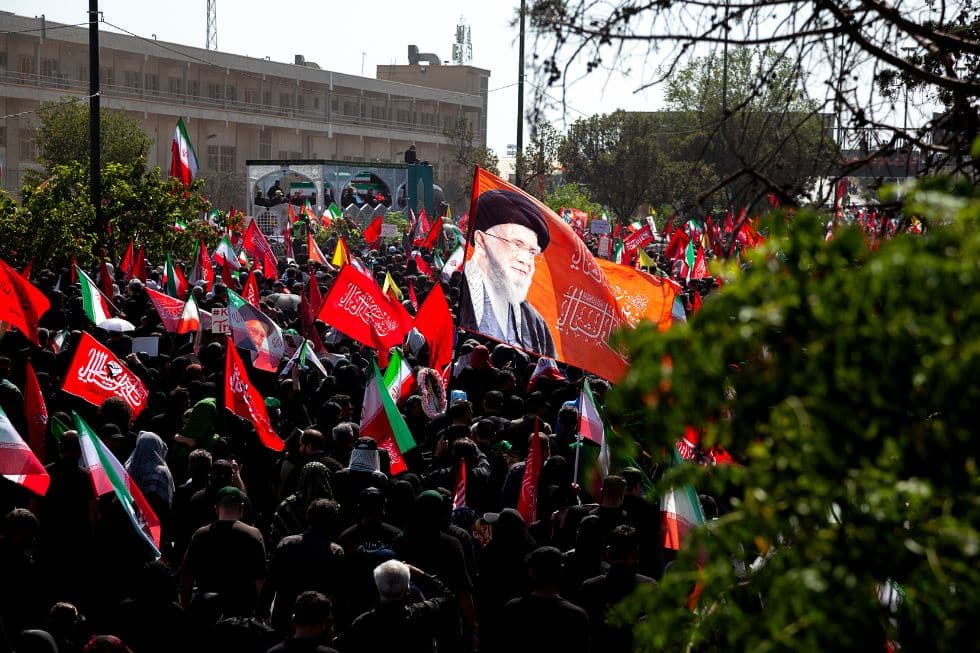



The state funeral for Ali Khamenei was never just a funeral. It was a choreographed act of political messaging designed to show that the Islamic Republic could absorb the death of its supreme leader and still project discipline, continuity and reach. The ceremony was also used to signal defiance toward the United States and Israel through a show of wartime endurance.
The most important question, however, is not about the ceremony itself. It is political: What kind of order is emerging after Khamenei, and who gets to define it?
What the crowds do — and do not — prove
The scenes of massive crowds in Tehran and Najaf, Iraq show that the Islamic Republic is still capable of mobilizing a large social base. That should not be dismissed. While many say the turnout reflected a mixture of grief, loyalty and political mobilization, others warn against reading the crowds as simple proof of public consensus.
That caution is essential. In authoritarian systems, mass participation can be genuine and instrumental at the same time. Some mourners may have been there out of religious conviction. Others may have seen the event as an expression of national dignity after war. Still others may have attended because the state expected them to. None of those motives cancel the others out.
The point is that crowd size does not settle the political argument. A funeral can show a social base, but not necessarily a stable mandate for the future. The regime may still be able to mobilize emotion, but it cannot assume that emotion translates into consent for whatever follows.
There is also an economic layer that is less visible and more durable. A confrontation economy does not disappear when a leader dies. It survives in ministries, military networks, sanctions workarounds, procurement channels and political habits. It survives because some actors profit from opacity and from the concentration of power that crisis enables.
That is why any serious analysis of post-Khamenei Iran has to look not only at personalities, but also at institutions and incentives. The hardline ecosystem is best understood not as a collection of loud voices, but as a political network that has long thrived on permanent confrontation, ideological discipline and the narrowing of the state’s internal debate.
The point is, confrontation gives several different camps something valuable at once: ideological coherence, institutional leverage and the ability to justify tighter control at home and beyond.
Najaf and the regionalization of mourning
What gives the ceremony its wider significance is the way it moved beyond Iran’s borders. The coffin arrived in Najaf, Iraq, where Iraqi Prime Minister Ali al-Zaidi, Iranian President Masoud Pezeshkian and various Shi’ite religious figures took part in the mourning events. Displaying the coffin in Iraq was purposeful. It placed the funeral inside a broader Shi’ite and regional political space, not just an Iranian one.
By turning the burial into a transnational ritual, Tehran signaled that Khamenei’s legacy would be framed as part of a larger axis of resistance, stretching from Iran to Iraq and beyond. The Islamic Republic has long used religious choreography to create political meaning. However, in moments of crisis, the ritual layer is never separate from the strategic layer. It is the strategic layer.
This regional dimension is especially important because Iran is simultaneously trying to convert post-war survival into diplomatic leverage. Tehran wants to secure recognition of its dominance over the Strait of Hormuz, a move that turns geography into bargaining power. The strait handles around one-fifth of the world’s oil transit, which means any disruption quickly becomes a global issue. There have been reports of attacks and incidents involving commercial vessels near the strait, while oil prices have reportedly risen in response to the renewed fears of disruption.
This shows how quickly a domestic transition in Tehran can become a maritime security issue for the Gulf and countries beyond the region. In that sense, the funeral was not only an Iranian event. It was also a marker of a region entering a more volatile equilibrium.
A performance of continuity
That is why, in a system built around clerical authority, security institutions and managed ritual, a funeral can be both a show of unity and a window into unresolved bargaining. That is also why the absence of Mojtaba Khamenei, Ali Khamenei’s son and possible successor, from his own father’s funeral sharpened speculation about the next phase of Iranian leadership.
Absence, in Iran’s political culture, is never empty. When authority depends on loyalties and symbolic legitimacy rather than a clean constitutional procedure, what is missing can be as revealing as what is displayed. The funeral therefore says less about religious closure than about how the state manages uncertainty. The funeral was a crucial test for the theocratic regime precisely because it has to demonstrate unity after years of unrest and conflict.
The regime’s problem is that unity on the street does not necessarily equal unity inside the elite. That is why the funeral should be read as the opening scene of a new competition over power. At least three contests are now underway. First, there is the struggle over succession: Who gets to speak for continuity? Second, there is the debate over strategy: Does the Islamic Republic seek consolidation through limited pragmatism, or through continued confrontation? Third, there is the battle over narrative: Will Khamenei’s death be framed as a martyrdom that legitimizes harder rule, or as a strategic shock that forces adaptation?
Hardliners have every reason to push the martyrdom narrative. For factions that define themselves through resistance to the West, the funeral offers an opportunity to reassert ideological confidence. But ideology alone does not explain the timing. Confrontation also creates power. A state under siege tends to centralize authority, narrow political space and privilege actors who can claim to protect the nation from external pressure.
The inheritance problem
The deeper issue is what any successor in a situation such as this one would inherit. It would not be a clean slate, but a state stressed by war, pressure, protest and economic exhaustion. The next power center will have to manage a society that has been fragmented by repression and conflict while also preventing the security state from becoming visibly disjointed.
That creates a narrow and unstable set of options. A more pragmatic leadership could try to re-open parts of the economy, reduce international pressure and slow the confrontation cycle. But a hardline leadership would likely argue that the safest response to uncertainty is discipline: tighter control, more ideological coherence and fewer openings for domestic challenge.
A transition of this scale will be led by whichever camp can convince the public that it can maintain stability and keep the machinery running the best. In Iran, that machinery includes the clerical hierarchy, the IRGC, the judiciary, politically connected technocrats and the media ecosystem that frames legitimacy for the public.
That is where the importance of figures such as Mahmoud Nabavian and Saeed Jalili comes in. Nabavian, an Iranian MP, is a hardliner who publicly denounced the US–Iran deal. He was recently voted out of Iran’s National Security and Foreign Policy Committee. Jalili, a fundamentalist political figure and former nuclear negotiator, has run for the Iranian presidential position three times. Both personify a political culture in which anti-Western posture, internal discipline and suspicion of compromise reinforce one another.
Seen from that angle, the funeral can be considered a rehearsal for post-Khamenei politics. It showed which symbols still move people, which institutions can mobilize quickly and which narratives remain powerful enough to override uncertainty. Those are the ingredients of succession politics, not just for a country in mourning.
The hardline coalition and the logic of permanent tension
The funeral also exposed an older pattern in Iranian politics: the way hardline factions convert external confrontation into internal authority. Figures associated with the Paydari Front, a fundamentalist faction, and parliamentary hardliners such as Mahmoud Nabavian, do not simply oppose compromise as a matter of taste. They operate in a political environment where resistance to the West has become a source of status, access and influence.
That helps explain why the dispute over foreign policy is inseparable from disputes over domestic control. The same state apparatus that insists on ideological conformity abroad also polices social behavior at home, from internet access to public morality. A system that presents itself as under siege usually claims the right to discipline society more aggressively.
In that sense, the post-funeral moment is about who benefits from keeping the political temperature high. For some actors, permanent tension provides the conditions for bureaucratic promotion, media influence and security prerogative. For others, it creates the atmosphere in which dissent becomes easier to stigmatize and harder to organize.
Currently, Saeed Jalili represents the clearest ideological version of that world: a politics that treats compromise as weakness and sanctions as proof of moral consistency. Whether or not his camp captures the succession process, the logic it embodies is already visible in the funeral’s broader messaging. It asks the public to read hardship as sacrifice and sacrifice as legitimacy.
That logic matters because it narrows the set of policy choices available to the state. A leadership transition could, in theory, open space for pragmatic adjustment. But if the most influential factions define survival as deeper discipline, then the transition becomes a reason to harden, not soften, the system.
The result is a familiar Iranian paradox. The state needs tactical flexibility to avoid isolation, yet many of its most powerful internal actors are rewarded by rigidity. A funeral can temporarily mask that contradiction. However, it cannot resolve it. The broader warning is that a leadership transition in Tehran rarely produces calm. It can produce opportunism, because rival power centers try to prove their relevance. It can produce rigidity, because hardliners are often strongest in periods of uncertainty. And it can produce escalation, because Iran has repeatedly used regional pressure to strengthen its hand at home.
Whether that effort succeeds will depend on the elite bargain that follows, the regional pressure that continues and the extent to which Iranian society still accepts the terms of a system that asks it to mourn in public while power is renegotiated in private. For now, the most important lesson is that the funeral did not settle Iran’s future. It only made the struggle for it impossible to ignore.
[Cheyenne Torres edited this piece.]
The views expressed in this article are the author’s own and do not necessarily reflect Fair Observer’s editorial policy.
FO Talks: What the Domestic Situation in Iran Tells Us About the War
In this episode of FO Talks, Luke De Cresce and Mehdi Alavi examine how the ongoing war has reshaped Iran’s...
The Internet as a Tool of Wartime Governance in Iran
Iran has begun gradually restoring online access after the state imposed an 88-day internet blackout. However, Iran’s case raises questions...
Gender, Nuclear Weapons and Repression: The Complex Case of Iran
The international concerns about Iran’s nuclear ambitions and the repression of women’s rights, especially after Mahsa Amini's death, are profound....
Support Fair Observer
We rely on your support for our independence, diversity and quality.
For more than 10 years, Fair Observer has been free, fair and independent. No billionaire owns us, no advertisers control us. We are a reader-supported nonprofit. Unlike many other publications, we keep our content free for readers regardless of where they live or whether they can afford to pay. We have no paywalls and no ads.
In the post-truth era of fake news, echo chambers and filter bubbles, we publish a plurality of perspectives from around the world. Anyone can publish with us, but everyone goes through a rigorous editorial process. So, you get fact-checked, well-reasoned content instead of noise.
We publish 3,000+ voices from 90+ countries. We also conduct education and training programs
on subjects ranging from digital media and journalism to writing and critical thinking. This
doesn’t come cheap. Servers, editors, trainers and web developers cost
money.
Please consider supporting us on a regular basis as a recurring donor or a
sustaining member.
Will you support FO’s journalism?
We rely on your support for our independence, diversity and quality.





Comment