


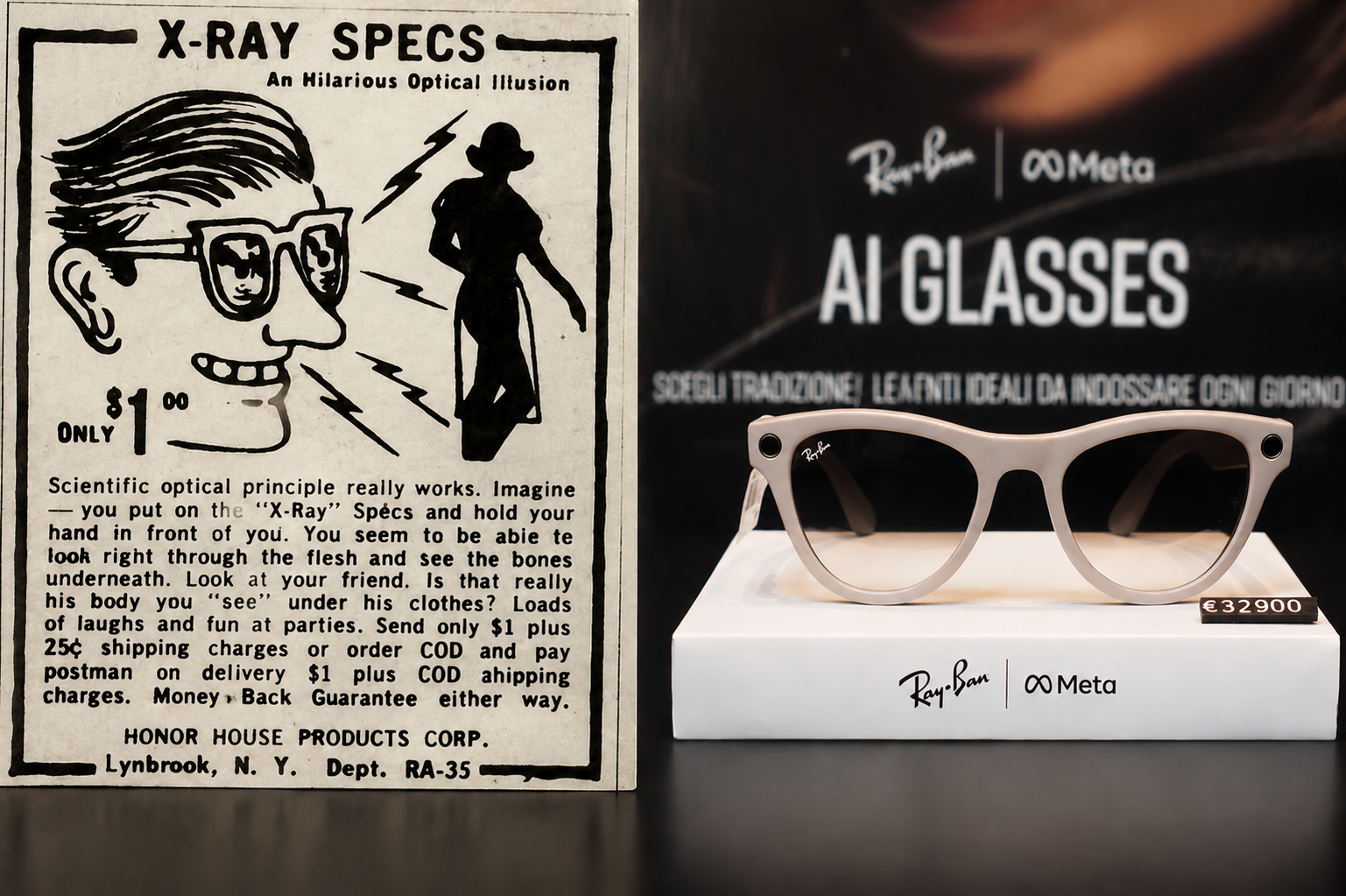


In the 1950s, mail-order advertisements offered an extraordinary invention: X-Ray Specs. For only a dollar, customers could acquire “scientific optical principles” that appeared to allow them to see through flesh and clothing. The product ad typically sat next to ads for stink bombs and itching powder. This novelty product touted absurd claims, but a profoundly human fantasy backed the joke: the desire to see and, by implication, know what others could not.
Seven decades later, that fantasy has acquired a far more sophisticated technological form. Today’s smart glasses promise not to reveal skeletons beneath clothing but something arguably more valuable: information. They extend human perception beyond the limits of ordinary eyesight by identifying objects, translating foreign languages in real time, answering spoken questions, recording photographs and video from the wearer’s point of view and allowing users to search the Internet without reaching for a phone. The original X-Ray Specs never worked. Meta’s reimagined versions actually do.
Earlier this year, Meta, the owner of Facebook and other online platforms, recruited influencer par excellence Kylie Jenner to help promote Meta Glasses marketed as the Starfire Kylie Edition, retailing for about $500. These are very much not the reading glasses sold in packs of three at Walmart. Embedded in the frames are cameras, microphones, speakers and Meta’s AI assistant. The wearer can photograph or film almost everything they see; livestream events from a first-person perspective; ask the glasses questions about nearby buildings, landmarks or products; receive spoken answers; translate conversations between languages; make phone calls; listen to music and, increasingly, rely on the glasses as a 24/7 digital companion. Meta’s ambition is transparent: to shift artificial intelligence from something we consult on a screen to something we wear on our faces that makes us look cool in the process.
The AI eyewear has been available since 2023 and Meta already shares a market that’s bound to become congested over the next year or so. Google, Apple and Alibaba, among others, are preparing to launch their own versions. But Meta has stolen a lead and, last year, sold seven million pairs. The acquisition of Jenner, who has over 380 million followers on Instagram (owned by — guess who — Meta) discloses methods in Meta owner Mark Zuckerberg’s apparent madness: Jenner, whom Forbes named the youngest “self-made” billionaire in 2019, is arguably the most prodigious purveyor of fine goods in her family, probably edging out Kim in recent years. She pitches for, inter alia, adidas, Miu Miu and Jean Paul Gaultier.
She may yet turn Meta’s glasses into the most coveted consumer gadget since Apple’s iPhone X, whose launch in 2017 prompted overnight queues around the world despite its then humongous $999 price tag.
Sharing as a marketing
But there is a snag: The glasses render the wearer capable of seeing more than others know they are involuntarily revealing. So, the technology brings an obvious potential for invading personal space. The instant the wearer puts on the glasses, they acquire the capacity to intrude into others’ privacy without their knowledge. They can access all manner of data about the person or thing they’re looking at. And their subject won’t have a clue. Understandably, this piques many.
The New Zealand singer Lorde is one of them. She interrupted her performance at a recent concert in Madrid with an unexpected aside. “Increasingly, in our world, it gets harder and harder to know what is real,” she told the crowd. “Can I just say, for the record, f*** the glasses! Don’t get the glasses. Not sexy.”
Lorde is unlikely to remain alone. Some public figures will almost certainly voice similar objections, though others — if recent history is any guide — have built fortunes by turning disclosure into a business model. The issue isn’t that celebrities don’t mind sharing; it’s that many have made a good living by strategically baring themselves, or at least their souls.
Self-disclosure
In fact, anyone who cares to study cultural changes since the emergence of reality television, social media and the smartphone will know that privacy is not what it used to be. What we now call celebrity culture is predicated on the near disappearance of what once passed for privacy. Jenner herself personifies this: She is part of the Kardashians, on par with the Windsors in terms of global renown (and perhaps the Borgias, if we seek a historical perspective). The Kardashian–Jenner dynasty is unusual because its principal commodity is neither music, sport nor politics, but visibility itself. Sharing — not in the sense of generosity but of relentless self-disclosure — became both the product and the marketing strategy of the family.
Anyone with aspirations in showbusiness, politics or any field of endeavor that requires public approval needs to accept that they’ll have to surrender a large degree of their privacy. In that sense, Meta’s glasses are entirely consistent with the cultural trajectory of the 21st century. They don’t inaugurate the end of privacy so much as extend a process already well under way. Social media encouraged us to narrate our lives; smartphones encouraged us to record them; AI glasses promise to make recording continuous and almost effortless. Lorde’s objection is less to one new gadget than to the entire direction of travel itself.
Of course, privacy has not vanished. It has been renegotiated. Many readers will gladly post photos of themselves, family, pets and friends even in embarrassing situations on social media. They might also vent online — perhaps even abusively — expressing their opinions, revealing their values and opening up about their personal ambitions. But they probably wouldn’t welcome a stranger wearing AI glasses capable of recording them, analyzing what they see and, before long, identifying who they are and retrieving publicly available information about them. The fear is less about today’s technology than about tomorrow’s.
Recording Ray-Bans
Many readers will already be wondering about the implications of the AI-driven eyewear for women. Upskirting (taking photos or videos under someone’s clothing without their consent) has been illegal in the United Kingdom since 2019; in the United States, state-level legislation varies, but it is a criminal form of sexual harassment. AI eyewear is not designed to facilitate this type of voyeurism, but it creates the possibility of equally discomforting kinds of intrusion.
Meta’s glasses contain an LED that illuminates when the wearer is recording, though this may not satisfy everyone and, in any case, may not be noticeable in bright daylight. While millions have sold, how many people are aware of the potential of this piece of technology? Everyone knows about how today’s smartphone can do much, much more than facilitate a conversation. Most people realize that their TV sets are like computers capable of picking up signals, lawfully and unlawfully, from anywhere in the world. But would they suspect the person they’re talking to who happens to be wearing stylish Ray-Bans is recording them? And soon, not only recording them, but assembling copious information about them?
Five years from now, when the technology has progressed, most people will have assimilated the concept that their already limited privacy has been denuded. But privacy is one thing; personal safety is another. Women will wonder if potential predators will find the eyewear a boon.
Do we have the right to privacy?
Yet concentrating solely on women’s safety risks obscuring a larger question. AI eyewear does not simply introduce another opportunity for harassment; it forces us to reconsider what privacy means in an age when recording, searching and sharing have become ordinary social practices. The technology merely compresses into a pair of spectacles capabilities that already exist in smartphones. What changes is not the possibility of surveillance but its invisibility. We may soon reach the point where we no longer know whether the person looking at us is merely looking or simultaneously recording, identifying and retrieving information about us.
This suggests a deeper philosophical question. Do we still possess a meaningful right to privacy in a culture that increasingly rewards disclosure? Every day we volunteer fragments of ourselves: photographs, locations, purchases, opinions, friendships and routines. Social media encourages us to share; AI promises to organize and interpret what has been shared. What a jarring contradiction! We demand privacy while participating enthusiastically in systems that erode it.
Perhaps this isn’t the disappearance of privacy so much as another stage in its evolution. Every communications revolution, from photography and portable cameras to smartphones and social media, has forced societies to redraw the boundary between what’s public and what’s private. AI eyewear represents the next step in that historical process. We can’t wish it away any more than we can wave a magic wand and make AI itself disappear. Like it or not, our expectations of others, our sense of self and our understanding of the anatomy of privacy will have to adapt.
[Ellis Cashmore is the author of Celebrity Culture.]
[Lee Thompson-Kolar edited this piece.]
The views expressed in this article are the author’s own and do not necessarily reflect Fair Observer’s editorial policy.
You Don’t Need Data Centers to Win the AI Race
The standard framing of the AI race as a two-way contest between the US and China misses a third competitor...

Mediaphobia — A Timeline of Panic
We never welcome new media with open arms, but with suspicion or trepidation. New media changes not just how we...

FO Talks: Are Companies Using Software to Quietly Eliminate Your Legal Rights?
In this episode of FO Talks, Roberta Campani and Bill Softky discuss how information theory helps explain the erosion of...

Is Privacy Such a Good Thing?
Much ink has been spilled on cancel culture, perhaps without considering the privacy culture that preceded it. Was it such...

When Technology Cancels Anonymity
The Puritanical obsession with shaming has again become a public virtue, with Big Data as its ally.

Support Fair Observer
We rely on your support for our independence, diversity and quality.
For more than 10 years, Fair Observer has been free, fair and independent. No billionaire owns us, no advertisers control us. We are a reader-supported nonprofit. Unlike many other publications, we keep our content free for readers regardless of where they live or whether they can afford to pay. We have no paywalls and no ads.
In the post-truth era of fake news, echo chambers and filter bubbles, we publish a plurality of perspectives from around the world. Anyone can publish with us, but everyone goes through a rigorous editorial process. So, you get fact-checked, well-reasoned content instead of noise.
We publish 3,000+ voices from 90+ countries. We also conduct education and training programs
on subjects ranging from digital media and journalism to writing and critical thinking. This
doesn’t come cheap. Servers, editors, trainers and web developers cost
money.
Please consider supporting us on a regular basis as a recurring donor or a
sustaining member.
Will you support FO’s journalism?
We rely on your support for our independence, diversity and quality.





Comment