



Editor-in-Chief Atul Singh and FOI Senior Partner Glenn Carle, a retired CIA officer who now advises companies, governments and organizations on geopolitical risk, examine why the British Labour Party’s commanding parliamentary majority has failed to translate into political domination. “Broken Britain,” as the UK is often called these days, faces deep-rooted, difficult problems that no change of government can solve speedily.
After a poor showing at the local elections, British Prime Minister Keir Starmer is increasingly vulnerable. Lying in wait is Andy Burnham, the mayor of Manchester known as the King of the North. Burnham has just won a by-election to parliament, clearing his path to 10 Downing Street.
A shallow victory masks a deeper crisis
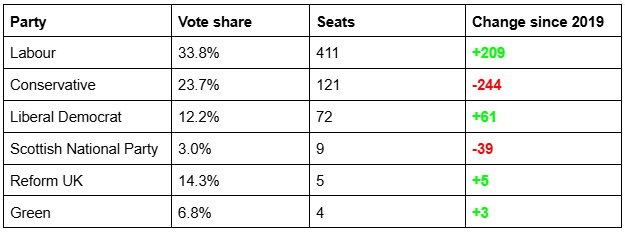
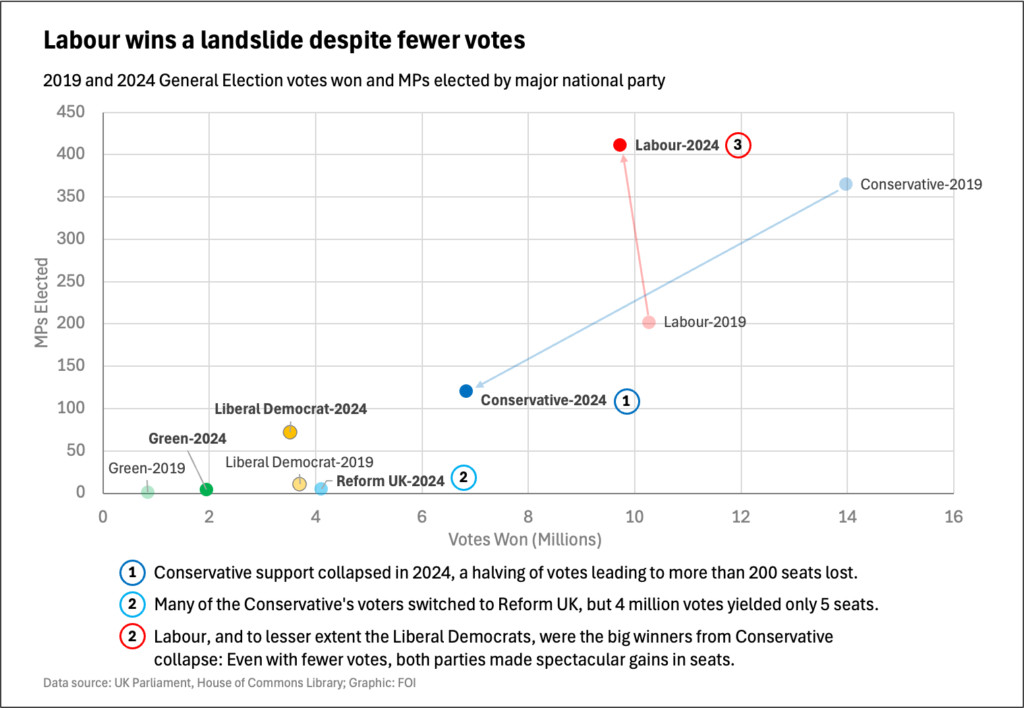
At first glance, Labour’s 2024 election victory appeared overwhelming. The party won 411 seats out of 650 in the House of Commons after the Conservatives had secured 365 seats in 2019, breaching Labour’s fabled red wall in the North. Yet it was a shallow victory. The number of votes went down, even as seats went up, suggesting that Labour’s mandate was far weaker than its parliamentary majority implied.
Starmer entered office with a reputation as an honest, decent and hardworking public servant, and an excellent lawyer. What he lacked, however, was vision, direction, agenda, policies and governing philosophy. Like former prime minister Rishi Sunak, Atul says, he displayed the “charisma of a dead mouse,” combined with U-turns and damaging lapses in judgment that quickly undermined public confidence in his leadership.
Almost immediately after Starmer took office, his blunders reinforced that perception. The decision to scrap a popular winter fuel handout for pensioners provoked an immediate backlash. He also admitted accepting free clothing and football tickets from wealthy donors, damaging the image of integrity that had helped bring Labour to power. The appointment of Peter Mandelson as ambassador to the US revived old controversies when it came to light that the “Dark Lord,” a nickname for Mandelson, was close to infamous sex trafficker Jeffrey Epstein.
For all his faults, Starmer had some genuine achievements. He helped steer international support for Ukraine after US President Donald Trump largely withdrew American backing. Starmer also worked to position Britain for a leading role in the AI revolution. Importantly, he brought net immigration down from the record levels that had fueled support for the populist right.
Broken Britain looks to Burnham
Starmer’s governing philosophy rested on a simple proposition: “Tories were responsible for all problems in the UK.” Yet Britain’s malaise cannot be pinned on the sins of one party. Broken Britain has endured years of economic stagnation, strained public services and declining confidence in political institutions. As veteran journalist Andrew Neil observed, the country has been governed by a “parade of mediocrities.”
Political instability has become the norm. Britain had five prime ministers in 37 years and then cycled through seven in ten years, leaving successive governments focused on surviving rather than governing. As Atul puts it, living in Britain today is “like watching the Romans turn into Italians.” One can see a slow erosion of national confidence rather than a dramatic collapse of the country.
These pressures on the country have exposed Labour’s internal contradictions. Labour presides over an unwieldy coalition of liberal and left-leaning middle classes, working-class white voters and minorities, which now comprise mainly Muslims. Holding together such a broad alliance becomes increasingly difficult as economic pressures and cultural divisions deepen.
Against that backdrop, attention has shifted to Burnham. Mayor of Greater Manchester from 2017 to 2026 and the member of parliament for Leigh from 2001 to 2017, Burnham served in several cabinet positions under Gordon Brown, ending up as Secretary of State for Health from 2009 to 2010.
Burnham identifies as a socialist and is associated with the soft left faction of the Labour Party. He also presents himself as a politician guided by faith. A Catholic like former prime ministers Boris Johnson and Tony Blair, he attended a Catholic school and has said that “Catholic social teaching underpins my politics.” Unlike Johnson and Blair, who attended Oxford, Burnham studied English literature at Cambridge. No less than 31 British prime ministers have been Oxonians, while only 14 have been Cantabrigians. Burnham will become the first Cambridge man to enter 10 Downing Street since Stanley Baldwin, who was prime minister from 1935 to 1937.
Burnham’s ascent to the top job has been gradual. He finished fourth in the 2010 Labour Party leadership election, then came second to Jeremy Corbyn in the 2015 election. During the Covid pandemic, Burnham dramatically raised his national profile by standing on the steps of Manchester Central Library in October 2020. Dressed in jeans and a worker’s jacket, this ambitious politician harshly criticized the Johnson government’s Covid restrictions.
Burnham is a slippery politician who has changed his positions opportunistically. In 2015, he opposed devolution of health services to local leaders as shadow health secretary. Less than a year later, Burnham reversed course and championed devolution. By this time, he was running for mayor of Greater Manchester, and devolution meant he would enjoy greater power. The public forgave Burnham for his opportunistic inconsistency and his popularity continued to grow. When he applied to stand as Labour’s candidate for the House of Commons in the 2026 Gorton and Denton by-election, Starmer shot it down. The prime minister was keeping a potential rival out of Westminster and, unluckily for him, Labour not only lost that seat but finished in third place. Once Labour fared poorly in the local elections, Starmer’s position was untenable and Burnham’s entry into 10 Downing Street inevitable.
Starmer’s greatest political challenge has come not from the Conservatives but from within his own party. As Broken Britain continues to struggle, Labour’s future will be shaped not by the man in Downing Street, but by the King of the North.
[Lee Thompson-Kolar edited this piece.]
The views expressed in this article/video are the author’s own and do not necessarily reflect Fair Observer’s editorial policy.





































Comment