


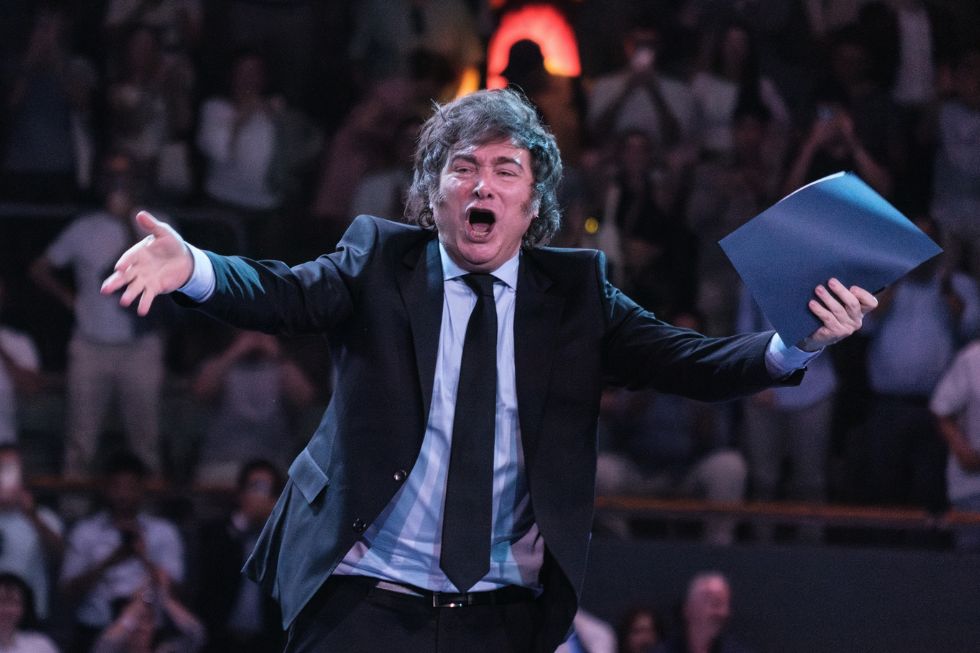


I am a liberal. By that, I don’t mean someone who has a partisan identity or a tribal label, but rather someone who has a commitment to a tradition that runs through the famed philosopher John Locke’s natural rights, economist John Stuart Mill’s harm principle, theorist Thomas Paine’s moral clarity against tyranny and philosopher John Rawls’ insistence that liberty must be equal and justifiable to all. At its core, this tradition is skeptical of power and deeply concerned with the rights and dignity of all individuals and communities alike.
But liberalism, if it is to mean anything at all, must be consistent. And consistency is precisely what is missing when many of these same voices rally behind Argentina’s President Javier Milei, portraying him as a libertarian and as a brave fighter against government overreach.
This includes libertarian organizations such as the Foundation for Economic Education, which described him as the first libertarian President. The Cato Institute, a famous American think tank that describes its mission as “to keep the principles, ideas and moral case for liberty alive for future generations,” invited Milei to address a Conference on the “Rebirth of Liberty in Argentina.” And of course, Milei tries to portray himself as a defender of liberty, famous for using his political catchphrase “Viva la libertad, carajo! (Long live liberty!)”
Argentina has had a long history of authoritarian rule, most infamously under the Peronist regime. Milei’s rhetoric and promises of liberty and economic prosperity played a key role in winning the votes of many Argentines.
But strip away the slogans and what remains is not liberty, but something far more familiar: the reproduction of authoritarian power under a new aesthetic.
True liberty is not reducible to economic deregulation or hostility toward the state in the abstract. Freedom was inseparable from protection against oppression and coercion. Liberty meant basic rights cannot be traded away in the name of state efficiency. A political project that erodes rights while claiming to expand freedom is not liberal; it is incoherent. Under Milei, Argentina has seen precisely this contradiction play out in practice.
Attacks on reproductive freedom
One of the clearest examples of Milei’s illiberal agenda is abortion. On January 14, 2021, Argentine President Alberto Fernández signed Argentina’s 27.610 law into effect after Senate Approval in December 2020, thereby legalizing abortion. This was a landmark expansion of bodily autonomy, particularly for poor and rural women. It was not a gift from above; it was the hard-won result of decades of organizing. For years, women campaigned and fought for the right to have abortions; they brought together a coalition of several feminist groups under the “Green Wave Movement,” with a simple demand that women not die from illegal procedures and have the right to bodily autonomy.
But Milei has made no secret of his hostility to this achievement, even describing abortion as “murder” and openly aligning himself with efforts to dismantle access.
Lawmakers from Milei’s Party, La Libertad Avanza, even introduced a bill to repeal abortion rights. Even though Milei’s spokesperson said the lawmakers were acting independently and that signing the bill was not part of Milei’s agenda, Milei said he wished to hold a plebiscite on whether to repeal the country’s landmark 2020 legislation.
While the law technically remains in place, access has been deliberately undermined. Funding for reproductive health programs has been slashed, abortion pills have become harder to obtain and healthcare providers report a climate of fear and uncertainty that discourages them from offering care.
Amnesty International reported last year that they received at least four times as many reports of barriers to abortion as in the previous year, potentially reflecting an increase in barriers to access. As CNN reports, this has created a situation where abortion is legal in theory but increasingly inaccessible in practice, especially for those without resources.
Liberty that depends on wealth, geography or political favor is not liberty. It is a privilege.
Indigenous rights, state violence and the collapse of property protections
Perhaps the most revealing contradiction of Milei’s presidency is found in his government’s treatment of Indigenous communities, particularly the Mapuche. Milei repealed Argentina’s Indigenous territorial emergency law, stripping communities of legal protection against eviction and land dispossession. Human rights organizations have warned that this rollback effectively nullifies Indigenous legal personhood and opens the door to unchecked state and private encroachment.
But the problem goes even deeper than Indigenous rights alone. What is happening here is an assault on private property itself, carried out by the very state that claims to defend it. As documented by Genocide Watch, in February this year, Jorge Millán’s home in the small Patagonian town of El Maitén was violently raided. Millán, a member of the Indigenous Mapuche community and a journalist working at La Radio Comunitaria Mapuche Petü Mogeleiñ, described the incident plainly:
“It was total madness,” Millán said. His home was invaded by Argentine military border police officers, who told him they were searching for Molotov bombs or anything that could start or accelerate a fire. “They arrived unexpectedly and violently.”
This was not a protest camp. This was not contested land. This was a private home, raided without evidence, under a presumption of guilt rooted in ethnicity and political association. If private property means anything in a liberal tradition, it means protection from arbitrary state intrusion. When armed officers invade a civilian’s house looking for hypothetical weapons, without due process, property rights cease to exist in any meaningful sense.
Supporters of Milei often justify these actions using the language of order, security or anti-terrorism. But history is clear on this point: Every authoritarian project claims exceptional necessity. The Mapuche are framed as dangerous, criminal or disruptive and that framing becomes the excuse for suspending rights that supposedly apply to everyone.
Latin America Reports has documented how Mapuche women in particular face aggravated persecution, blending racism, sexism and political repression into a single apparatus of state violence.
This is not the defense of liberty. It is its inversion.
Crushing dissent and protestors
The same pattern appears in the government’s response to some protests held by his opponents.
Argentina knows better than most what happens when a state decides that protest is an enemy. In March 1976, the country’s democratic government was overthrown in a military coup that brought seven years of brutal dictatorship.
Between 10,000 and 30,000 people were killed or disappeared; dragged from their homes at night, tortured and in many cases thrown from aircraft into the sea. Among them were 98 journalists killed or disappeared between 1973 and 1980. The lesson the regime drew from this era — that dissent is destabilization, that protest is subversion — is one Argentina spent decades learning to unlearn.
Milei has not disappeared. But his reaction towards protestors and dissent is still worth examining carefully. Retirees demonstrating against economic hardship have been met with brutal police repression, including beatings, injuries and intimidation, as documented by the International Federation for Human Rights. More than a hundred people were arbitrarily detained, including two children and at least 20 protesters had to be hospitalized due to the repressive actions of the police.
They also reported that government officials had launched threats of removal against Judge Karina Andrade, who released all those detained due to the clear failure of police officers to meet the minimum requirements for verifying the legality of the detentions, such as the circumstances of the manner, place, time and specific accusations against each detainee.
Reporters without Borders (RSF) has reported that Milei’s first year in power saw a sharp decline in Press Freedom. RSF recorded at least 12 physical attacks on journalists in 2024, with some of them perpetrated by the police. This was after security minister Patricia Bullrich implemented a security protocol designed to control and limit public protests.
Human Rights Watch has similarly condemned Argentina’s abusive response to demonstrations, citing arbitrary detentions and excessive force. Amnesty International concluded that more than 1,100 people were injured in protest repression during Milei’s first year in office. A government that treats protest as a security threat rather than a democratic right is not preserving order; it is protecting power from accountability.
Hypocrisy without borders, beyond labels
This pattern is not unique to Milei, nor to Argentina.
Conservatives who condemned authoritarianism in Venezuela often support mass surveillance, war and police violence at home, such as in the US under President Donald Trump. Some libertarians rightly denounce the surveillance state, yet fall silent when state power is used against indigenous communities or women exercising bodily autonomy in Argentina. Many communists rightly criticize brutality in Guantanamo Bay and the Kent State Massacre; yet many often openly praise a party that is putting Uyghurs in concentration camps and perpetrated the Massacre of Student Protestors at Tiananmen Square.
Different ideologies. Same moral failure.
What unites these political figures is not ideology, but the instrumental use of moral language to justify power.
[Patrick Bodovitz edited this piece]
The views expressed in this article are the author’s own and do not necessarily reflect Fair Observer’s editorial policy.
Milei’s Midterm Victory: Endorsing Austerity, Eroding Democracy?
Argentine voters, preferring painful economic shock therapy to a return to failed Peronist governance, have granted President Javier Milei a...
Argentina’s Endless Cycle: Why Sovereign Debt Crises Keep Returning
Argentina’s recurrent debt crises reflect deep structural weaknesses: fiscal dominance, financial dollarization and institutional fragility. Despite repeated reforms, external bailouts...
Argentina’s New President Is Weird, Ultra-Right and Economically Ruthless
Once a television commentator, Javier Milei became the Argentinean president in 2023. His ultra-right policies have ushered in a new...

Support Fair Observer
We rely on your support for our independence, diversity and quality.
For more than 10 years, Fair Observer has been free, fair and independent. No billionaire owns us, no advertisers control us. We are a reader-supported nonprofit. Unlike many other publications, we keep our content free for readers regardless of where they live or whether they can afford to pay. We have no paywalls and no ads.
In the post-truth era of fake news, echo chambers and filter bubbles, we publish a plurality of perspectives from around the world. Anyone can publish with us, but everyone goes through a rigorous editorial process. So, you get fact-checked, well-reasoned content instead of noise.
We publish 3,000+ voices from 90+ countries. We also conduct education and training programs
on subjects ranging from digital media and journalism to writing and critical thinking. This
doesn’t come cheap. Servers, editors, trainers and web developers cost
money.
Please consider supporting us on a regular basis as a recurring donor or a
sustaining member.
Will you support FO’s journalism?
We rely on your support for our independence, diversity and quality.





Comment