

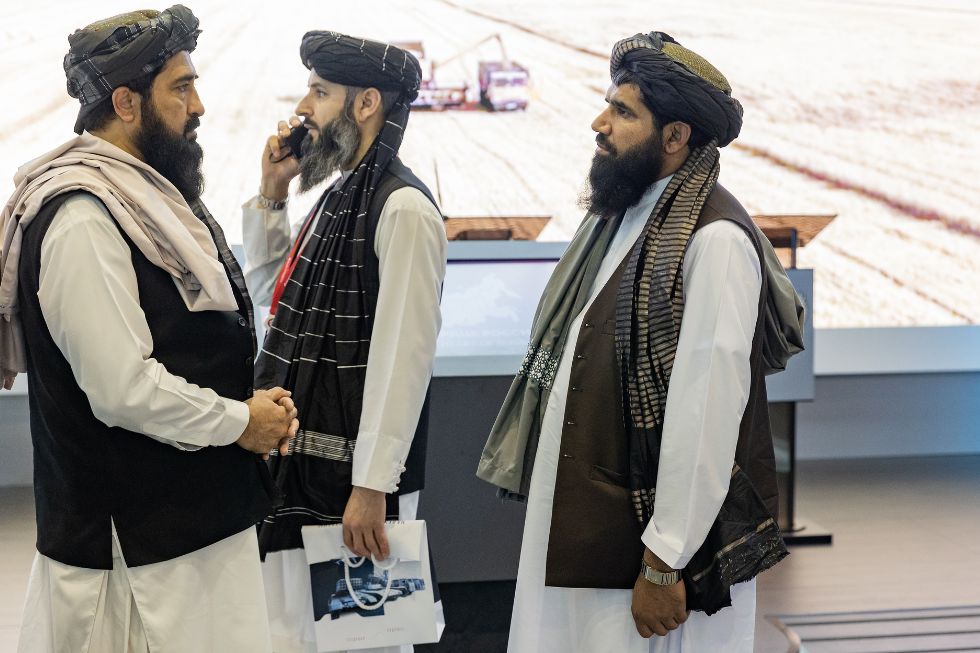



On April 10, gunmen attacked Shia civilians near the Sayed Mohammad Agha shrine in Injil district and left a trail of dead and wounded. The UN expressed condolences over the mass killing, while local and international outlets reported that most victims belonged to the Shia community.
Early casualty figures varied across outlets, but the political meaning of the massacre did not. This was not a freak breach in an otherwise secure order. It was another reminder that under Taliban rule, Afghanistan remains a space where sectarian terrorists can assemble, move, select soft targets and strike minorities in broad daylight. That is the real story of Herat: not just who was killed, but what the attack says about who is still able to operate.
The Taliban response is by now predictable. Officials repeatedly insist that Islamic State Khorasan Province (ISKP). ISKP, also called the Islamic State of Iraq and the Levant-Khorasan (ISIL-K) in UN reporting, has been defeated, dismantled or pushed outside Afghanistan.
In October 2024, the Taliban said an Islamic State of Iraq and Syria (ISIS) group in the Ghor Province had been eradicated after attacks on Shia civilians. In October 2025, the Islamic Emirate repeated this claim in a broader anti-Pakistan security statement, asserting that ISIS/Daesh had been dismantled inside Afghanistan and that remaining members had fled to Pakistan.
In February 2026, Deputy Information Minister of Afghanistan Zabihullah Mujahid said that no foreign or rogue groups exist in the country and that ISIS had been defeated there. In May, he went further, saying ISIS had been eliminated in the country.
These are useful examples of the Taliban line. They are also the problem with it: Governments that are truly containing a terrorist network do not keep producing the same headlines year after year. Repetition is evidence. Continuity is evidence. Geographic spread is evidence. Afghanistan’s post-2021 record shows not eradication, but endurance.
A pattern of operational freedom
Consider the January 19, 2026, attack on a Chinese-run restaurant in Kabul’s Shahr-e-Naw district, claimed by the Islamic State. The blast killed at least seven people, including one Chinese national, and wounded others. The attack hit a commercial neighborhood associated with foreigners and embassies, not some distant rural pocket beyond the reach of the state.
Its meaning was therefore strategic. The message was ISKP’s, not the Taliban’s: Chinese investors, diplomats, aid agencies and governments considering normalization should understand that the Taliban cannot reliably protect even politically sensitive foreign-linked targets in the capital.
That message did not appear out of nowhere. It followed the December 12, 2022, assault on Kabul’s Longan Hotel, a property known for hosting Chinese nationals, an attack that took planning, surveillance and follow-through. When ISKP can repeatedly hit Chinese-linked venues in Kabul, it is not merely causing casualties. It is undermining the Taliban’s most important diplomatic sales pitch: that engagement with the Emirate will buy stability.
The same logic applies to the September 5, 2022, bombing outside the Russian Embassy in Kabul, which killed two Russian embassy staff and Afghan civilians and was claimed by the Islamic State. Before that came the October 8, 2021, massacre at a Shia Mosque in Kunduz and the October 15, 2021, massacre at a Shia Mosque in Kandahar.
Those atrocities were central markers in a deliberate anti-Shia campaign, part of a broader pattern of ISKP attacks on Afghanistan’s Shia minority. The bloodshed in Herat in April 2026 belongs to that continuum. It is the continuation of a campaign, not the exception to one.
How the Taliban enables the terror environment
The Taliban does not need to order every attack to be responsible for the security order that makes attacks possible. Nor should ISKP be treated as a simple Taliban proxy. ISKP is an ideological rival that has killed Taliban officials and embarrassed the regime internationally.
The more accurate charge is different: Taliban rule has created a permissive environment in which terrorists can recruit, transit, hide, communicate, raise money and choose targets with tolerable risk. That permissiveness comes from five overlapping features of the Taliban state.
First, Taliban counterterrorism is selective. The regime strikes ISKP when the group threatens Taliban authority, but it has not built a neutral security order that suppresses all militant actors equally.
Furthermore, Tehrik-e Taliban Pakistan (TTP) had been given greater liberty and support, and Al-Qaeda continued to enjoy Taliban patronage, so Al-Qaeda in the Indian Subcontinent (AQIS) remained active in areas where the Haqqani Network exerts influence. Furthermore, yet more terrorist organization members had received identity documents and moved freely inside Afghanistan. This is not comprehensive counterterrorism. It is a hierarchy of enemies and tolerated allies.
Second, the Taliban is not a disciplined modern state in the way its diplomatic language suggests. It is a victorious insurgent coalition governing through clerical authority, intelligence services, provincial networks, former battlefield commanders and factional patronage. Central edicts can coexist with local protection, informal deals, family ties and old jihadist relationships.
That matters because terrorist ecosystems do not require an official ministry of terrorism. They require safe houses, documents, local guides, sympathetic clerics, non-interference at checkpoints, and the ability to disappear into communities or allied networks.
Third, the regime’s treatment of vulnerable communities worsens the problem. ISKP targets Shia, Hazara, Sufi, Sikh, Hindu and foreign-linked civilians for ideological and propaganda reasons. But the Taliban’s own sectarian bias, repression of minority civic life and unwillingness to build inclusive protection leave those communities exposed.
ISKP repeatedly attacked Hazaras and other religious minorities while the Taliban authorities did little to protect these communities or assist victims. That failure is not merely operational. It is political.
Fourth, the Taliban has weak incentives to police the entire infrastructure that sustains armed groups. Afghanistan’s informal financial sector, porous borders, weapons markets and cross-border smuggling routes remain difficult to regulate.
The International Centre for Counterterrorism has noted that Taliban checks on informal banking remain superficial, partly because the sector is economically vital. That weakness benefits ISKP, but also the broader militant field around TTP, Al-Qaeda and other groups.
Fifth, the Taliban profits politically from the wider militant ecosystem even when it suffers from ISKP attacks. Keeping older jihadist allies close reduces the risk that they defect en masse to ISKP. Tolerating or restraining groups selectively gives Kabul leverage over neighbors, especially Pakistan.
At the same time, the Taliban presents itself to Russia, China, Iran, Central Asian states and Western interlocutors as the only force capable of containing these terrorists. In other words, the Taliban benefits less from ISKP’s individual attacks than from the bargain that those attacks make possible: engage us, fund us, equip us or recognize us because the alternative is worse.
Different from the American occupation, but not innocent
There is an obvious objection that Afghanistan was also violent during the American occupation and the Islamic Republic. That is true. ISKP emerged before the Taliban returned to Kabul; the previous state was corrupt and unevenly present outside major cities, and insurgents exploited rural sanctuaries, cross-border networks, weak policing and factional politics. The difference is not that pre-2021 Afghanistan was secure. It was not.
The difference is responsibility and structure. Before August 2021, the internationally backed state was fighting the Taliban and ISKP while depending on foreign military, intelligence and financial support. Today, the Taliban controls the state, border posts, intelligence service, prisons, police, ministries, identity documents, checkpoints and most public spaces.
It also governs through the same movement that historically maintained relationships with Al-Qaeda and other jihadist actors. When terrorism persists under these conditions, the Taliban cannot blame a foreign-backed government, NATO operations or republican corruption. It owns the security architecture it has created.
The Taliban’s security narrative has collapsed
There is a tendency in some foreign capitals to separate Taliban incompetence from Taliban responsibility, as if repeated failure somehow absolves the regime. It does not. Once a movement claims sovereign authority, monopolizes force and demands diplomatic legitimacy, it owns the consequences of the security order it creates. The April 2024 Mosque shooting in Herat already showed that western Afghanistan was vulnerable to anti-Shia terrorism.
ISIS-K’s external ambitions make clear that the branch is not merely a local irritant. The Council on Foreign Relations tracker continues to describe persistent instability and ISIS-K violence under Taliban rule. A regime cannot market itself as the provider of order while its adversary keeps staging headline attacks against civilians, diplomats, minorities and foreigners.
What matters most is not whether every attack is centrally directed from one command room or whether local cells vary in quality. What matters is the enabling environment. By that standard, Afghanistan is not hostile terrain for ISKP; it is permissive terrain. If a network can keep resurfacing from Kabul to Herat, keep selecting symbolic targets and keep forcing emergency responses after every supposed crackdown, then the crackdown is not solving the problem. It is managing headlines.
A wider terror ecosystem, not a single threat
The most damning evidence comes from the international monitoring architecture itself. The UN Monitoring Team report of February 2026, its December 2025 predecessor and the broader UN monitoring reports archive point toward the same conclusion: Afghanistan under Taliban control remains a permissive environment for multiple terrorist entities.
An Amu summary of UN findings captured the blunt assessment that the Taliban provides a haven to terrorist groups, while SATP’s note on ISKP manpower echoed assessments putting ISKP strength around 2,000 fighters. A separate EU Institute for Security Studies brief warned years ago that risks emanating from Afghanistan were not disappearing but diffusing outward. The wider terrorist ecosystem matters because it demolishes the fiction that the Taliban has delivered counterterrorism success.
The reality, then, is clear. Herat is not a tragic outlier. It is a fresh exhibit in an old case. ISKP survives under Taliban rule because Afghanistan has again become what the Taliban promised it would not be: a terror-permissive sanctuary. Minorities are paying the price first, foreigners are being warned in blood and the region will keep absorbing the consequences so long as rhetoric about Taliban stability outruns the evidence on the ground.
[Casey Herrmann edited this piece]
The views expressed in this article are the author’s own and do not necessarily reflect Fair Observer’s editorial policy.






Join the conversation
Share your perspective
Log in to share your thoughts and take part in the discussion.