





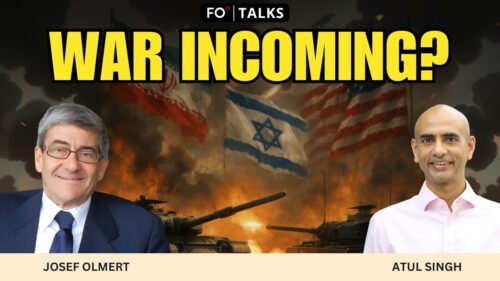
Editor-in-Chief Atul Singh and Josef Olmert, a former Israeli government official and Middle East scholar, discuss the apparent conclusion of the latest round of conflict involving the United States, Israel and Iran. While Israel and the US severely damaged Iran, Olmert argues that the political outcome tells a very different story. He contends that the emerging ceasefire framework leaves the central issues unresolved, strengthens Iran’s strategic position and exposes deeper political problems inside Israel and across the region.
A ceasefire that settles little
Olmert begins by outlining reports of a proposed agreement awaiting approval from both US President Donald Trump and Iranian Supreme Leader Ayatollah Mojtaba Khamenei. The arrangement would reopen the Strait of Hormuz and halt direct hostilities, but it postpones decisions on Iran’s nuclear program, ballistic missiles and regional network of allied groups for another 60 days.
For Olmert, this is the central weakness of the deal. Rather than resolving the issues that triggered the conflict, it merely delays them. The agreement, he argues, amounts to a temporary pause rather than a durable settlement.
Before the war, discussions focused on Iran’s military capabilities and the possibility of regime change. Instead, Tehran successfully turned the Strait of Hormuz into the decisive issue. Olmert says that Iran leveraged its ability to disrupt global trade and energy flows to force Washington and Jerusalem into a position they had not adequately anticipated.
“The main elements of the agreement are that basically, there is no agreement,” he states.
Military defeat, political victory
Olmert distinguishes sharply between military and political outcomes. Militarily, he believes Iran suffered enormous losses. Israeli and American operations severely damaged missile capabilities, destroyed much of Iran’s navy and eliminated key military leaders. Iran’s missile campaign against Israel also failed to achieve the catastrophic effects many had feared.
Yet Olmert argues that wars are ultimately judged by their political conclusions rather than battlefield statistics. From that perspective, he believes Iran emerged stronger.
The regime survived. The ceasefire appears to acknowledge Iran’s influence over the Strait of Hormuz. Reports of a possible international investment mechanism could also provide substantial economic relief. Taken together, these developments allow Tehran to claim that it withstood a coordinated American–Israeli campaign and preserved its core political structure.
Olmert compares the situation to Egyptian military officer Gamal Abdel Nasser after the 1956 Suez Crisis. Although Nasser suffered military setbacks, he ultimately secured political control over the canal and emerged stronger in the eyes of much of the Arab world.
“As it stands now in this round, Iran comes out victorious,” Olmert argues.
The problem of another round
The proposed agreement raises a larger concern for Olmert: the likelihood that the conflict simply resumes later.
By postponing decisions on nuclear activities, missile programs and Iran’s regional alliances, the deal creates conditions for another confrontation rather than eliminating the causes of the current one. This could merely be one round in a longer struggle.
He believes the Trump administration has limited room for escalation. Time works in Iran’s favor as American political attention shifts toward upcoming midterm elections. Even if Washington wanted to increase pressure, Olmert questions whether it has the political appetite for a prolonged campaign.
This concern extends beyond Iran. In Gaza, Hamas remains active despite Israeli military gains. In Lebanon, Hezbollah continues to operate despite suffering substantial losses. According to Olmert, Israel’s battlefield successes have not translated into decisive political outcomes.
“The war is not over. This round may be over,” he says.
Netanyahu’s declining position
Singh and Olmert turn to Israel’s domestic politics. Olmert argues that Israeli Prime Minister Benjamin Netanyahu enters this period politically weakened despite the military achievements of the Israel Defense Forces.
Public support for Netanyahu has declined, and Olmert believes growing dissatisfaction exists within parts of Israel’s military and security establishment. After nearly three years of conflict across multiple fronts, fatigue has become a significant factor.
Olmert acknowledges Netanyahu’s intellectual abilities but argues that his political standing has deteriorated. He predicts that the prime minister will struggle to survive the next election, which he expects within several months.
More troubling is what Olmert sees as Israel’s increasing dependence on Washington. He argues that major strategic decisions are now heavily influenced by the US, reducing Israel’s freedom of action. Previous Israeli leaders maintained greater strategic autonomy, while Netanyahu appears increasingly constrained by American priorities.
According to Olmert, a future Israeli government will need to rebuild both domestic trust and a more balanced relationship with the US.
A changing Middle East
Beyond Israel and Iran, Olmert sees signs of broader regional change. Saudi Arabia is exploring alternative partnerships. Gulf states are pursuing increasingly independent policies. Lebanon remains politically fragile despite Israeli military pressure on Hezbollah.
At the same time, criticism of Israel has intensified internationally. Olmert rejects many of the arguments made by foreign critics, particularly when they fail to propose viable alternatives to Hamas or Hezbollah. However, he also criticizes extremist settler activity in the West Bank and argues that a future Israeli government will need to address the issue more forcefully.
Despite these challenges, Olmert emphasizes that Israel remains a formidable military power. The question is whether military success can be translated into sustainable political outcomes.
Israel and the US won many of the battles. Iran lost ships, missiles, infrastructure and senior commanders. Yet because the regime survived and appears poised to negotiate from a position of continued relevance, Olmert concludes that Tehran achieved the more important victory.
The conflict demonstrates an enduring lesson of statecraft: Military success matters, but political results determine who ultimately wins the war.
[Lee Thompson-Kolar edited this piece.]
The views expressed in this article/video are the author’s own and do not necessarily reflect Fair Observer’s editorial policy.






























Comment