




When the US and Israel launched Operation Epic Fury on the morning of February 28, the Middle East witnessed the acceleration of a conflict simmering for nearly half a century. The opening salvos of this joint campaign were vast and precise. Within the first 12 hours, nearly 900 strikes dismantled the Iranian regime’s security apparatus. The operation eliminated the regime’s leadership, resulting in the death of Supreme Leader Ayatollah Ali Khamenei and dozens of commanders of the Islamic Revolutionary Guard Corps (IRGC).
In the ensuing weeks, American and Israeli forces carried out the largest naval fleet elimination since the Second World War, according to White House Press Secretary Karoline Leavitt. They destroyed over 140 Iranian vessels, crippled ballistic missile production facilities with 5,000-pound bunker-buster munitions and erased infrastructure that has menaced the world for decades.
Following the degradation of the regime’s military-industrial complex, a debate has emerged within Western diplomatic and academic circles. Proponents of conflict-resolution paradigms argue that the optimal strategy is now a cessation of hostilities. They suggest leveraging the regime’s current vulnerability to negotiate a permanent ceasefire, strike a diplomatic bargain and establish a stabilized status quo in the Persian Gulf.
However, this diplomatic approach rests on the assumption that the Islamic Republic of Iran is a conventional nation-state. It presumes the leadership in Tehran prioritizes traditional calculations of border security, economic self-interest and national preservation. Conversely, an analysis of the Islamic Republic reveals a totalitarian framework whose foundational ethos, institutional architecture and worldview do not align with the traditional Westphalian system of sovereign states.
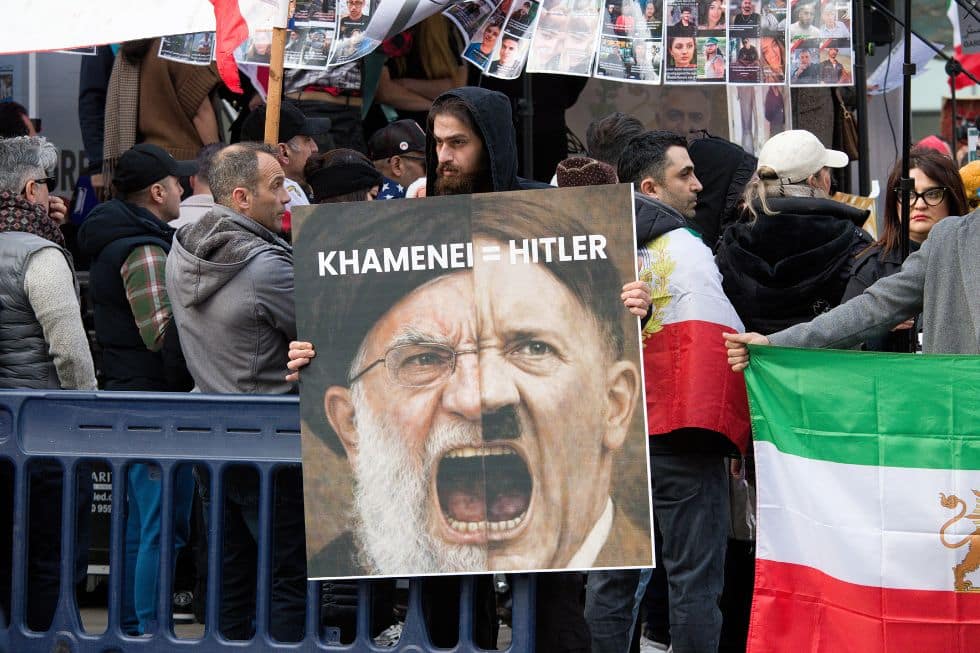
To accurately assess the strategic requirements of this conflict, historical comparisons are instructive. The closest structural analog to the Islamic Republic is not a Cold War superpower or a conventional authoritarian dictatorship; rather, it is National Socialist Germany from 1933 to 1945. Both systems demonstrate a reliance on a collective, totalitarian ideology oriented toward absolute endpoints. Both centralized authority at the expense of independent legal and legislative institutions, subordinating them to a supreme leader. Both utilized paramilitary organizations to enforce domestic compliance and pursue expansion. Furthermore, both regimes maintained a systemic, religiously and racially defined antisemitism as a core tenet of their geopolitical objectives.
Therefore, proposing a negotiated settlement with the remnants of the current regime presents the same strategic risks as seeking diplomatic accommodation with Nazi Germany during the Second World War. Such an approach risks allowing the regime to use treaties as tactical pauses rather than binding resolutions. As philosopher Karl Popper outlined in his “paradox of tolerance,” extending unlimited tolerance to fundamentally intolerant systems ultimately threatens the liberal society itself.
Consequently, Operation Epic Fury represents more than a regional security dispute; it is a fundamental clash between incompatible governing models. A durable peace cannot be achieved through diplomatic compromise with the Islamic regime. A definitive resolution necessitates the comprehensive dismantling of the regime’s coercive apparatus and total ideological capitulation.
The Munich fallacy and the illusion of pragmatic diplomacy
A fundamental error of modern Western diplomacy is the cognitive trap of mirror-imaging — the deeply ingrained assumption that all adversaries ultimately share the same basic motivations regarding peace, economic prosperity and national survival. Western democracies, by their very nature, operate as “status quo” states. They seek geopolitical stability, predictable international markets, the peaceful flow of global commerce, and the management of disputes through established institutional frameworks and international law. The Islamic Republic of Iran, however, has operated entirely as a “revolutionary state” since its violent inception in 1979.
For the ruling clerics in Tehran, the state itself is merely a temporary, earthly vessel for perpetuating the revolution. The 1979 revolution was never conceived as a nationalist uprising to secure better material conditions or democratic rights for the Iranian populace; it was explicitly designed as a vanguard movement to overturn the entire global order. The first Supreme Leader, Ayatollah Ruhollah Khomeini, framed the revolution as an eternal struggle to export a radical, fundamentalist vision of Islam far beyond the borders of Iran, dividing the entire world into the oppressed and the oppressors, and completely rejecting the bipolar “East versus West” geopolitical structures of the era as inherently corrupt and illegitimate.
This revolutionary, totalizing imperative closely mirrors the underlying dynamic of Nazi Germany. Dictator Adolf Hitler did not view the German state as an end in itself, but strictly as the mechanism through which to achieve a racially purified, millenarian empire that would dominate the globe. For the Nazis, the ultimate goal was the realization of the thousand-year Reich, an ideological destiny that necessitated permanent mobilization, relentless warfare and the subjugation or extermination of “inferior” peoples. For the Islamic Republic, the ultimate goal is the realization of an Islamist utopia, the destruction of Western liberal hegemony and the violent preparation of the world for the return of the Mahdi, or the Twelfth Imam.
Because both regimes view their struggles through a messianic, existential and uncompromising lens, they cannot be contained by traditional, rational deterrence strategies. In an ideologically driven system, pragmatic calculations regarding economic stability or human life are always subordinated to theological or racial imperatives. If a regime genuinely believes it is executing the divine will of God — or the biological destiny of the blood — it will willingly absorb catastrophic human and economic losses rather than abandon its core mission. Asking the Islamic Republic to abandon its nuclear ambitions, cease its sponsorship of global terror networks or recognize the right of its neighbors to exist via a negotiated treaty is akin to asking the Nazi regime to voluntarily abandon its racial laws at a negotiating table in Geneva. The aggression is not a policy choice that can be bargained away; it is the regime’s very reason for existing.
Despite the overwhelming historical and empirical evidence of the Islamic Republic’s totalitarian and exterminationist nature, there remains a persistent lobby in Western capitals that argues for de-escalation and diplomatic engagement. This argument is the direct intellectual descendant of the disastrous appeasement policies of the 1930s.
In 1938, British Prime Minister Neville Chamberlain returned from the Munich Conference clutching a piece of paper, having traded the Sudetenland to Nazi Germany in exchange for a solemn promise of “peace for our time.” The fundamental flaw of the Munich Agreement was the belief that a totalitarian dictator could be satiated by territorial concessions or diplomatic recognition. Instead of securing peace, the concessions merely validated Hitler’s utter contempt for Western weakness, bought the German war machine vital time to finalize its rearmament and paved the way for a devastating global war that consumed tens of millions of lives.
Over the past decade, Western diplomatic engagement with Iran — most notably through the Joint Comprehensive Plan of Action (JCPOA) and subsequent, desperate attempts to revive it — has exactly replicated the Munich fallacy. The underlying premise of these negotiations was the belief that by lifting crippling economic sanctions, unfreezing billions of dollars in assets and welcoming Iran back into the community of nations, the regime would moderate its extreme behavior, empower its so-called “reformist” political factions and begin to prioritize domestic economic development over its revolutionary, expansionist ambitions.
The results of this diplomatic gamble were entirely predictable to anyone who understood the nature of totalitarian ideology. The Islamic Republic did not use the massive influx of billions of dollars to build hospitals, improve failing infrastructure or alleviate the suffering of the Iranian people. Instead, the regime channeled this newfound wealth directly into its imperial, revolutionary project. They vastly expanded their ballistic missile arsenals, accelerated their drone manufacturing capabilities (eventually supplying the Russian Federation with kamikaze drones for its brutal war of aggression in Ukraine) and massively subsidized the “Axis of Resistance” across the Middle East. The financial relief provided by Western appeasement funded the Hamas atrocities of October 7, 2023, the relentless Hezbollah rocket barrages that caused large-scale displacement in northern Israel and the Houthi blockade of the Red Sea that paralyzed global shipping
Providing a diplomatic off-ramp to the Iranian government following the military impacts of Operation Epic Fury could signal broader geopolitical vulnerabilities. It risks validating the strategic utility of employing proxy militant groups to test and exhaust Western diplomatic endurance. This could incentivize global militant organizations by demonstrating that a nuclear-threshold state utilizing aggressive regional tactics can compel diplomatic concessions and survive significant military retaliation.
Such a precedent could bolster anti-Western coalitions, signaling to nations like Russia and China that allied resolve can be outlasted. As former Israeli Prime Minister Yair Lapid stated following the onset of the 2026 war, the current hostilities do not represent a conventional dispute over borders or tariffs, but rather an existential conflict with a regime fundamentally opposed to its neighbors’ existence. Consequently, an effective strategic goal must move beyond a temporary ceasefire that permits the existing ideological and military infrastructure to rebuild.
Velayat-e Faqih and the Führerprinzip
The political architecture of Iran functions as a totalitarian system that exhibits direct structural parallels to the Third Reich of the 1930s. To achieve their respective ideological visions, both regimes recognized the necessity of systematically eradicating all competing sources of moral, legal and political authority.
In Nazi Germany, the legal and moral foundation of the entire state apparatus was the Führerprinzip, or the “leader principle.” The word, will and desire of Hitler constituted the ultimate, unchallengeable law of the land, effortlessly overriding any constitution, legislature or independent judiciary. Hitler was not merely a political executive or a head of state; he was elevated to the status of the ideological conduit for the destiny of the German race, possessing absolute and unquestionable authority over every facet of public and private life. The state existed solely to execute his will.
The Islamic Republic of Iran is governed by an eerily similar doctrine known as Velayat-e Faqih (Guardianship of the Islamic Jurist), a concept pioneered and weaponized by Khomeini. Before 1979, traditional Shi’ite political thought largely advocated a form of quietism; because the Twelfth Imam (the Mahdi) was in occultation, all earthly governments were viewed as inherently flawed and clerics generally advised waiting for his messianic return before attempting to establish a pure Islamic state. Khomeini radically and forcefully reinterpreted this centuries-old theology. He asserted that, in the Mahdi’s absence, a supreme, righteous cleric must wield absolute political and religious power over society to prepare the way for the end of days.
The doctrine of Velayat-e Faqih institutionalizes the absolute authority of the supreme leader over all state and religious affairs. This position structurally supersedes nominally republican institutions — including the elected presidency, the Majlis (parliament) and the judiciary — by maintaining direct, unilateral control over the armed forces, state media apparatuses and the centralized economic conglomerates that govern the national economy.
The doctrines of the Führerprinzip and Velayat-e Faqih both function to neutralize democratic institutions and reduce elections to performative exercises. Just as the Führerprinzip rendered the Weimar Constitution obsolete to consolidate dictatorial power, Velayat-e Faqih subordinates Iran’s republican structures to the supreme leader. The Guardian Council, an unelected body of clerics and jurists, strictly vets all electoral candidates based on their loyalty to the state. By disqualifying individuals who do not demonstrate ideological commitment to the revolution, the regime restricts political competition to approved loyalists and systematically eliminates genuine political pluralism.
The Nazi and Iranian dictatorships rely on procedural theater and absolute information control to mask their unaccountable governance. Nazi Germany’s Ministry of Propaganda weaponized the media for ideological mobilization, a function directly replicated by Iran’s state broadcasting monopoly, strict censorship apparatus and targeted internet blackouts. As a result, both systems profoundly moralize and securitize political dissent: Opposition to the Nazi party was prosecuted as treason against the race, while opposition to the Islamic Republic is legally classified as moharebeh (“enmity against God”), a capital offense.
The Schutzstaffel and the IRGC
The bifurcation of the military apparatus constitutes a primary structural similarity between the Islamic Republic and Nazi Germany. Because totalitarian regimes frequently distrust traditional armed forces — which typically prioritize professional ethics and loyalty to the nation-state over a specific radical ideology — they establish parallel military organizations dedicated exclusively to the ruling ideology and leadership to secure absolute power.
In Germany, the traditional army (the Wehrmacht) was viewed with suspicion by Hitler. It was therefore shadowed, infiltrated and eventually dominated by the Schutzstaffel (SS). The SS was not merely a military unit; it was the elite, ideological vanguard of the Nazi Party. It operated completely outside the bounds of normal military law. It ran the vast network of concentration camps, enforced draconian racial purity laws, operated the domestic secret police (the Gestapo) to crush internal dissent and eventually fielded its own massive, fanatical combat divisions (the Waffen-SS) to wage wars of annihilation abroad.
In Iran, the traditional national army (the Artesh) has been entirely eclipsed and marginalized by the Islamic Revolutionary Guard Corps (IRGC). Established after the 1979 revolution to prevent conventional military intervention, the IRGC has expanded into a dominant economic, political and military organization structurally mirroring the SS. By controlling substantial sectors of the Iranian economy, the IRGC secures independent funding that circumvents civilian oversight. Furthermore, it suppresses domestic opposition through its paramilitary Basij force, while its intelligence branch oversees political prisons and the systemic execution of dissidents.
Furthermore, both the SS and the IRGC developed extensive, deeply loyal foreign networks to export their ideology and wage war beyond their borders. During the Second World War, the Nazis commanded numerous non-German Waffen-SS divisions, recruiting ideological sympathizers, anti-communists and antisemites from across occupied Europe and the Middle East to fight and die for the Reich.
Similarly, the IRGC’s elite external operations branch, the Quds Force, has spent decades constructing and commanding a vast, multinational Axis of Resistance. The IRGC funds, arms, trains and directs a network of foreign proxy militias that serve as the expeditionary forces of Iranian totalitarianism. This includes the heavily armed Lebanese Hezbollah, the Palestinian terror group Hamas, the Houthis in Yemen, and various Shi’ite militias in Iraq and Syria. The IRGC has even organized specific foreign fighter divisions, such as the Fatemiyoun (composed of Afghan refugees) and the Zainebiyoun (composed of Pakistanis), deploying them as shock troops to prop up the murderous Assad regime in Syria.These proxies do not act independently; they are extensions of the IRGC’s will, holding foreign governments hostage, destabilizing the region and spreading terror on Tehran’s behalf.
Negotiating with the smiling, suit-wearing diplomats of the Iranian Foreign Ministry while the IRGC retains its military and economic hegemony is a fool’s errand. It is structurally equivalent to negotiating a peace treaty with the German Foreign Ministry in 1943 while allowing Heinrich Himmler to retain full command of the SS, the concentration camps, and the military-industrial complex. The diplomats are merely the velvet glove hiding the iron fist of the ideological vanguard.
The fusion of European and Islamic Antisemitism
The ideological framework of the Iranian regime directly connects mid-century European fascism with modern radical Islamism. The antisemitism central to the Islamic Republic is not merely a byproduct of the contemporary geopolitical dispute concerning Israel and the Palestinian territories. Rather, it operates as a foundational ideology that was significantly influenced and transmitted to the Middle East by Nazi Germany.
During the 1930s and 1940s, the Third Reich engaged in a massive, sophisticated propaganda effort directed specifically at the Middle East. Nazi ideologues realized early on that their specific brand of biological, racial antisemitism — which categorized Arabs and Persians as inferior alongside Jews — did not easily translate to Islamic populations. Therefore, the Nazi Ministry of Propaganda, working closely with the Foreign Office, meticulously tailored its messaging.
Through the incredibly popular Persian and Arabic shortwave broadcasts of Radio Zeesen, Nazi propagandists fused European, pseudoscientific conspiracy theories of Jewish global domination with historic, anti-Jewish themes cherry-picked from early Islamic texts and traditions. These broadcasts manipulated religious sentiment; Hitler was frequently portrayed not just as a strong political leader fighting the British and the French, but as a quasi-messianic figure. In some Persian broadcasts, Hitler was even equated with the Twelfth Imam, a savior who had arrived to destroy the Jews, crush the communists and liberate the Islamic East. The Nazi struggle was explicitly compared to the Prophet Mohammed’s historical clashes with Jewish tribes in Arabia.
Among the dedicated, daily listeners to the Radio Zeesen broadcasts in the late 1930s was a young, radical cleric named Ruhollah Khomeini. The German political scientist Matthias Küntzel has documented how Khomeini absorbed these European antisemitic conspiracies and masterfully integrated them into his radical Shi’ite theology. In Khomeini’s seminal political tract, Islamic Government, the Jews are depicted not merely as temporal political rivals or infidels, but as a cosmic, supernatural evil attempting to establish a “Jewish world state” to subjugate humanity and destroy Islam from within.
When former President Mahmoud Ahmadinejad, Supreme Leader Ali Khamenei or senior IRGC commanders speak of “Zionists,” they are not referring to a political nationalist movement. They use the term identically to how Hitler used the word “Jew” — as the dark incarnation of absolute evil, a demonic force responsible for all global suffering, economic hardship and moral decay. This worldview makes the physical destruction of the State of Israel not just a political preference or a territorial ambition, but a profound theological and historical necessity.
For the IRGC and the supreme clerical leadership, history is not a slow march toward progress; it is hurtling toward an apocalyptic, bloody showdown. In this millenarian framework, the physical annihilation of the Jewish state is required to trigger the messianic age. It is a mindset that actively embraces and glorifies martyrdom. The regime views the death of millions — including the death of their own citizens and their proxy fighters — as an acceptable, even glorious, price to pay for ultimate ideological victory.
This is why the Iranian pursuit of a nuclear weapon is so uniquely terrifying. For a rational, status quo state, nuclear weapons serve as the ultimate deterrent against invasion. For a messianic, totalitarian regime that views extermination as a religious mandate, a nuclear weapon is not a defensive shield; it is an offensive tool of divine retribution. You simply cannot negotiate a rational, enduring compromise with a regime that denies the Holocaust while simultaneously planning the next one and views the extermination of a neighboring nation as its most sacred duty.
Discerning the Iranian nation
The totalitarian regime must be clearly distinguished from the people it violently subjugates. Just as the Nazi party terrorized and murdered millions of Germans who rejected its racist fanaticism, the Islamic Republic operates not as a representative government but as a hostile occupying force over the Iranian nation.
A war against the Islamic Republic’s military infrastructure is fundamentally distinct from a war against the Iranian people. For decades, the Iranian populace has actively resisted the theocratic dictatorship. Through the 1999 student uprisings, the 2009 Green Movement, the 2017/18 economic protests, the 2022–2023 “Woman, Life, Freedom” movement and the subsequent uprisings of 2026, citizens have repeatedly faced live ammunition to demand an end to clerical rule. In response, the regime consistently employs mass violence, utilizing the IRGC and the Basij to kill thousands of unarmed citizens, blind protesters and execute dissidents in sham trials.
Recent empirical data illustrate a distinct division between the regime’s ideology and Iranian public opinion. Polling conducted by the Netherlands-based Group for Analyzing and Measuring Attitudes in Iran (GAMAAN), which uses secure digital networks and virtual private networks (VPNs) to circumvent state censorship, reveals a rapidly secularizing, highly educated society that opposes the status quo.
According to GAMAAN’s extensive, weighted 2024 and 2025 surveys, the internal collapse of the regime’s legitimacy is nearly absolute:
- A staggering 81% of Iranians residing inside the country explicitly reject the Islamic Republic entirely, answering “No” when asked if they want the current system to continue. This opposition rises to an incredible 99% among the Iranian diaspora.
- Support for the fundamental “principles of the Islamic revolution and the Supreme Leader” — the very core of the regime’s justification for ruling — has plummeted to a mere 11%.
- Over 73% of the population explicitly supports a transition to a democratic, secular political system, entirely rejecting the concept of clerical rule.
- Crucially, the regime’s anti-Western and anti-Israel fanaticism is overwhelmingly rejected by the populace. Nearly 70% of Iranians believe the regime should immediately stop calling for the destruction of Israel, and over 60% believe the government should negotiate directly with the US to resolve diplomatic tensions.
| Iranian Public Opinion Data (GAMAAN Surveys, 2024–2025) | Percentage (%) |
| Oppose the continuation of the Islamic Republic | 81% |
| Support a democratic, secular political system | 73.7% |
| Oppose governance based on religious law (Theocracy) | 66% |
| Believe the regime should stop calling for the destruction of Israel | 69.2% |
| Support the principles of the Islamic Revolution / Supreme Leader | 11% |
| Preferred Post-Regime Governance Model (GAMAAN, 2024) | Percentage (%) |
| Presidential Republic | 28% |
| Constitutional Monarchy | 22% |
| Parliamentary Republic | 12% |
| Undecided / Other | 38% |
In the wake of the 2026 US-Israeli military strikes targeting Khamenei and the IRGC headquarters, the streets of Tehran witnessed a profound, deeply revealing duality. While regime loyalists and paid paramilitaries mourned in organized, state-mandated gatherings, vast numbers of citizens celebrated the strikes in the privacy of their homes, and occasionally in the streets, hoping they signaled the imminent collapse of the dictatorship.
The younger generation, deeply connected to global digital culture despite government firewalls, is actively turning away from state-sponsored Islam. They are seeking meaning and identity in Iran’s rich, pre-Islamic, Persian heritage, increasingly viewing the 1979 revolution not as a moment of national liberation, but as an alien, barbaric imposition akin to the 7th-century Arab conquests. Treating the clerical regime as the legitimate, permanent representatives of the Iranian people is not just a strategic error; it is a profound moral failure. Such diplomatic engagement effectively abandons a captive, sophisticated nation that is actively striving for its own liberation and eager to reintegrate with the international community.
The imperative of ideological surrender and denazification
Mid-20th-century history offers a structural blueprint for addressing ideologically mobilized regimes resistant to traditional deterrence. The Allied victory in Europe did not stem from a negotiated truce with the Nazi party in 1944. It required the unconditional military and ideological surrender of the German state, followed by a systemic, generation-long process of denazification.
The Allied powers recognized in 1945 that defeating the Wehrmacht militarily was insufficient for securing long-term peace. Allied forces systematically dismantled the institutional and ideological apparatus of the German state. Authorities outlawed organizations such as the SS and the Gestapo, banned ideological symbols, rewrote educational curricula to remove militaristic and racist doctrines, and prosecuted regime architects at Nuremberg. This realignment functioned as a necessary cognitive and institutional process to destroy totalitarian structures and reintegrate Germany into the international community.
Western policymakers must apply a similar strategic paradigm to the Islamic Republic of Iran. Operation Epic Fury achieved necessary military milestones. The destruction of 140 naval vessels and the targeting of underground cruise missile facilities are significant tactical achievements. However, the ultimate strategic objective must remain the collapse of the regime and the complete dismantling of its ideological state apparatus.
A comprehensive strategy must target the institutions of ideological reproduction alongside kinetic military operations to secure the unconditional surrender of a regime rooted in a theology of martyrdom. A viable post-conflict blueprint must implement a systemic “de-Khomeinification” process, structured around several core objectives.
First, the IRGC and the Basij operate primarily as ideological enforcers and paramilitary networks, making their integration into a democratic state structure impossible. Post-conflict authorities must disband them entirely, return their economic assets to the public treasury, and hold their leadership accountable in international or legitimate domestic tribunals.
Second, the constitutional mechanisms elevating the clergy above the law, the judiciary and the electorate must be abolished. Future legal frameworks must codify the separation of religion and state to protect the political system from authoritarianism and religious institutions from political co-optation.
Third, the Iranian educational system requires a systemic overhaul to remove radical Islamist ideology and antisemitic propaganda. Similar to the removal of Aryan-supremacist textbooks from post-war German schools, educators must establish a secularized and objective curriculum.
Finally, Western allies must adopt strategies reminiscent of the Cold War approach toward the Soviet Union to empower the Iranian public. Democratic nations should actively support internal dissidents, fund independent labor unions, provide secure communications technology and strengthen civil society networks to organically fill the power vacuum following the regime’s collapse.
The post-regime transition period will inevitably generate significant security risks. The sudden loss of central command following leadership decapitation strikes currently leaves elements of the IRGC and its regional proxy networks operating autonomously. This vacuum increases the short-term probability of asymmetric warfare, piracy and terrorism. Nevertheless, the prospect of short-term instability must not deter the strategic objective of removing the totalitarian structure.
Israeli strategist Dan Schueftan characterizes this difficult phase as “violent maintenance,” reflecting the reality that uprooting an entrenched radical ideology requires sustained fortitude. Abandoning the objective of regime collapse due to concerns over short-term instability guarantees a more severe long-term outcome. An ideologically intact — even if militarily degraded — Islamic Republic will likely retreat, accelerate its underground nuclear program, and prepare for future geopolitical confrontations.
[Kaitlyn Diana edited this piece.]
The views expressed in this article are the author’s own and do not necessarily reflect Fair Observer’s editorial policy.





Join the conversation
Share your perspective
Log in to share your thoughts and take part in the discussion.