






On February 27, I began my The Devil’s Advocate column with this statement: “Europe finds itself submerged in a deepening crisis, financial, social and political.” The next day, as everyone now knows, things got significantly worse. That was the day that saw the opening salvo of what future historians may end up describing as the “Strait of Hormuz Apocalypse.”
In that same column, I asserted that I was “tempted to view the current crisis as something beyond politics in the sense that no set of political measures can address the causes and reestablish order.” Can we now be experiencing the ultimate, fatal and irredeemable crisis of unintended enlightenment that exposes the entire edifice of the traditional European/North Atlantic worldview for what it is: at its essence, a centuries long campaign to destroy civilizations… including its own?
As usual, it was the effusive personality of the current president of the United States, Donald J. Trump, who, devoid of any sense of shame, articulated the true intention of his peer group — which more skilled communicators usually seek to disguise — when he typed this message on Truth Social for all the world to ponder: “a whole civilization will die tonight, never to be brought back again.”
What better way to remind us of the kinds of thoughts entertained — largely unconsciously, but also quite frequently consciously — by generations of European conquerors who believed they were placed on earth to play a modest (and sometimes immodest) role in their race’s collective mission to replace all existing societies and cultures by their particularly refined brand of “civilization?” From St. Louis (Louis IX of France, one of the modest ones), to Belgium’s King Leopold II and Adolf Hitler (supreme paragons of immodesty), entertained the conviction that what they were doing was improving the world by imposing on the less enlightened a more evolved civilization. When it wasn’t about massacring and exploiting natives and clearing the land, it was about marketing. In fact, alternating the two turned out to be the ultimate key to success perfected during the 20th century’s far more palatable pax americana. Fully armed hard power comfortably accompanied, if not abetted, by well-funded soft power.
Trump has taken the US and the world one step beyond.
A long and still developing history
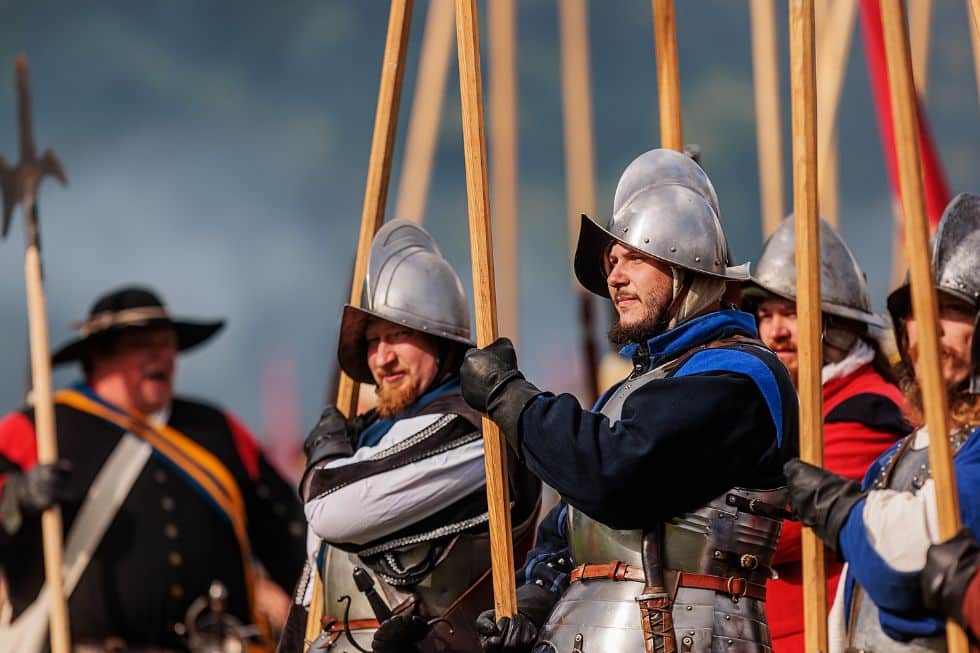
During the Thirty Years’ War (1618–1648) Europeans applied a logic of violence they had already experimented with locally in the Americas to their own population. The Reformation had conveniently fractured Europe into two competing “civilizations,” Catholic and Protestant. Many of today’s historians frame that painful episode as a combat for the “internal colonization” of Europe, in which tactics of total war, demographic displacement and state-sanctioned plunder were perfected at home before being exported globally to the rest of the world, usually in the name of profitable commerce. The Dutch and English East India companies, both created at the cusp of the 17th century, led the way abroad.
Long before today’s paragons of bellicosity, Trump and Bibi Netanyahu, two enterprising military leaders — Holy Roman Empire commander Albrecht von Wallenstein and the brilliant general, Count Tilly, author of the traumatizing Sack of Magdeburg in 1631 — distinguished themselves as engineers of industrial caliber violence against the Protestant enemy. England offered its own acolyte: Oliver Cromwell, who honed his trade with particular efficacy in Ireland, gracing history with the Sack of Wexford in 1649. Many historians consider Wallenstein, who was also a businessman, the godfather of our modern military-industrial complex. For three full decades, both sides justified massacres, torture and executions of religious opponents as “justice” or “purification” carried out explicitly in the name of their faith.
Geoffrey Parker is perhaps the most eminent but certainly not the only historian to argue that the Thirty Years’ War spawned a level of professionalized violence and logistical ruthlessness that changed European behavior for centuries to come. A taste for ideologically or ethnically motivated violence became implanted in the European mindset. Most of the action was concentrated in what is now modern Germany, though it quickly spilled over into much of central Europe. Thirty years of chaos spread across Bohemia, Silesia, the Rhineland, Saxony, Swabia, Bavaria and northern Germany along the Elbe and Oder. The “Westphalian Order” that eventually emerged in 1648 had the effect not only of ending what seemed an interminable conflict, but also drafting a new set of rules that would ultimately define our modern world order as a system dominated by nation states.
In his book, Imperialism, Sovereignty and the Making of International Law, Antony Anghie suggests that the culture generated by a 30-year conflict followed by the new Westphalian order encouraged European leaders to “export” the continent’s inherent chaos and violence to the Americas, Africa and Asia.
What Europe managed to do for itself in 1648 provided a model to be imposed, mutatis mutandi, to the rest of the world. At the Berlin Conference (1884–1885), the actively colonizing powers of Europe, inspired by the lessons of Westphalia, duplicated it by devising a much needed extension. They divided an entire continent, Africa, into appendages of the now well constituted nation states of Europe.
Following a logic derived from Wallenstein’s “businesslike” approach to conquest codified as “effective occupation,” the Berlin assembly of civilized nations established what appeared to be a rational principle: European powers couldn’t just claim land; they had to demonstrate they could control and exploit it.
From Westphalia to Berlin, the entire philosophy of war as practiced by Europeans took on a new character. It has seen a few variations, but we see it playing out even today across our entire civilized Western culture, and not just in the mindsets of Yahoos with names like Trump, Netanyahu and Pete Hegseth. Their mindset took a very tangible form on the American continent in the 19th century when it was formulated as “manifest destiny.” That same doctrine appears evident today as the driver of Israel’s actions regarding not only its permanently occupied population, which it seeks to ethnically cleanse, but also in the fact that Netanyahu’s government has also become specialized in exporting the idea to all its neighbors. Europe was content with 30 years of brutality 400 years ago. Israel appears to be stretching its war of cruelty to a record-breaking 80 years. Christian fundamentalists in the US are applauding it as the first act of the Apocalypse.
In light of the violence of our ongoing wars in Iran, Gaza, Lebanon and Ukraine, we might find the idea of reflecting on the historical significance of Europe’s devastating Thirty Years’ War as at least theoretically instructive. Parker, cited above, explains why we should pay attention to history in a video recorded ten years ago. Listening to it today, it’s impossible to dismiss the impression that it’s a commentary on current events. Parker warned us at that time that our policies were “perhaps precipitating the worst economic crisis since the Depression.” He encourages us to “start organizing for the next disaster.” It’s a sobering thought to think that at the time of the recording, it wasn’t Trump the warmonger but Barack Obama, the “peace president,” who was reigning over the US and “the free world.”
The German model
The heritage of the traumatic war that devastated Europe in the 17th century has endured and persisted. The most extreme near-contemporary example was, of course, Nazi Germany. This might lead us to conclude that Germany stands out as the culture most inclined towards extreme cruelty. Germans have long been aware of this. Postwar Germany struggled to find the corrective and finally came up with a solution: its “culture of remembrance” (Erinnerungskultur). As a nation, post-World War II Germans are expected to draw the consequences, even on a personal level, of the shame of the Holocaust.
But a strategy designed to repair or at least prevent from repeating the errors of the past hasn’t produced the expected results. Instead of becoming hypersensitive to the evil associated with acts of genocide, all recent German governments not only consciously ignore manifest genocide when practiced by its historical victims, they appear to regard it as a “right” Israel earned due to the suffering Germany subjected them to.
But it doesn’t stop there. Within its own borders, Germany has restricted free speech by enforcing a strict adherence to the IHRA definition of antisemitism that conflates criticism of the policies of the manifestly bellicose government of Israel with antisemitism. Authorities mobilize the laws against those who think differently. Berlin and Frankfurt have banned pro-Palestinian demonstrations and have clamped down in many cases with excessive use of force. One of the most controversial (and absurd) aspects is the targeting of Jewish artists and intellectuals. For example, the “Jüdische Stimme” (Jewish Voice for a Just Peace in the Middle East) has had its bank accounts frozen and its events canceled by state authorities.
Do the German authorities believe that this is an appropriate way to express their people’s shame and exorcise their ancestral guilt for actions conducted nearly a century ago? The rest of the world may see through the charade. Germany’s fanatical defense of a nation that demonstrates day after day its own taste for fanatical violence indicates that the Germans have failed to learn the true meaning of the dictum “never again.”
If the damage these behaviors and laws have done to democracy was limited to Germany alone, there might be less reason to complain. But we can now see that German media barons have begun applying it beyond their own borders. Mathias Döpfner, the chairman and CEO of Axel Springer, heads a media group that includes WELT, BILD, Politico, Insider and Morning Brew and most recently, in March 2026, one of the pillars of the British press, The Telegraph. Upon assuming ownership, Döpfner informed his British staff that they must align with what he calls his five “Essentials,” which he claims defines a framework for journalistic freedom while requiring intellectual commitment. Here are the five points:
- We stand for freedom, freedom of expression, the rule of law and democracy.
- We support the right of Israel to exist and oppose all forms of antisemitism.
- We advocate the transatlantic alliance between the United States and Europe.
- We uphold the principles of a free-market economy.
- We reject political and religious extremism, as well as all forms of discrimination.
Döpfner urged those who disagree, including on Israel and antisemitism, to seek work elsewhere.
It’s time for this Devil’s Advocate to ask a diabolically significant question: Why is Germany as a political entity so consistently attracted to the practice of genocide?
And I’ll add one more: Germany committed no less than two historical genocides in the 20th century. The first took place in its colony in Namibia in 1907. Why does Döpfner insist on imposing his nation’s penchant for genocide on the outside world? While doing so, he mocks a pair of ideas long associated with the practice of legitimate democracy: freedom of speech and journalistic integrity.
Recently, Germany’s chancellor, Friedrich Merz, vowed to build “Europe’s strongest army.” This leads me to wonder: Have we learned nothing from the history of the Thirty Years’ War, the 1884 Berlin Conference or Hitler’s Third Reich? Or have we simply learned all the wrong things and forgotten what counts?
*[The Devil’s Advocate pursues the tradition Fair Observer began in 2017 with the launch of our “Devil’s Dictionary.” It does so with a slight change of focus, moving from language itself — political and journalistic rhetoric — to the substantial issues in the news. Read more of the Fair Observer Devil’s Dictionary. The news we consume deserves to be seen from an outsider’s point of view. And who could be more outside official discourse than Old Nick himself?]
[Lee Thompson-Kolar edited this piece.]
The views expressed in this article are the author’s own and do not necessarily reflect Fair Observer’s editorial policy.
Is Europe a Possessed Continent?
Europe’s crisis runs deeper than economics or politics — it’s both an identity crisis and a spiritual collapse. Its leaders...

The Devil’s Advocate in a World Without Saints
Modern society has abandoned its search for saints, both religious and political. Since the Vatican eliminated the Devil’s Advocate role...
Europe Endorses Assisted Dying: Its Own Suicide
European leaders are now invoking "existential threats" from Russia to justify military spending, a trend Shakespeare seems to have adumbrated...
Europe’s Scripted March to War
From Washington’s cherry tree to today’s war rooms, lying about what you did became democracy’s unforgivable sin while the deeds...

The Devil’s Advocate: Europe’s Accelerating Descent into Hell
When we learned of “the end of history,” a little over three decades ago, our geopolitical meteorologists forecasted sunny skies...
Support Fair Observer
We rely on your support for our independence, diversity and quality.
For more than 10 years, Fair Observer has been free, fair and independent. No billionaire owns us, no advertisers control us. We are a reader-supported nonprofit. Unlike many other publications, we keep our content free for readers regardless of where they live or whether they can afford to pay. We have no paywalls and no ads.
In the post-truth era of fake news, echo chambers and filter bubbles, we publish a plurality of perspectives from around the world. Anyone can publish with us, but everyone goes through a rigorous editorial process. So, you get fact-checked, well-reasoned content instead of noise.
We publish 3,000+ voices from 90+ countries. We also conduct education and training programs
on subjects ranging from digital media and journalism to writing and critical thinking. This
doesn’t come cheap. Servers, editors, trainers and web developers cost
money.
Please consider supporting us on a regular basis as a recurring donor or a
sustaining member.
Will you support FO’s journalism?
We rely on your support for our independence, diversity and quality.





Comment