






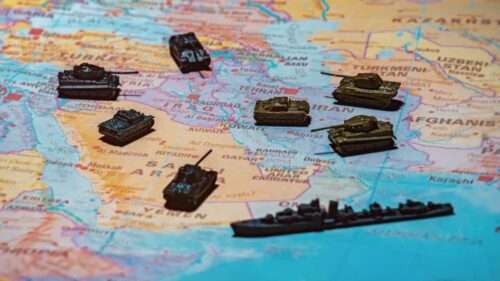
Unlike last year’s 12-day conflict, in which Iran’s nuclear facilities were the main targets, this year’s US-Israeli war with Iran has produced much broader and more dangerous results. In addition to military targets and key regime figures, including Supreme Leader Ali Khamenei, energy infrastructure in Iran has also been hit. Iran’s retaliation has also been different this time. It is no longer directed only at Israel. Iran has also targeted Gulf countries and other Arab states in the region, justifying this by pointing to the presence of US military bases. Most importantly, it has targeted energy infrastructure and effectively closed the Strait of Hormuz, causing severe disruption in energy markets and supply chains.
Although the global transition to renewables is gaining momentum, the energy crisis during the Iran war has underscored a basic lesson: Oil and gas remain indispensable for a while, and no serious energy policy can neglect security, redundancy and resilience during the long years of this expected transition.
Therefore, a sound energy policy should pursue renewable energy while strengthening energy security. Strategic stocks, resilient pipelines, alternative routes and reliable firm power, such as nuclear, still matter because governments do not manage energy systems in theory. They manage them in the midst of shocks, shortages and war.
A chokepoint shock that markets cannot innovate away overnight
In 2025, around 20 million barrels per day of crude oil and petroleum products moved through the Strait of Hormuz. That was roughly a quarter of the world’s seaborne oil trade, and around 80% of it was destined for Asia. These numbers explain why the Iran War is not a regional event for energy markets. When Hormuz closed, the shock spread immediately through oil prices, insurance costs and physical supply, especially for Asian importers.
For months, many analysts had already warned that if a US and Israeli attack on Iran began, Tehran’s greatest leverage would be the Strait of Hormuz. Yet despite that, the Trump administration openly said that it did not expect Iran to close the strait. That was not simply a miscalculation. It was a serious policy failure that ignored an obvious strategic risk.
As the war has continued, fuel supply problems have begun to emerge, including shortages in gasoline and petroleum products. Some Asian refiners have stopped external sales, and prices have surged globally. In the US, the average gasoline price rose by nearly 35% after the war began, while debates over oil export restrictions resurfaced and sanctions on Russian oil were eased.
Meanwhile, the US has continued to threaten that keeping Hormuz closed would carry heavy consequences for Iran. Yet despite threats, potential military escorts and emergency measures, no truly reliable solution has emerged. That is why the search for alternatives has accelerated. The decision by the International Energy Agency (IEA) and its member countries to coordinate a 400-million-barrel emergency stock release in March was important, but such a measure only buys time. If war continues, it cannot substitute for real supply security. Because no government can replace a chokepoint-scale flow with brand-new infrastructure or a fully transformed vehicle fleet in a matter of months. That is why governments need a balanced approach that pushes decarbonization forward while also building buffers and alternatives for future crises.
Fossil fuels remain the base of the system
The uncomfortable baseline is that the global economy still runs mostly on fossil fuels. In 2024, fossil fuels still accounted for 86% of the global energy mix, which means that oil, gas and coal remain the foundation of the system even as cleaner sources expand. This structural fact shows that the world still moves goods, powers industry, heats buildings and supports global trade through fossil-based systems.
The same pattern is visible in the gas trade. Liquefied natural gas (LNG) is not a marginal fuel in today’s economy. GIIGNL reports 406 million tonnes of global LNG trade in 2024. And these volumes matter because crises rarely hit only crude oil. Disruption also affects refined products, gas logistics, petrochemicals, shipping networks and industrial production.
In other words, even a strong renewable build-out does not instantly eliminate dependence on oil, gas and the global infrastructure that moves them. Pretending otherwise only sets governments up for policy panic when the next shock arrives.
Renewables are growing, but the denominator is huge
None of this is an argument against renewables. It is an argument for realism about scale. For example, the transition is real, especially in the electricity sector. In 2024, renewables provided 32% of global electricity generation. But the broader economy changes much more slowly. Modern renewables accounted for only 13% of global total final energy consumption in 2022, which shows how difficult it is to decarbonize heat, heavy industry and transport at the system level.
Transport is a good sign of this gap between fast growth and limited total impact. Global electric car sales exceeded 17 million in 2024, yet the total electric car fleet reached only about 58 million, or roughly 4% of the global passenger car fleet.
Even the clean energy build-out still depends on carbon-intensive industrial production today. Around 70% of global steel relies heavily on coal. In other words, electrification and renewables are expanding fast, but the denominator is so large that the overlap period will be long. For years to come, energy security planning will have to assume that societies need both cleaner systems and conventional fuels at the same time.
Security tools that work in a crisis
In the short run, the first tool available in a crisis is emergency stocks. That is exactly why they exist, as can be seen in the IEA’s largest coordinated stock release in March. But emergency stocks are a bridge, not a new supply system. The more important question is what happens when a disruption lasts longer.
This brings us to pipelines and alternative routes. Existing bypass capacity around Hormuz remains limited relative to the scale of normal flows. The IEA estimates that only 3.5 to 5.5 million barrels per day can be redirected through existing pipelines. The main examples are Saudi Arabia’s East-West pipeline from Abqaiq to Yanbu, which provides access to the Red Sea, and the United Arab Emirates’ Abu Dhabi crude oil pipeline to Fujairah, which bypasses Hormuz by reaching the Gulf of Oman. Their value is not theoretical. During the current war, Saudi exports from Yanbu rose to nearly 4 million barrels per day as volumes were rerouted away from the Strait of Hormuz.
Another example, although far too small to replace Hormuz and not directly located in the Gulf, is Iraq’s northern export route through the Iraq-Turkey pipeline, which ends at Ceyhan on the Mediterranean. After being largely inactive for the past two years, the pipeline resumed operations in March at around 170,000 barrels per day, with plans to increase flows toward 250,000 barrels per day.
These volumes are still too small to bypass Hormuz, but that is not the point. Countries with alternatives can better absorb shocks. Countries with only one route cannot. Optionality is not a luxury in energy security. It is one of its basic conditions. Pipelines, LNG terminals, storage, multiple entry points and diversified contracts all improve resilience because they reduce the cost of disruption and increase bargaining power in a crisis.
Nuclear is still part of the balance
Another important part of a balanced policy is firm, low-carbon power that does not depend on daily fuel shipments through contested sea lanes. That is where nuclear still matters. Europe’s recent energy experience, first with Russian supply risk and now with the shock created by the Iran war, has pushed many leaders to see energy policy not only as a climate issue but as a strategic one. This is why the debate around nuclear has returned so strongly.
In 2024, nuclear power plants in 12 EU countries produced 23.3% of the EU’s electricity. That is not a marginal share. It is a major pillar of supply security as well as decarbonization. The political debate in Europe reflects this reality. In March 2026, President of the European Commission Ursula von der Leyen said that Europe’s decision to let nuclear power’s share fall from about one third of electricity generation in 1990 to around 15% today was a “strategic mistake.”
Germany illustrates the same tension. Even after shutting its reactors, debate continues over whether some nuclear capacity could return if price pressures and import dependence worsen. The implication is not that every country must expand nuclear power. It is that removing firm options before credible replacements are fully in place raises the cost of every geopolitical shock and makes policy reversals more likely when a crisis hits.
As prices rise and import dependence becomes more politically costly, arguments for rethinking earlier decisions return. That alone shows the issue remains alive whenever security and affordability come under pressure.
Build the future, but defend the present
The clean energy transition is moving, especially in electricity. But the Iran War is a blunt reminder that energy systems change more slowly than geopolitics. States should invest aggressively in renewables, grids, storage and electrification because these reduce dependence on imported fuels over time. But they also need a security portfolio for the overlap years.
That portfolio should include strategic stocks that can be released quickly, diversified supply chains for LNG and refined products, resilient routes that bypass chokepoints where possible and reliable firm power where politically viable. It also means maintaining and modernizing pipelines and interconnectors, not as an alternative to decarbonization, but as insurance during an unstable transition.
The central policy inference is simple. Build the future, but do not leave the present undefended.
[Kaitlyn Diana edited this piece.]
The views expressed in this article are the author’s own and do not necessarily reflect Fair Observer’s editorial policy.
The Disruptive Iran War, Limits of Western Power and Moral Costs of Grotesque Imperialist Wars
Western imperialism persists through economic sanctions, military interventions and control over global resources, as seen in Venezuela and Iran. Nations...
FO Exclusive: The Dangerous Implications of the New US/Israel–Iran War
In this section of the March 2026 episode of FO Exclusive, Atul Singh and Glenn Carle highlight how Iran’s decentralized...

Why a Fragmented Iran is Israel’s Greatest Security Threat
The dissolution of the Iranian state into smaller ethnic or sectarian entities is a catastrophic miscalculation in 2026. Rather than...
Support Fair Observer
We rely on your support for our independence, diversity and quality.
For more than 10 years, Fair Observer has been free, fair and independent. No billionaire owns us, no advertisers control us. We are a reader-supported nonprofit. Unlike many other publications, we keep our content free for readers regardless of where they live or whether they can afford to pay. We have no paywalls and no ads.
In the post-truth era of fake news, echo chambers and filter bubbles, we publish a plurality of perspectives from around the world. Anyone can publish with us, but everyone goes through a rigorous editorial process. So, you get fact-checked, well-reasoned content instead of noise.
We publish 3,000+ voices from 90+ countries. We also conduct education and training programs
on subjects ranging from digital media and journalism to writing and critical thinking. This
doesn’t come cheap. Servers, editors, trainers and web developers cost
money.
Please consider supporting us on a regular basis as a recurring donor or a
sustaining member.
Will you support FO’s journalism?
We rely on your support for our independence, diversity and quality.





Comment