


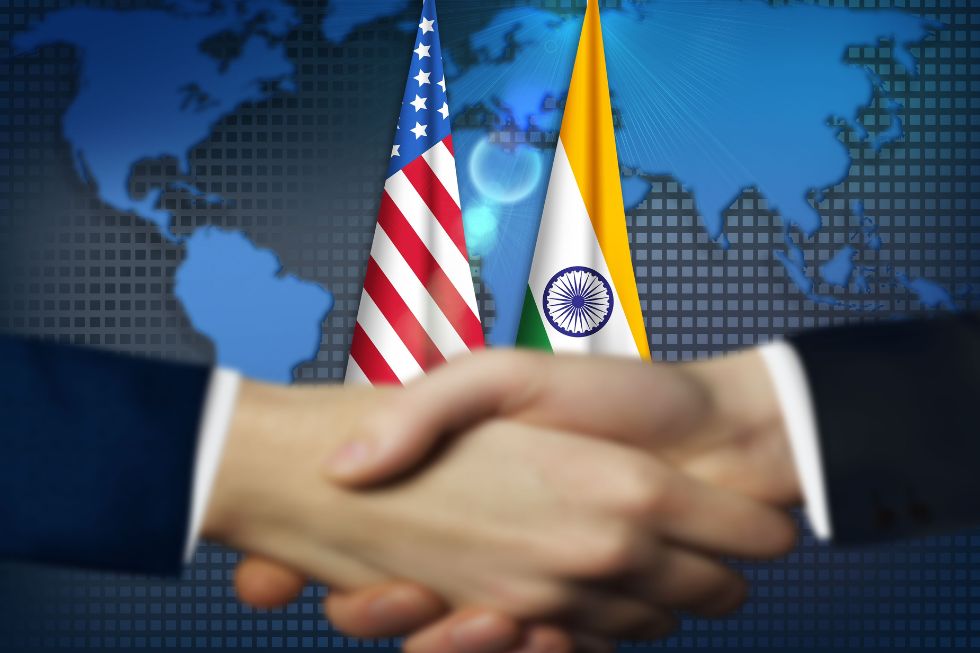



The recent India-US trade deal offers limited economic gains despite being presented as a diplomatic success. The agreement reduces reciprocal US tariffs on Indian goods to 18%, but the material benefits appear modest when assessed against regional competitors. Negotiations unfolded under visible political pressure from Washington, a dynamic that many in New Delhi viewed as unusually forceful for a country officially described as a strategic partner.
Tariffs in a crowded Indo-Pacific market
The 18% tariff rate is only marginally lower than those applied to other Indo-Pacific exporters. Vietnam faces tariffs of approximately 20%, Bangladesh around 19%, while Japan and South Korea are subject to rates closer to 15%. China, despite being framed as Washington’s principal geopolitical competitor, currently faces a nominal reciprocal tariff rate of about 10%. Additional sanctions and trade restrictions, however, are likely to raise China’s effective tariff burden to around 30%. In practical terms, India’s advantage over many competitors may amount to only two to three percentage points in several sectors. This margin is frequently absorbed by structural cost differences rather than translating into sustained competitiveness.
In the apparel sector, valued at roughly $120 billion annually in US imports, India exports about $9 billion, accounting for approximately 7% of the market. Vietnam exports over $22 billion, Bangladesh around $11 billion and China, despite tariff pressures, continues to ship more than $25 billion. Operating margins in apparel typically range between 3% and 6%, meaning that a modest tariff differential is often outweighed by Bangladesh’s labor cost advantages and Vietnam’s scale efficiencies and faster production cycles.
Electronics and electrical machinery present an even starker contrast. US imports in this category exceed $500 billion annually, yet India’s exports remain relatively small, at an estimated $11–13 billion. Vietnam exports more than $43 billion in electronics to the US market, while China’s shipments remain above $120 billion despite diversification efforts. These disparities reflect deeper structural factors, including component ecosystems, logistics integration and supply-chain reliability — areas where tariff relief alone offers limited leverage.
Pharmaceuticals are frequently cited as a comparative strength for India. The US imports more than $230 billion worth of pharmaceutical products annually, and Indian firms supply roughly $13 billion in finished formulations and active pharmaceutical ingredients, accounting for nearly 40% of US generic prescriptions by volume.
Historically, tariffs in this sector were minimal, but since October 2025, the US has imposed a 100% tariff on branded and patented drugs to incentivize domestic manufacturing. The trade deal leaves these measures unchanged, limiting its relevance for Indian pharmaceutical exporters. In this sector, competitiveness is shaped more by regulatory approvals, intellectual property regimes and compliance costs than by customs duties.
Indian goods exports to the US total approximately $86 billion annually. Even an optimistic export expansion of 6–8% under improved tariff certainty would generate only $5–7 billion in additional exports. After accounting for imported inputs, exchange-rate effects and trade elasticity, the net impact on India’s GDP is estimated at around 0.15–0.3%. For an economy approaching $4 trillion, the gain is measurable but far from transformative.
Oil diplomacy and the cost of alignment
Parallel to trade discussions, political attention has focused on India’s purchases of Russian crude oil. India imports roughly 5.2 million barrels of oil per day, amounting to nearly 1.9 billion barrels annually. In recent years, approximately 35% of these imports have come from Russia.
Russian Urals crude has typically traded at a discount of about $8–10 per barrel relative to Brent benchmarks. At an average discount of $8, India’s annual savings on roughly 550–600 million barrels could approach $5 billion, rising toward $6 billion when discounts widen. Replacing these volumes entirely with North American crude oil, relative to the West Texas Intermediate (WTI) benchmark, would eliminate this discount. This could potentially increase India’s import bill by $4–6 billion each year. Additional freight and insurance costs associated with Atlantic routes could increase expenses by a further $0.5–1.5 billion annually. Moreover, refineries optimized for medium-sour Urals blends may require technical adjustments, entailing capital expenditure and temporarily reduced refining margins. These costs are comparable to the projected export gains from tariff relief.
Concerns are further amplified by indications that India may reduce or eliminate tariffs on a wide range of US industrial and agricultural goods. The US currently exports around $40 billion worth of goods to India each year, including aircraft, advanced machinery, medical devices, chemicals, energy products and agricultural commodities. Significant tariff reductions would likely benefit US capital goods manufacturers, which operate at larger scales and with higher automation intensity.
In agriculture, US producers of corn, soybeans, dairy and processed foods combine high productivity with extensive federal support mechanisms. Increased access to the Indian market could exert downward pressure on domestic prices in sensitive categories, affecting millions of smallholder farmers whose margins are already thin. With agriculture supporting more than 46% of India’s workforce, the distributional consequences could be substantial, even if consumers see modest price declines.
Benefit first, pressure last
The broader policy environment also warrants consideration. US trade policy in recent years has been marked by volatility, with tariffs imposed, suspended and recalibrated in rapid succession. Any tariff advantage secured today could be eroded if Washington extends similar concessions to competing Asian exporters or introduces new measures in response to domestic political cycles. As a result, projected export gains remain inherently uncertain.
Taken together, the agreement offers India limited but tangible economic benefits while exposing it to potentially higher energy costs and intensified domestic competition. At the Munich Security Conference in February 2026, External Affairs Minister S. Jaishankar underscored that India’s decisions would be guided by calculations of economic interest and national priorities rather than external pressure. The durability of that principle may ultimately determine whether the trade deal proves advantageous beyond its headline figures.
[Luna Rovira edited this piece.]
The views expressed in this article are the author’s own and do not necessarily reflect Fair Observer’s editorial policy.
India is the Latest Target of America’s Economic Attrition Diplomacy
India’s trade negotiations with the US have been derailed by sudden tariffs, penalties and strategic pressure. This pattern of “economic...

FO° Talks: An Indian Foreign Secretary Makes Sense of Multipolarity
India’s former foreign secretary Kanwal Sibal shares his reflections on the changing global balance of power. We are living at...

Support Fair Observer
We rely on your support for our independence, diversity and quality.
For more than 10 years, Fair Observer has been free, fair and independent. No billionaire owns us, no advertisers control us. We are a reader-supported nonprofit. Unlike many other publications, we keep our content free for readers regardless of where they live or whether they can afford to pay. We have no paywalls and no ads.
In the post-truth era of fake news, echo chambers and filter bubbles, we publish a plurality of perspectives from around the world. Anyone can publish with us, but everyone goes through a rigorous editorial process. So, you get fact-checked, well-reasoned content instead of noise.
We publish 3,000+ voices from 90+ countries. We also conduct education and training programs
on subjects ranging from digital media and journalism to writing and critical thinking. This
doesn’t come cheap. Servers, editors, trainers and web developers cost
money.
Please consider supporting us on a regular basis as a recurring donor or a
sustaining member.
Will you support FO’s journalism?
We rely on your support for our independence, diversity and quality.
The Fertilizer Fault Line: The Hidden System That Could Trigger the Next Global Crisis
Fertilizer, deeply tied to energy and concentrated supply chains, is a critical yet fragile foundation of global food systems. Disruptions...

Monetizing Carbon Markets Now: The Results India Needs
India’s farmers produce a sizable chunk of the country’s carbon dioxide (CO2) emissions, and if we are to slow climate...

Big Agribusiness: A Look at Brazil’s Disastrous Rural Feudalism
Agribusiness has made Brazil the world’s largest net exporter. Due to historic property laws, however, land ownership remains a major...






Comment