


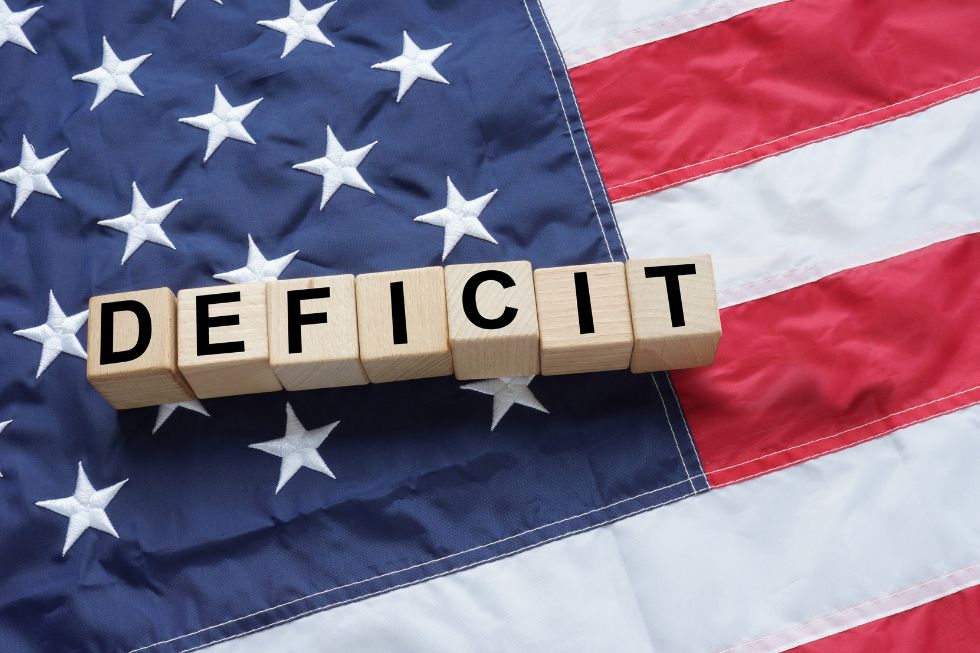



Tariffs built a dam, but the river found the ocean anyway.
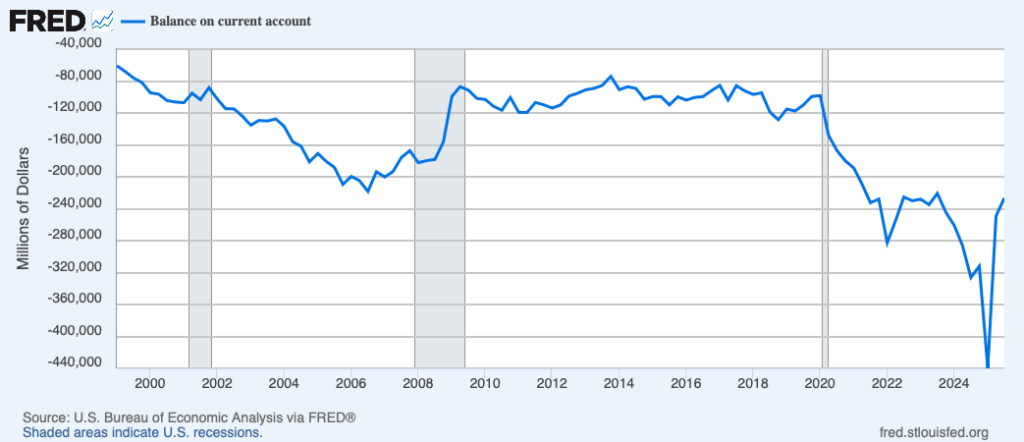
In 2025, the US goods trade deficit reached $1.24 trillion, the largest on record. This occurred even after the average tariff rate climbed sharply from 2.6% to 13%. At first glance, this appears contradictory. If tariffs raise the cost of imports, shouldn’t imports fall and the trade deficit shrink?
The persistence of the deficit suggests something deeper. Trade balances are not simply the outcome of border policy. They are the visible expression of macroeconomic forces — capital flows, savings behavior, fiscal policy and global industrial strategy. Tariffs can reshape the shoreline of global commerce. But they do not change the gravitational pull beneath the surface.
The arithmetic beneath the politics
The trade deficit is often framed as a competitiveness problem. In reality, it is fundamentally a savings–investment identity. When a country invests more than it saves domestically, it must borrow the difference from abroad. That capital inflow necessarily corresponds to a current-account deficit.
The US runs large fiscal deficits while simultaneously attracting global investment into technology, infrastructure, artificial intelligence and capital markets. Foreign capital flows into Treasury securities, equities and real estate because of the depth, safety and liquidity of US markets. This inflow strengthens the dollar. A strong dollar makes imports cheaper and exports more expensive, widening the trade deficit.
In that sense, the deficit is not purely a symptom of weakness. It is partly the byproduct of strength — of being the world’s primary financial hub and reserve currency issuer.
If the US eliminated its trade deficit tomorrow without raising national savings, something else would adjust. Either domestic investment would fall — reducing future productivity and growth — or the dollar would depreciate sharply, altering global financial conditions. The deficit finances real economic activity. The critical question is qualitative: Is the borrowing funding productive investment or unsustainable consumption?
Tariffs focus attention on the symptom — imports — rather than on the balance sheet dynamics underneath.
Attempting to erase the deficit with tariffs alone is like trying to shorten your shadow by scraping the pavement. Unless the position of the sun changes, the shadow remains.
The wall and the detour
The 2025 tariff increases significantly reduced China’s share of US imports, pushing it below 10%. But total US imports did not collapse. Instead, sourcing shifted toward Mexico, Vietnam and other emerging manufacturing hubs. Supply chains reorganized.
This illustrates a second structural truth: Modern trade flows are adaptive. Close one channel, and another opens. Tariffs altered geography more than magnitude.
Empirical research indicates that roughly 90% of the tariff burden in 2025 fell on US firms and consumers, not foreign exporters. Import prices rose substantially, while exporters reduced prices only modestly. In practice, tariffs functioned largely as a domestic price increase.
This has important consequences. US manufacturers reliant on imported inputs faced higher costs. Consumers encountered higher prices. Rather than eliminating global linkages, firms rerouted production networks. A semiconductor might be fabricated in one country, assembled in another and integrated into final goods elsewhere. Global supply chains resemble a web, not a line. Tugging one strand redistributes tension across the network.
Tariffs act like a dam across a river. For a moment, water pools behind it. But unless the river’s source dries up, pressure builds, and the water eventually finds a path around or through the barrier. Trade volumes shift and reorganize, but the underlying demand remains.
The export engine abroad
While the US escalated tariffs, surplus economies such as Germany, Japan and South Korea reinforced export competitiveness through industrial subsidies, energy support and financial assistance.
Germany’s current-account surplus remains around 5% of GDP, while China’s is projected 3.3%. These figures reflect deliberate economic strategies. For many surplus nations, manufacturing underpins employment, technological capability and political stability. Shrinking trade surpluses would require boosting domestic consumption — often through wage growth, structural reform or reduced precautionary savings. Such transitions are politically sensitive and slow-moving.
From Washington’s perspective, surplus persistence appears unfair. From Berlin or Tokyo’s perspective, export strength represents economic resilience. Each country operates within its own political economy constraints.
This creates a coordination dilemma. If multiple countries pursue export-led growth simultaneously, someone must run a deficit. For decades, the US has filled that role, supported by its reserve currency and financial depth.
The global economy resembles a circulatory system. Surplus countries pump goods outward and accumulate savings. The US absorbs those savings and provides demand. Tariffs introduce friction into this bloodstream, but they do not change the heart’s rhythm.
Growth, investment and the productive deficit
Not all trade deficits are created equal. A deficit driven by consumption of imported consumer goods differs from one associated with high levels of capital investment.
In recent years, much US import demand has been tied to capital goods and intermediate inputs supporting technology and infrastructure expansion. Data centers, semiconductor equipment and advanced manufacturing facilities often rely on globally sourced components. In the short run, such imports widen the trade deficit. In the long run, they may raise productivity and income.
This distinction complicates the narrative. If the deficit finances future growth, its existence may not be inherently destabilizing. The problem arises if borrowing fuels asset bubbles or unsustainable fiscal trajectories.
Tariffs, however, do not discriminate between productive and unproductive imports. They increase costs across categories.
What would true rebalancing require?
Reducing the trade deficit structurally would require adjustments beyond border measures. On the US side, higher national savings — through fiscal consolidation or policy reforms encouraging household saving — would narrow the savings-investment gap. On the surplus side, stronger domestic demand and consumption would reduce reliance on exports.
Such changes are politically complex. Fiscal tightening is rarely popular. Structural reforms abroad challenge entrenched industrial and social arrangements. Tariffs, by contrast, are visible and unilateral. They signal resolve even if they do not transform fundamentals.
The persistence of the US trade deficit demonstrates that trade balances are anchored in deeper macroeconomic realities. Tariffs can redirect shipments, alter sourcing patterns and raise prices. They can reshape the coastline of trade. But they cannot change the gravitational forces of savings, investment and global capital flows.
Until the underlying incentives that drive capital and production shift, the deficit will likely endure — changing form, perhaps changing partners, but reflecting the same structural logic. The question is not whether tariffs can block the waves. It is whether policymakers are willing to alter the forces that move the sea itself.
[Kaitlyn Diana edited this piece.]
The views expressed in this article are the author’s own and do not necessarily reflect Fair Observer’s editorial policy.
Tariffs, Treasuries and the Quiet Risk to America’s Financial Power
Trade has not collapsed under tariffs; it has rerouted, as firms and countries adapt supply chains and sourcing strategies. But...

Tariffs, Strategy and the Cost of Misplaced Power
US tariffs aimed at constraining China have spurred Beijing to strengthen its strategic position. It’s embedded its manufacturing and innovation...
Why Trade Is Critical and Tariffs Fail
International trade greatly benefits the United States and supports 41 million American jobs, contributing to higher wages in export-intensive industries....
Support Fair Observer
We rely on your support for our independence, diversity and quality.
For more than 10 years, Fair Observer has been free, fair and independent. No billionaire owns us, no advertisers control us. We are a reader-supported nonprofit. Unlike many other publications, we keep our content free for readers regardless of where they live or whether they can afford to pay. We have no paywalls and no ads.
In the post-truth era of fake news, echo chambers and filter bubbles, we publish a plurality of perspectives from around the world. Anyone can publish with us, but everyone goes through a rigorous editorial process. So, you get fact-checked, well-reasoned content instead of noise.
We publish 3,000+ voices from 90+ countries. We also conduct education and training programs
on subjects ranging from digital media and journalism to writing and critical thinking. This
doesn’t come cheap. Servers, editors, trainers and web developers cost
money.
Please consider supporting us on a regular basis as a recurring donor or a
sustaining member.
Will you support FO’s journalism?
We rely on your support for our independence, diversity and quality.





Comment