

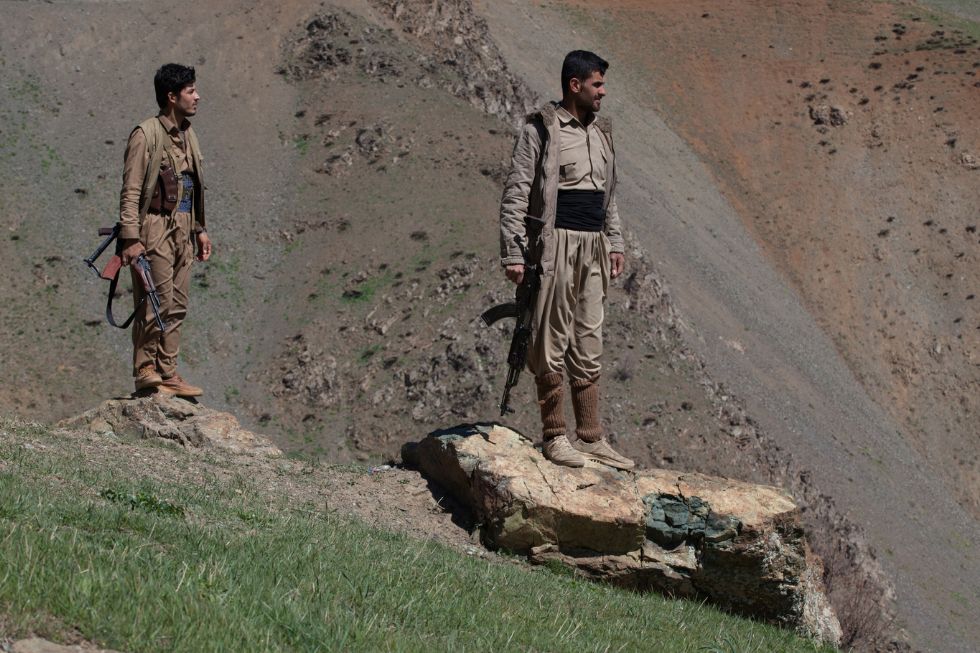



With war breaking out between the US, Israel and the Islamic Republic, many have begun speculating about what the next phase of the war might be. As the Ayatollahs in Tehran face Israeli and American bombs from the sea and sky, the prospect of a serious military challenge on the ground is looming. Spectators and political analysts are left wondering if we will see the start of an internal uprising against the regime. Given the century of political struggle by the Kurds in Iran, all eyes are fixating on them as the likely force to challenge the Islamic regime in ground operations inside Iran.
Early signals of external encouragement and rising attention
On the first day of the war, US President Donald Trump addressed the Iranian people and urged them to seize the momentous opportunity by taking over their government once America and Israel are done destroying the regime. His message was positively received by opposition groups and activists as it suggested that the US was serious about using its military might to weaken the brutal regime and pave the way for conditions for internal political change.
Days later, the Kurds of Iran became the focus of international attention after CNN reported that the Central Intelligence Agency (CIA) was looking to arm Kurdish groups based across the border to spark an uprising against the regime. While the report suggested Kurdish fighters could engage Iranian forces in western Iran or seize territory in Kurdish regions in a ground operation, it framed the Kurds more as proxies comparable to terrorist Iranian militias in the region rather than a stateless nation with more than a century-long struggle for self-determination.
Consequently, Kurdish political parties strongly refuted the claims by publicly denying any requests from the US or Israel to launch such operations. Nevertheless, the Kurds and US administration came under intense scrutiny due to the negative framing of the development that President Trump had made a phone call to not only Kurdish leaders in Iraq but also to Mustafa Hijri, the leader of the Democratic party of Iran (PDKI), whose party was crucial in the formation of a multi-party coalition known as the Coalition of the Political Forces of Iranian Kurdistan (CPFIK).
Mixed messaging and cautious Kurdish calculations
In the days following this coverage, Trump was asked about Kurdish forces potentially becoming involved in the conflict by Reuters. He initially described Kurdish participation as a “wonderful” idea, but walked back his statement days later by stating that he did not want to further complicate the conflict or endanger Kurds by getting them involved. This left many Kurds wondering whether they could rely on America as an ally, given the President’s mixed messages and what they had witnessed recently in Rojava, where the Trump Administration abandoned the Kurds in support of the new Jolani government.
The combination of attention and ambiguity on exactly what the US and Israel want has made Kurdish leaders act cautiously while monitoring developments closely. As Komala leader Abdullah Mohtadi has repeatedly warned, the Kurds “will not send [their] forces to the slaughterhouse,” underlining that any move into Iran without clear guarantees and adequate support would be strategically reckless. Mohtadi added that the highly organized Kurdish parties, part of a new alliance, are ready to take up arms if supported by US air power, noting “10,000 strong” forces are prepared but fear attacks from Iranian forces without such backing.
In a recorded message to Fox News on March 9, Khaled Azizi, spokesperson for PDKI, emphasized that Kurdish forces are not rushing into the war. “We are not part of the ongoing war between Israel, the United States and the Islamic Republic,” Azizi explained, “But we have been struggling against this regime for many years.” He noted that the current conflict is primarily being fought through air and naval operations: “Right now, ground forces are not the topic.” Kurdish groups are therefore not currently preparing to cross into Iran in large numbers, but they do have many members on the inside. Azizi also highlighted that the Kurdish coalition is carefully watching developments and coordinating politically with other Iranian opposition groups.
His remarks suggest that the Kurdish strategy is to wait for a further weakening of the regime’s missile and drone capabilities while building an internal coalition of opposition groups, including Baluch, Ahwazi Arab and Azeri forces, along with other opposition to eventually confront the regime from within. This corresponds well with other sources that I have spoken to on the matter. Even without direct engagement from the Americans and Israelis, Kurdish leaders are preparing for the possibility of future operations, as the decimation of the IRGC’s infrastructure in the Kurdish regions may open the vacuum of power necessary for them to consolidate control. If attacks on the political, economic and military capabilities of the regime continue with intensity, the Kurds may develop the confidence to move into their regions in Iran sooner rather than later.
Military requirements and political risks of escalation
For Kurdish forces to engage in ground operations, they would likely require substantial support to counter the regime’s military capabilities. A no-fly zone over Kurdish regions in Iran, anti-drone defenses, air defense systems to intercept missiles and heavy weaponry capable of countering the IRGC would be crucial in not only taking territory but also keeping it. While the mountainous terrain of Iranian Kurdistan provides a natural defensive advantage, launching a large-scale campaign without a reduction in missile and drone threats would be extremely risky. Kurdish leaders are fully aware of these dangers and are therefore waiting for the right moment to act. Their cautious posturing is directly linked to both military realities and the broader political stakes within Iran.
Another factor curtailing possible operations is concerns about civil war. There are many accusations that Kurds are attempting to break up Iran. Such statements are not only misleading but also echo propaganda by the Islamic Republic and ultranationalist Iranians to justify attacks on Kurdish people and forces in Iran and across the world. For more than a century, Kurdish movements have consistently demanded autonomy for Kurdistan and democracy for Iran, not secession. A federal Iran represents a return to a historically grounded governance model that recognizes ethnic and cultural diversity while strengthening unity by allowing all peoples to preserve their identity through participation in a shared political system.
In contrast to narratives that paint Kurdish movements as inherently divisive, Kurds in other parts of Kurdistan, particularly in Iraq and Syria, have shown a strong preference for avoiding civil war with neighbors and maintaining cooperative relationships across ethnic and national lines. The semiautonomous Kurdistan Region in Iraq has functioned within a federal framework that balances Kurdish self-rule with peaceful coexistence with Baghdad and neighboring communities. Likewise, in northeastern Syria, Kurdish leaders have advocated for a democratic, decentralized system that protects Kurdish rights while recognizing equal citizenship for all Syrians. This history reflects a political tradition among many Kurdish movements of seeking coexistence and mutual respect rather than domination or secession.
As Qubad Talabani of the Patriotic Union of Kurdistan (PUK) rightly pointed out in a recent interview with the UK’s Channel 4, “Kurds are not just good fighters, they are also diplomats and negotiators.” PDKI’s US representative, Hejar Berenji, echoed similar sentiments, stating that:
The Iranian Kurds should not be seen as a security issue. We are not asking to be seen as a side story … We are part of the answer and the biggest chance at a democratic and great Iran and region.
Another factor that makes Kurdish efforts at autonomy likely in Iran is the strong Kurdish yearning for self-rule and the memory of the Kurdistan Republic, founded in 1946 in Mahabad by the PDKI. The Republic, often referred to by Kurds as Komar, remains a powerful symbol of both hope and possibilities for a generation of Kurdish youth who take great pride in their roots.
A potential turning point for Kurdish strategy
While the Kurdish coalition may be exercising caution now, it may not remain that way for long. Kurdish parties possess thousands of experienced forces, strong networks and organizational structures that may allow them to assert control over parts of Iranian Kurdistan if the Islamic Republic’s authority continues to weaken. The Kurdistan region of Iraq (KRG) may not be able to host Iranian Kurdish forces for much longer, given the heightened danger it poses to their security. Thus, even without direct foreign support, the coalition may seize the moment to carve out what territory it can in the Kurdish regions in Iran. Kurdish party leaders have stressed that for Iran’s Kurds “the priority is to overthrow the Islamic Republic,” but in a way that leads to a democratic, decentralized Iran in which “the rights of all nations and citizens are guaranteed,” not just those of the Kurds.
Kurdish consolidation of rule in western Iran could have consequences far beyond Kurdish areas in Iran. By consolidating control in parts of western Iran, the Kurds could trigger a domino effect, inspiring other marginalized regions and opposition movements across the country to assert control over territory and challenge the regime’s authority. The leadership in Tehran is well aware of this significant fact and knows the serious threat that Kurdish forces could pose to its power in the Kurdistan region in Iran. This is precisely why Iran’s president, Masoud Pezeshkian, recently warned Kurdish parties — referring to them as “certain groups and factions in neighboring countries” — not to join the conflict on the side of outside powers in his apology to regional countries that have been attacked by Iran.
The century-long struggle of the Kurds for autonomy, combined with the current military and political upheaval unfolding in Iran, has placed them at a historic crossroads where the wrong decision could doom them to another century of subjugation and assimilation. The decisions made by Iranian Kurdish leaders in the coming days and months could shape not only the future of the Kurdish region of Iran but also the broader course of Iran’s internal opposition movements and the status of the Kurds in Iran, the Middle East and on the international stage.
[Kaitlyn Diana edited this piece.]
The views expressed in this article are the author’s own and do not necessarily reflect Fair Observer’s editorial policy.





Join the conversation
Share your perspective
Log in to share your thoughts and take part in the discussion.