

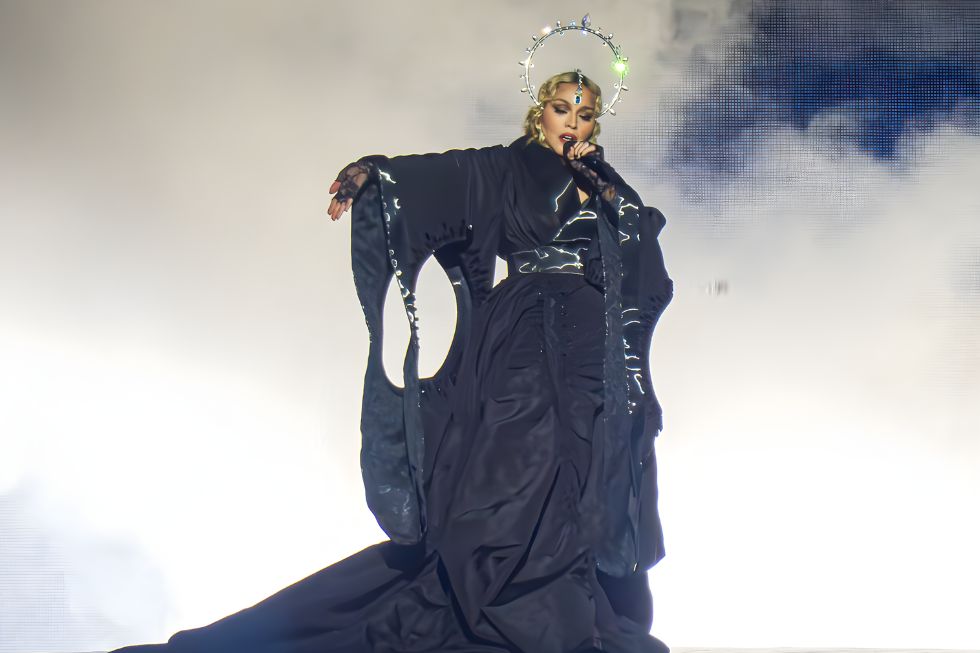


“I think the most controversial thing I’ve ever done is to stick around. I have seen many stars appear and disappear, like shooting stars. But my light will never fade.”
So says Madonna, with a measure of defiance. She’s someone who understands that endurance, not provocation, is her greatest transgression. She is now 67: For more than four decades, she’s offended religious leaders, unsettled moral guardians and insulted polite society. Yet none of those affronts has proved as subversive as her refusal to exit quietly. In a culture organized around novelty and replacement, she’s managed to weaponize longevity.
Madonna’s career might be seen as a sequence of calculated shocks: The wedding dress writhing of “Like a Virgin,” the supposedly sacrilegious imagery of “Like a Prayer,” the BDSM themes of Sex. A notable biography of her is subtitled A Rebel Life. But her subversive moments, however incendiary at the time, were ephemeral. If anything, her most renegade accomplishments often went relatively unnoticed. Like earning $50 million (£26.7 million), a record for a female singer in 2004. Or selling more than 400 million records, including albums, singles and digital. Grossing more than $1.3 billion from her tours, another record. In 1992, she signed a then-unprecedented $60 million deal with Time Warner.
But what really distinguishes Madonna is not the intensity of any single provocation or her prodigious earnings but the cumulative force of her continued presence. She’s outlived her critics, her imitators and many of her contemporaries. The real scandal is not what she did but that she survived so long.
Her endurance matters not simply because it is unusual but because it allowed her cultural experiment to take place. Over decades, Madonna tested the limits of exposure, turning private life into public performance until the distinction between the two appeared to dissolve. What started as provocation became a template for modern celebrity.
The zeitgeist
In February, she sat in the front row at Dolce & Gabbana’s Milan Fashion Week show, her arms wrapped around her knees, heavily tinted glasses shading eyes that have seen nearly every iteration of fame in the modern era. Leather gloves accessorized her black outfit, a theatrical flourish that harked back to her Erotica tour of 1992–93 (gloves, corsets and leather were part of the visual vocabulary she borrowed from fetish subcultures and, in that tour, repurposed for public consumption.) Across the mirrored runway, models twirled in lace and pinstripes, reflecting Madonna’s many incarnations of the past.
To call Madonna a diva is almost tautological. She is the very definition of a temperamental, world-renowned singer, famed for her volatile temperament and for being notoriously difficult to please. Formidable, demanding, exacting, she’s a force as likely to exhaust collaborators as she is to enchant audiences.
Her epigones and successors — Taylor Swift, Lady Gaga, Beyoncé, Ariana Grande, included — entertain, enchant, influence and inspire, yet all seem anodyne next to Madonna. None has matched her performative ferocity, her willingness to court scandal and alchemize controversy into precious metal. Forty years in, Madonna remains unrepentant, uncontainable, unyielding, the center of attention. She may no longer shape the zeitgeist on her terms, but she remains part of it.
In the 1980s, the world was barely aware of cellphones, the internet was inconceivable and social media was something English novelist H.G. Wells might have dreamt up. Madonna arrived in this landscape as a wannabe dancer who soon learned how to take the cultural pulse. She figured out that the press (as it then was) could either proclaim or annihilate her, that audiences rewarded artists who aroused as well as just entertained them, and who provided spectacle as well as song and dance. She decided to combine them all. In doing so, she did more than respond to a shifting world; she helped catalyze a further shift, scandalizing at every opportunity and dissolving the binary between private and public.
The experiment
Madonna Louise Ciccone moved to New York in 1978, a 20-year-old with nothing but ambition and a few borrowed instruments. She danced, drummed and sang with local bands before releasing her debut single “Everybody” in 1982 and her first album, Madonna, in 1983. By 1984, her second album, Like a Virgin, produced by Nile Rodgers, cemented her international status. The video for the title track and her performance at the MTV Video Music Awards in a wedding dress simulating masturbation was a foretaste of what was to come.
In 1985, few could imagine a woman deliberately inducing scandal and usually achieving the results she desired. Madonna’s real innovation lay in recognizing something earlier entertainers had missed: Scandal had changed its meaning. No longer necessarily career-ending — as it had been in the cases of Roscoe Arbuckle, Ingrid Bergman and Errol Flynn — controversy had become a resource. Madonna didn’t provoke randomly; she choreographed provocation, each gesture and outfit a calculated engagement with public sensibilities. Audiences, she seemed to conclude, actually enjoyed being outraged: the surge of anger, shock and indignation was oddly satisfying. This may appear obvious today. In the 1980s, it was radically contrarian.
Her 1989 album Like a Prayer marked what might have been a Eureka! moment. Madonna appeared to sense that audiences would demand ever more from stars. This was before MTV’s The Real World launched in 1992, allowing viewers to eavesdrop by watching what became known as reality TV. Madonna seems to have arrived at a broadly similar conclusion: Audiences were turning into peeping Toms.
Her ambition was not to shock for its own sake, but to maintain attention by disclosing more and more of what once passed as a private life — and without inhibition. Madonna became, in essence, her own living experiment in making her personal life open to inspection. Before her, entertainers like Elizabeth Taylor had, in the 1960s, allowed private lives to seep into public view via a more cautious media, but this was rare or sensational and delivered to surprised audiences by the then-nascent paparazzi. Madonna made it a career strategy, presenting her personal self as indistinguishable from her stage persona and inviting audiences to witness. Not just witness: Audiences were encouraged to judge her; condemning Madonna was integral to her success.
Like Semtex
The 1990s solidified Madonna’s role as a cultural provocateur. The film Madonna: Truth or Dare (1991) documented her Blond Ambition tour with unprecedented candor, offering glimpses into backstage rivalries, rehearsals and intimate moments, all alongside the theatricality of her onstage performances. The film predated reality television by years, yet already anticipated its voracious appetite for the minutiae of celebrity.
Around the same period, her book Sex and the album Erotica pushed boundaries of sexual representation, blending performance, fetishism and artifice. She intentionally offended, proving unequivocally that scandal was like Semtex, a powerful explosive, but very pliable so that, handled carefully, it can be turned into different shapes. In the years that followed, Paris Hilton and Kim Kardashian corroborated this when they appeared on sex tapes that would have ruined show business careers in earlier times.
Yet Madonna’s influence went beyond shock and outrage. Critics like Camille Paglia recognized her as a harbinger of postfeminist performance: She demonstrated how a woman could be sensual, assertive, ambitious and aggressive while curating her image in a way that conferred power. From this perspective, being sexy was a form of empowerment. Madonna’s conquests were both commercial and symbolic, reframing what it meant to be a female entertainer in a male-dominated industry. Her affectations, from the pink cone bra to platinum blonde hair, were signifiers of her autonomy.
By the mid-1990s, Madonna was both a diva in the operatic sense and a pioneer in media literacy. Her aforementioned 1992 renegotiation with Time Warner secured her own record label. She remained a polarizing figure: The world alternately praised and disparaged her, keeping her relevant. She had transformed scandal into art and fame into an instrument of social influence. The celebrity landscape she helped sculpt is what we see all around us today.
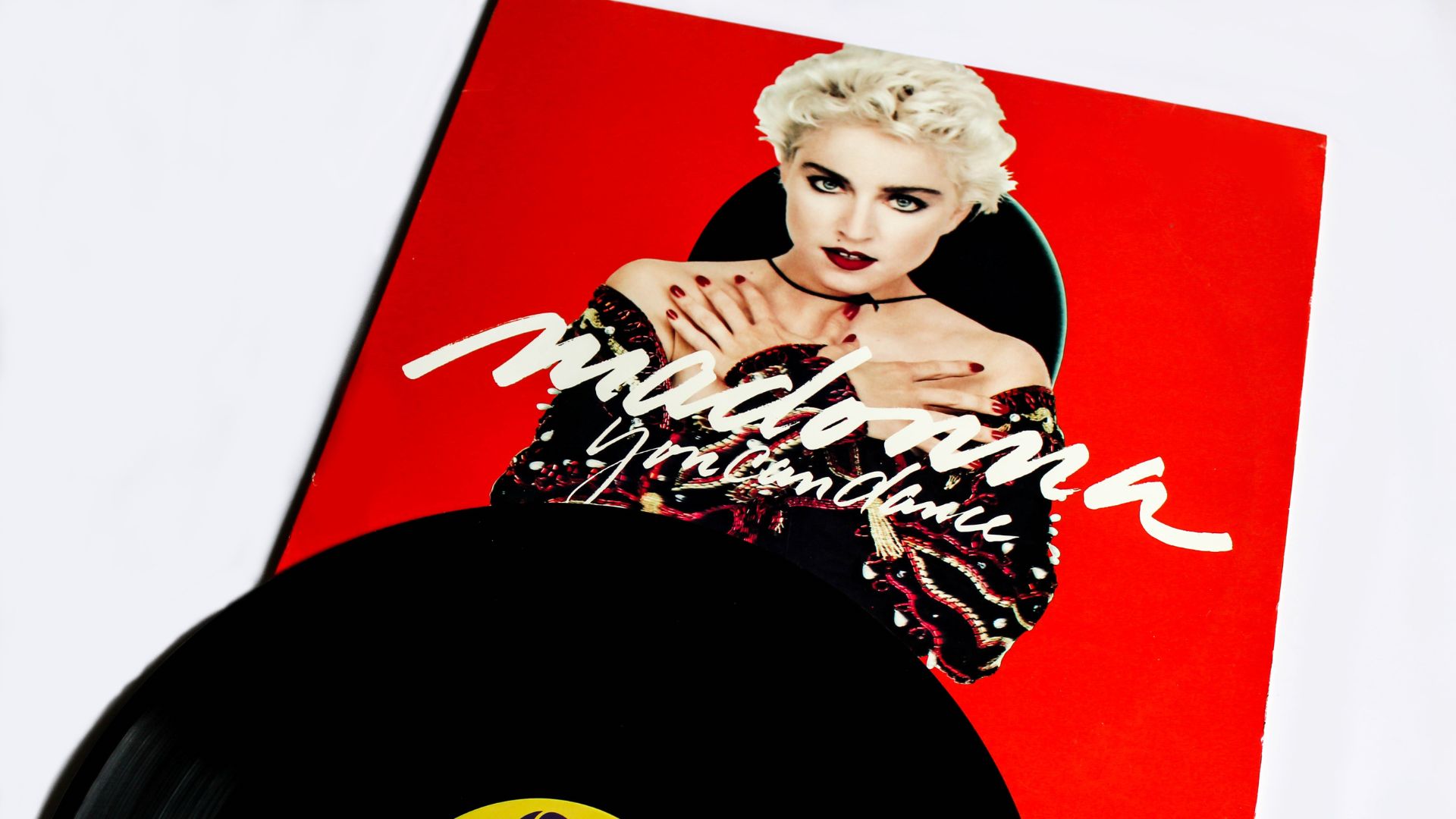
Even into the 2000s and 2010s, Madonna’s career reflected a Darwinian adaptability to changing environments. The 2003 MTV Video Music Awards kiss with Britney Spears sparked a viral debate, raising questions about bisexuality. Tours such as Sticky & Sweet and albums like Hard Candy demonstrated a willingness to collaborate with younger artists while retaining her signature sound. Her postfeminist sensibilities, rooted in self-expression and independence, carried through to her later albums and public appearances. At the 2023 Grammys, she reacted to critics, accusing them of “ageism and misogyny.”
Diva provocatrix
Today, Madonna’s presence at Milan Fashion Week is emblematic of both her longevity and her continued authorship of the fame narrative. She’s still a model for what it means to inhabit the public sphere on one’s own terms. Unlike many successors, she hasn’t become her own tribute act. She’s refused to trade on nostalgia and strives to remain relevant. A figure whose demands, exacting nature and unyielding vision have shaped not only the entertainment industry but the very ways in which audiences understand and appreciate spectacle, Madonna evokes a reminder about the way we live — vicariously, voyeuristically, derivatively and by proxy.
Her legacy is inseparable from the media she mastered and, to be fair, was mastered by. Madonna didn’t merely reflect social and technological changes — she anticipated them, attempted to manipulate them and tried to force the world to respond. It did: From MTV to social media, from the controversy of Like a Prayer to the candor of Truth or Dare, she engineered a dialogue with audiences that has altered our relationship to celebrities. Many will not think this is such a good thing.
Madonna belongs in the same pantheon as Maria Callas (1923–77), Judy Garland (1922–69) and Barbra Streisand (b. 1942), all imperious figures feared as much as revered for their exacting standards and refusal to accept reality when it failed to conform to their visions. Like them, Madonna has attracted detractors as well as worshippers, her difficulty inseparable from her distinction. Yet she added something new to the tradition: Madonna was not simply a diva but a diva provocatrix, a performer who treated outrage as an artistic medium. While there are many contemporary stars of immense wealth and visibility, none appears willing — or permitted — to embody the risk, volatility and sheer force that once defined the type. Perhaps Madonna truly is the last of them.
[Ellis Cashmore is the author of The Destruction and Creation of Michael Jackson]
[Kaitlyn Diana edited this piece.]
The views expressed in this article are the author’s own and do not necessarily reflect Fair Observer’s editorial policy.








Join the conversation
Share your perspective
Log in to share your thoughts and take part in the discussion.