


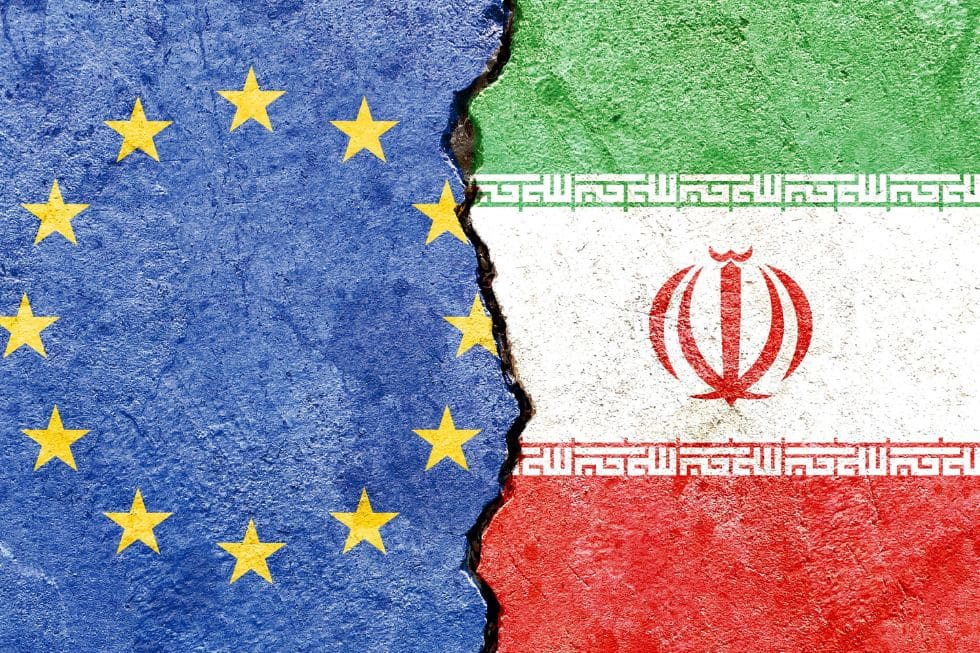



The diplomatic air between Brussels and Tehran has never been thinner. Not since 1992, when a state-sponsored hit squad opened fire in a Berlin restaurant, has the relationship been this toxic. But today’s rupture is deeper and more structural. We are witnessing “The Great Decoupling” — the final collapse of the engagement strategy that defined EU–Iran relations for three decades.
The current freeze draws a direct, haunting parallel to the 1992 Mykonos Restaurant assassinations. On that September night in Berlin, Iranian agents executed Dr. Sadegh Sharafkandi, the Secretary-General of the Kurdistan Democratic Party of Iran (PDKI), alongside three aides.
In April 1997, after a trial that exposed the inner workings of the regime’s “Special Affairs Committee,” a German court took the historic step of naming the highest echelons of power — including Iranian Supreme Leader Ali Khamenei and then President Hashemi Rafsanjani, among others — as the architects of the massacre. The EU’s response was swift: For the first time, every member state recalled its ambassador.
Yet, the resolve was fleeting. Within months, European officials were already rushing back to Tehran, desperate to resume the “Critical Dialogue” that had supposedly been suspended. Using the 1997 Iranian election of the “reformist” Mohammad Khatami as a convenient exit ramp for their principles, EU diplomats were soon seen seeking permission to re-enter Iran, effectively burying the Mykonos verdict under a mountain of new trade agreements. Today, however, that cyclical retreat seems impossible; the “reformist” illusion has shattered, and the door is being locked from the outside — an absolute blockade that remains impenetrable unless the regime undertakes a seismic, foundational reversal to dismantle its own political architecture.
The end of engagement
That 30-year hope — that trade and diplomacy could moderate the Islamic Republic’s behavior — finally died in the streets of Tehran over the last two years. In late January 2026, the EU closed a dark circle of history by formally designating the Islamic Revolutionary Guard Corps (IRGC) as a terrorist organization.
It is a move of profound symbolic and legal weight: the very same IRGC and its shadow proxies that orchestrated the 1992 Mykonos murders have finally been branded with the label they earned three decades ago. This long-overdue alignment with Washington raises a haunting question: “What if?” Had Europe stood firm and declared the IRGC and its branches a terrorist organization alongside the US back then, the geopolitical landscape of the Middle East — and the security of the Iranian diaspora in Europe — might look fundamentally different today. Instead, 30 years of hesitation allowed the regime’s paramilitary arm to entrench its influence and refine its machinery of repression.
Now, the divorce is absolute. The EU has achieved zero energy dependence on Iran, cutting off the investments that once served as Tehran’s lifeline. The conversation has turned toward the “nuclear” option: the total closure of Iranianembassies across the continent. Influential Members of the European Parliament (MEPs) argue that as long as these missions are used to coordinate transnational repression, they have no right to exist on European soil.
De-platforming the regime: a parliament of fury
The physical manifestation of this decoupling is most striking within the halls of European power. In January 2026, European Parliament President Roberta Metsola took the extraordinary step of banning all Iranian regime officials and diplomatic staff from entering the Parliament’s premises.
“This House will not aid in legitimizing a regime that sustains itself through torture,” Metsola declared. This ban represents a jarring departure from the era of “appeasement diplomacy.” Not long ago, EU officials were lining up to meet their counterparts in Tehran, with female leaders often obeying regime orders to be veiled during their visits. Those images of “veiled diplomacy” are now being replaced by a total eviction of the regime from the heart of European democracy.
This institutional ban provided the backdrop for even more visceral acts of protest. In a moment that defined the current session, Italian MEP Isabella Tovaglieri recently stood before the chamber and tore up a photograph of Ali Khamenei. The collective anger was further cemented in February 2026, when the Parliament issued a blistering condemnation of the UN for sending a “congratulatory” message to the regime — a blood-stained insult to the estimated 35,000 Iranians killed in recent state violence.
Europe’s hard pivot
The landscape shifted irrevocably on February 28, 2026. The decapitating US and Israeli strikes that claimed the life of Khamenei and his top military command have forced a hard pivot in European capitals. While the EU initially refrained from joining the kinetic phase of the assault, the regime’s response has made continued neutrality impossible.
In its final, agonizing throes, Iran has launched indiscriminate missile and drone strikes that targeted Gulf states and impacted European interests, viewing any Western presence as a fair target for its frustration. This unprovoked aggression against European assets has fundamentally altered the calculus in Brussels. Western leaders now realize that the IRGC is not a state actor to be contained, but a terminal threat to be neutralized. The “Critical Dialogue” has been replaced by an urgent necessity to counter the regime’s desperate and final acts of regional aggression.
The images of MEPs tearing up portraits of the Supreme Leader mark the funeral rites of a failed policy. Europe is finally standing on the right side of history; with the regime’s indiscriminate strikes on European interests having shattered the last shreds of diplomatic hesitation, Brussels is now forced to move beyond mere condemnation.
The strikes of February 28 did more than remove a Supreme Leader; they removed the final barriers to a unified Western front, signaling that Europe will finally have to join the US and Israeli assaults to neutralize Iran’s remaining infrastructure. This shift also represents a long-overdue closure for the 1992 Mykonos assassinations; by aligning with organized Iranian Kurdish forces on the ground to topple the regime, the US is finally helping to enforce a judicial verdict that was long deferred by European trade interests.
In this new geopolitical reality, Europe simply cannot afford to antagonize US President Donald Trump by standing against him or failing to provide the support his administration demands. Consequently, as Iran continues to lash out against the region and Western interests, the EU is no longer just “decoupling”; it is now preparing for the total collapse of the political architecture it once tried to save and aligning its strategic weight with the inevitable transition of power.
[Kaitlyn Diana edited this piece.]
The views expressed in this article are the author’s own and do not necessarily reflect Fair Observer’s editorial policy.
Force Without Legitimacy: Bombing Iran Will Not Produce Regime Change
The US-Israeli strike campaign against Iran aims to topple the regime but overlooks the resilience of Iran’s authoritarian power structure,...
A War to End All (Middle East) Wars?
The US and Israel’s strike on February 28 eliminated Iran’s Supreme Leader Ali Khamenei and other top leaders, revealing deep...
For Historians, Was This a Pearl Harbor or a Suez Moment? Part 1
A conversation with Claude about the US–Israeli attack on Iran explores its potential psychological impact on Americans, the growing fracture...
Support Fair Observer
We rely on your support for our independence, diversity and quality.
For more than 10 years, Fair Observer has been free, fair and independent. No billionaire owns us, no advertisers control us. We are a reader-supported nonprofit. Unlike many other publications, we keep our content free for readers regardless of where they live or whether they can afford to pay. We have no paywalls and no ads.
In the post-truth era of fake news, echo chambers and filter bubbles, we publish a plurality of perspectives from around the world. Anyone can publish with us, but everyone goes through a rigorous editorial process. So, you get fact-checked, well-reasoned content instead of noise.
We publish 3,000+ voices from 90+ countries. We also conduct education and training programs
on subjects ranging from digital media and journalism to writing and critical thinking. This
doesn’t come cheap. Servers, editors, trainers and web developers cost
money.
Please consider supporting us on a regular basis as a recurring donor or a
sustaining member.
Will you support FO’s journalism?
We rely on your support for our independence, diversity and quality.





Comment