





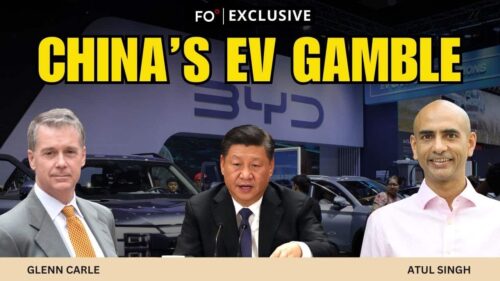
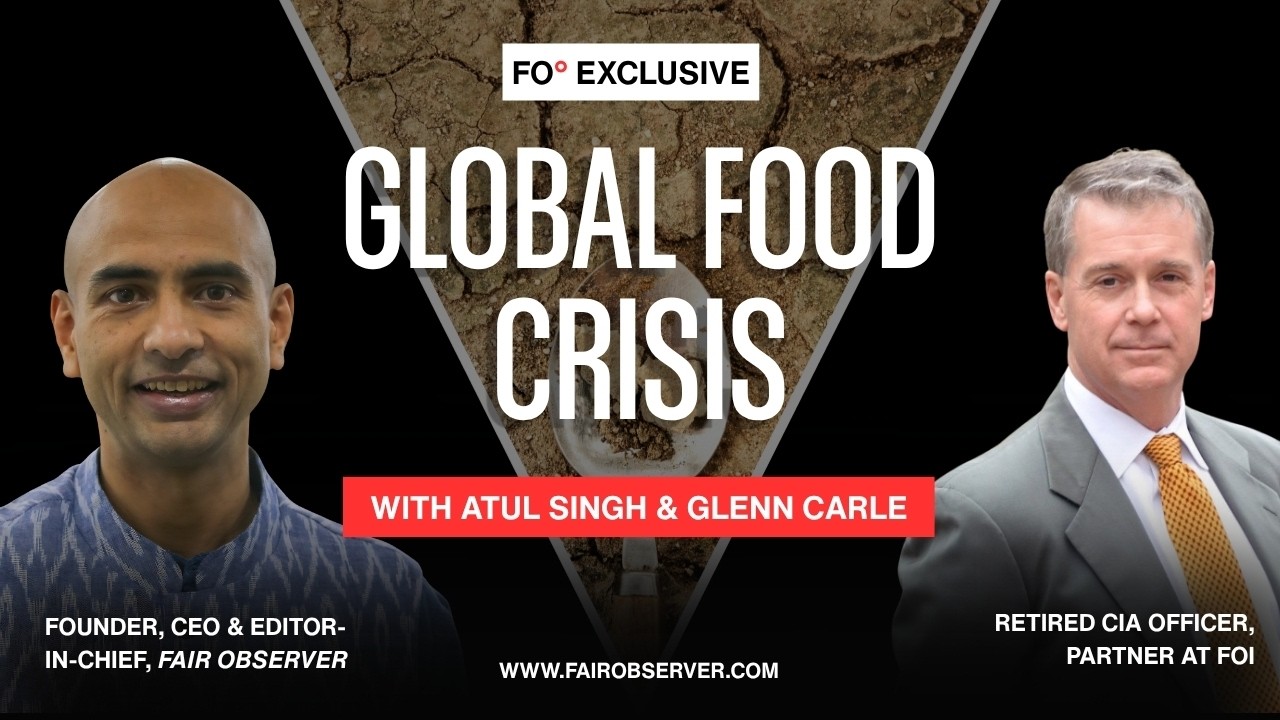
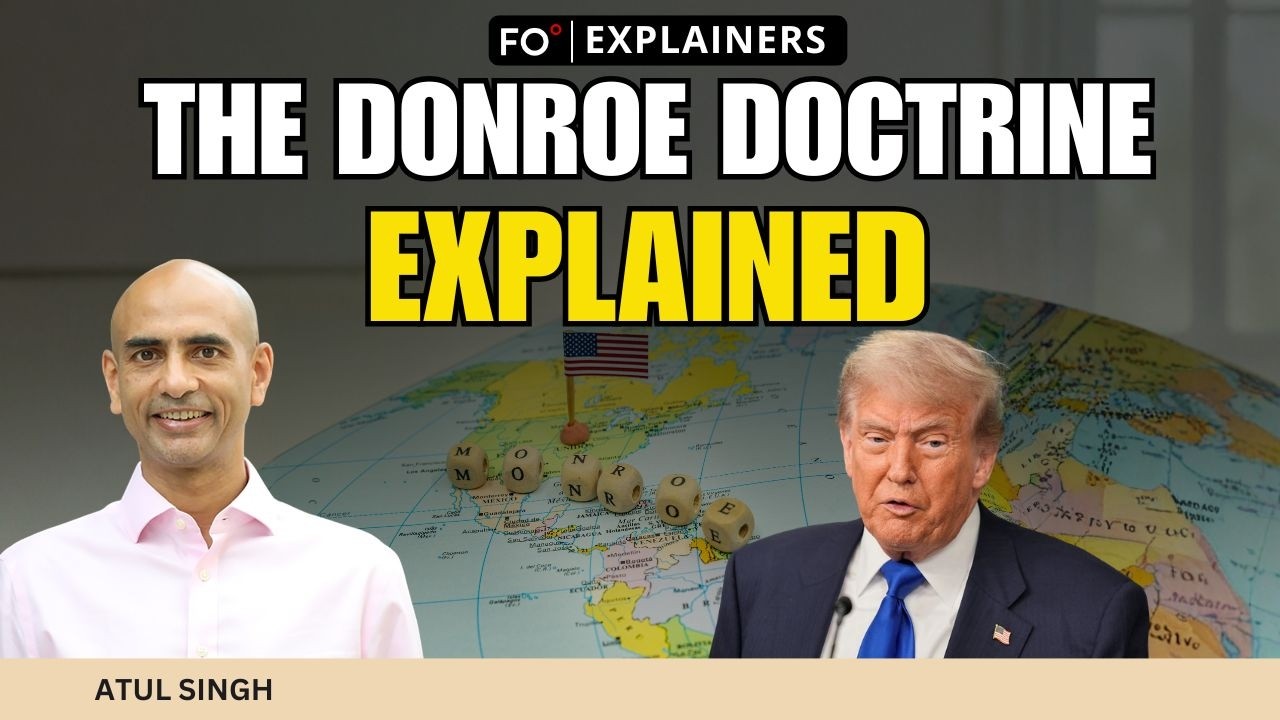
Editor-in-Chief Atul Singh and FOI Senior Partner Glenn Carle, a retired CIA officer who now advises companies, governments and organizations on geopolitical risk, examine Washington’s renewed assertion of the dominance of the Western Hemisphere under US President Donald Trump. Framed first as the “Trump Corollary” to the Monroe Doctrine and now as the “Donroe Doctrine,” this approach seeks to reestablish the Americas as an exclusive sphere of influence of the US. Venezuela is a test case for this doctrine. Atul and Glenn explore the strategic logic behind the Donroe Doctrine, its economic ambitions and its broader implications for a global order increasingly defined by power alone.
Doctrine revived and unrestrained
Glenn frames the Donroe Doctrine as an explicit assertion of American sphere-of-influence politics, modeled rhetorically on the Monroe Doctrine but stripped of any restraint. Its purpose is unambiguous: to exclude China and Russia from the Western Hemisphere, especially from strategic sectors like energy, and to formalize US dominance in the Americas as a geopolitical fact rather than a normative aspiration.
The historical irony matters. The original Monroe Doctrine, articulated in 1823, began as a declaration of weakness rather than strength — an attempt by a young United States to deter European imperial powers it could not yet confront militarily. Over time, as American power expanded, the doctrine evolved into a justification for intervention. The Donroe Doctrine reverses this arc: It is declared from a position of power, without the diplomatic restraint or multilateral cover that later tempered US hemispheric policy.
Where US President Franklin Roosevelt’s “Good Neighbor” policy sought to soften imperial optics, the Donroe Doctrine openly embraces a might-is-right philosophy. This candor reflects a broader shift in Washington away from normative language and toward assertions of dominance.
The “Petro Reset” and Washington’s internal logic
Atul explains Washington’s internal logic, described as the “Petro Reset.” Venezuela holds the world’s largest proven oil reserves but produces only a fraction of its potential. US policymakers argue that a compliant or US-administered Venezuela could bring several million additional barrels per day online. This would trigger a benign supply shock that lowers global energy prices and eases cost-push inflation.
Atul emphasizes how central energy remains to the global economy despite years of green energy transition rhetoric. Lower oil prices ripple through everything from food production to logistics, making energy a powerful lever for macroeconomic stabilization. From this perspective, Venezuela is seen as a distressed asset with enormous upside.
Because Venezuela’s extra-heavy crude oil can be refined at scale primarily on the US Gulf Coast, American firms would control the value chain. Proponents also point to dollarization of the Venezuelan economy as a stabilizing mechanism. They cite Ecuador as an example — the country dollarized its economy in 2000. A rehabilitated Venezuela could eventually rival Mexico as a manufacturing hub while reducing migration pressures northward.
This vision has an appealing internal coherence for policymakers. Dollarization promises to eliminate hyperinflation. Cheap energy could make Venezuela attractive for certain energy-intensive industries. Millions of Venezuelans who fled might return. American consumers might get gas at $1 per gallon. This seemingly brilliant strategy addresses inflation, supply chains and migration in one single stroke.
Feasibility, fantasy and the limits of power
Atul and Glenn stress the speculative nature of this vision. Venezuela’s infrastructure is severely degraded, investment requirements are enormous and political risk is extreme. Glenn highlights an often overlooked driver: US Secretary of State Marco Rubio’s determination to cut off Venezuelan oil support for Cuba. Rubio is Cuban American and has a Pavlovian aversion to communist regimes. He aims to strike at both Venezuelan and Cuban regimes and limit Russian and Chinese influence in the region. In this view, Venezuela is both an energy prize and a lever in a broader ideological campaign.
Glenn draws from his own experience to inject a note of realism. Atul points out that serious energy executives, including leaders of major US oil firms, have described Venezuela as effectively uninvestable. Pipelines have decayed, equipment has rusted and institutional capacity has collapsed. Even under ideal political conditions, the timeline between massive investment and meaningful output, as well as return on investment, would be long, uncertain and vulnerable to disruption.
Rubio’s role adds a distinct ideological layer. As a Cuban American with deep anti-communist convictions, Rubio views Venezuelan oil not only as an economic resource but as the lifeline sustaining the Cuban capital of Havana. By severing that lifeline, Washington could weaken two adversarial regimes simultaneously while constraining China’s foothold in the Caribbean basin.
A world of spheres of influence
Beyond Venezuela, the doctrine signals a deeper systemic shift. Spheres of influence displace rules, pushing the international order toward something closer to a pre-Westphalian order (pre-1648) or the logic of the Congress of Vienna (1814–15). If Washington asserts primacy in the Americas, it implicitly legitimizes Chinese dominance in Asia and weakens Western commitments to Ukraine and Taiwan.
Glenn is explicit about the precedent being set. Once great powers openly divide the world into exclusive zones, appeals to sovereignty and international law lose force. Smaller powers are left to choose between becoming symbiotes, clients or casualties.
Atul connects this logic directly to events beyond Latin America. Trump’s transactional approach to alliances fit comfortably within a worldview that believes in spheres of influence. So too does the implicit message to other major powers to dominate their respective spheres.
While US influence may increase in the short term, the longer-term result will likely be fragmentation, coercive bilateralism and declining American legitimacy, particularly among smaller states forced to choose between subordination and exclusion. Brazil, in particular, has shown unease at Washington’s willingness to enforce hemispheric dominance by coercion. Early trade diversification suggests that the doctrine may already be encouraging the strategic shift it seeks to prevent.
Even as Washington attempts to lock down its hemisphere, other powers are accelerating efforts to reduce dependence on the US altogether. Trade deals, alternative supply chains and new alignments are not acts of defiance so much as acts of insurance.
In that sense, the Donroe Doctrine may succeed tactically while failing strategically — asserting dominance in the near term while hastening a more fragmented, less deferential global order in the long run.
[Lee Thompson-Kolar edited this piece.]
The views expressed in this article/video are the author’s own and do not necessarily reflect Fair Observer’s editorial policy.



































Comment