







 | ||
| ||
| ||
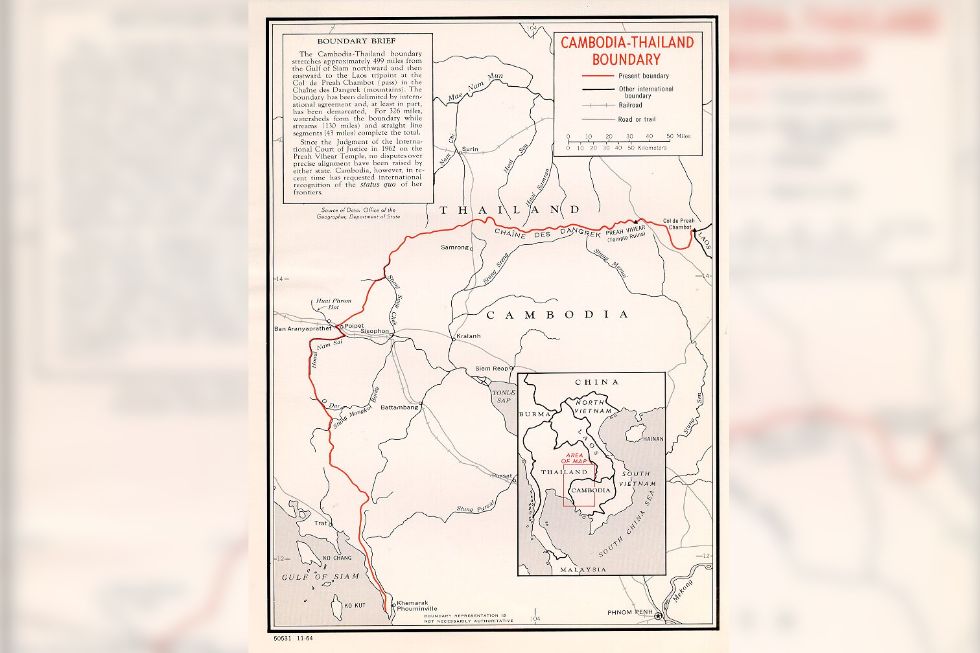
Dear FO° Reader, A merry Christmas and happy holidays to you all from the United States! While many parts of the world are currently celebrating winter holidays, and many scandals are keeping us busy in our own home country, we thought we would use this day to continue our mission and visit a corner of the world that typically doesn’t get much attention: the border between Cambodia and Thailand. As of the writing of this piece, both countries have entered a ceasefire after months of fighting over a territorial dispute dating back a century. Negotiators are currently engaged in tense discussions, and the results remain uncertain. However, as the year wraps up, we aim to provide context for an often unreported war amid a year dominated by news from Israel and Ukraine. Borders and the centuries of battles for them Thailand is one of the few countries in the world that remained independent during the era of European colonialism. However, that does not mean it was not heavily affected by the sweeping political changes throughout the region. To provide historical context, the regions now known as Cambodia and Thailand have a long history of conflict with each other. In the 19th century, the French forced the Cambodian king into a protectorate deal, which, while humiliating, is believed to have saved Cambodia from being ripped in two by neighboring Siam (now Thailand) and Vietnam. This ultimately led to a 1907 treaty between France and Thailand, which more or less determined the region’s modern-day borders. This also compelled Thailand to cede territory, including the Preah Vihear temple, a Hindu site built nearly a thousand years ago during the Khmer Empire’s rule over much of both modern-day countries. Thailand was not happy with these territorial losses. As a result, when Japan allied with Thailand in World War II, Thailand sought to reclaim the territory it had lost to France, a common foe at the time, before being forced to return those lands to French Cambodia in 1946 to join the UN. However, once Cambodia achieved independence from France in 1953, Thailand immediately responded by sending troops to Preah Vihear in 1954. After petitions to the International Court of Justice (ICJ), the court issued a 1962 ruling declaring that the site belonged to Cambodia, a ruling Thailand ultimately honored.  Cambodia–Thailand border map. Via Wikimedia Commons.
Sources: Thailand-Cambodia Border Conflict 2025 | Background, Escalation, Map, & Ceasefire | Britannica Preah Vihear | Wikipedia Thailand in World War II | Wikipedia There were no major border events for some time afterwards. Even in the 1970s, when Cambodia was flung into near total anarchy by the Khmer Rouge, Thailand did not try to reconquer the lost territory, in part due to complex geopolitical alliances taking place in the wake of the Vietnam War, and Thailand’s own highly unstable domestic situation throughout the decade. After the overthrow of the Khmer Rouge, the now guerrilla group occupied locations near Preah Vihear, effectively keeping the temple inaccessible until 1998. Peace held until 2008, when Cambodia sought to have Preah Vihear designated a UN Educational, Scientific and Cultural Organization World Heritage Site. While initially supportive of the move, a right-wing political party within Thailand managed to push the issue back into the spotlight, which kicked off another multi-year standoff, with deaths on both sides and the ICJ ruling again in favor of Cambodia. Sources: History of Thailand (1970s) | Britannica Khmer Rouge | Britannica Thailand and Cambodia: The Battle for Preah Vihear | FSI 2008–2011 Cambodia–Thailand border crisis | Wikipedia Thailand and Cambodia edge toward a ceasefire Thailand and Cambodia have agreed to resume negotiations to restore the ceasefire, marking their first coordinated effort to de-escalate tensions since fighting broke out earlier this month along disputed sections of their border. US President Donald Trump brokered the previous ceasefire agreement in July. Source: Exclusive: Trump’s call broke deadlock in Thailand-Cambodia border crisis The fighting began after a series of incidents between border patrol units spiraled into open confrontation. As casualties mounted, residents fled nearby villages, and each government accused the other of initiating hostilities. Nationalist rhetoric soon followed, narrowing political room for compromise even as commanders struggled to regain control of events on the ground. Diplomatic efforts continued to occur amid the events. The Association of Southeast Asian Nations (ASEAN) held emergency meetings amid fears that the conflict might spill over into mainland Southeast Asia. Bangkok and Phnom Penh indicated possible readiness to de-escalate tensions even amid new clashes, making it challenging to cease combat once the sides had mobilized their forces. Other states have been quietly operating in the background. China, which has close relations with both governments, has appealed for calm and pushed for dialogue, thereby positioning itself as a stabilizing force in the region. It has also helped to ensure that trade routes remain undisrupted. The United States has been acting subtly by urging calm and supporting ASEAN-led efforts. Negotiators are focusing on restoring ceasefire arrangements, reopening military communication lines and granting displaced civilians access. The extent to which these will work is still unclear. Previous attempts have faltered due to a lack of trust and a border demarcation issue. Military officials from both countries met on December 24 to discuss resuming the ceasefire after 16 days of clashes, which have brought the estimated death toll to 86. Source: Thailand carries out more airstrikes on Cambodia as deadly border conflict flares For now, the agreement to talk is fragile but meaningful — a sign that neither side sees prolonged conflict as serving its interests, even if the underlying dispute remains unresolved. There is also the question of why this dramatic, if smaller-scale, conflict is not getting much attention in the West. This is partly due to the conflict’s relatively small scale and its distance from many Western powers, but there is another critical reason. Thailand has a free press, even if there are serious limitations. Cambodia does not. While Thailand has struggled with democracy, it ultimately allows journalists, particularly foreign press, to do their job within its borders. Cambodia, meanwhile, is still in the grips of authoritarian rule, which has choked out the free press at all levels. Ironically, Cambodia has unintentionally allowed Thailand to have much more control over the narrative. Sources: Why Cambodia Is Losing the Information War With Thailand | The Diplomat Cambodia: Press freedom under attack | DW Thai and Cambodia militaries hold talks on resuming ceasefire Cambodia-Thailand conflict: The poison of nationalism Thailand, Cambodia agree to talks in bid to end deadly conflict – minister Cambodia, Thailand Willing to Deescalate Border Conflict, Chinese FM Says New clashes erupt on Thai-Cambodia border as ASEAN convenes peace talks Thailand and Cambodia to resume ceasefire talks after deadly border clashes Future battles, future stalemates As always, the future is in motion. It is unclear now how the diplomatic talks will develop or if fighting will continue after a short reprieve. The border dispute will likely remain unresolved, given the interests of both parties and the fact that no government ever wants to be seen as giving up territory, especially in a conflict that has lasted for over a century. This is a great tragic irony, because as previously mentioned, the temple was built by the Khmer Empire when it ruled both lands. What could be a symbol of friendship between nations rooted in shared ancient history is primarily used to fuel nationalistic conflict, fanning tensions left in the wake of foreign rule. Both countries view the status of the lands as culturally significant, considering the bloodshed over these provinces. Whatever the resolution of this current conflict, and no matter how many more people are killed or displaced, it seems clear that this cycle may be doomed to be repeated. Wishing you a thoughtful week, Casey Herrmann and Liam RomanAssistant Editors | ||
We are an independent nonprofit organization. We do not have a paywall or ads. We believe news
must
be free for everyone from Detroit to Dakar. Yet servers, images, newsletters, web developers and
editors cost money.
So, please become a recurring donor to keep Fair Observer free, fair and independent. 
| ||
| ||
| About Publish with FO° FAQ Privacy Policy Terms of Use Contact |





Explore More FO° Spotlight

Support Fair Observer
We rely on your support for our independence, diversity and quality.
For more than 10 years, Fair Observer has been free, fair and independent. No billionaire owns us, no advertisers control us. We are a reader-supported nonprofit. Unlike many other publications, we keep our content free for readers regardless of where they live or whether they can afford to pay. We have no paywalls and no ads.
In the post-truth era of fake news, echo chambers and filter bubbles, we publish a plurality of perspectives from around the world. Anyone can publish with us, but everyone goes through a rigorous editorial process. So, you get fact-checked, well-reasoned content instead of noise.
We publish 3,000+ voices from 90+ countries. We also conduct education and training programs
on subjects ranging from digital media and journalism to writing and critical thinking. This
doesn’t come cheap. Servers, editors, trainers and web developers cost
money.
Please consider supporting us on a regular basis as a recurring donor or a
sustaining member.
Will you support FO’s journalism?
We rely on your support for our independence, diversity and quality.





Comment