


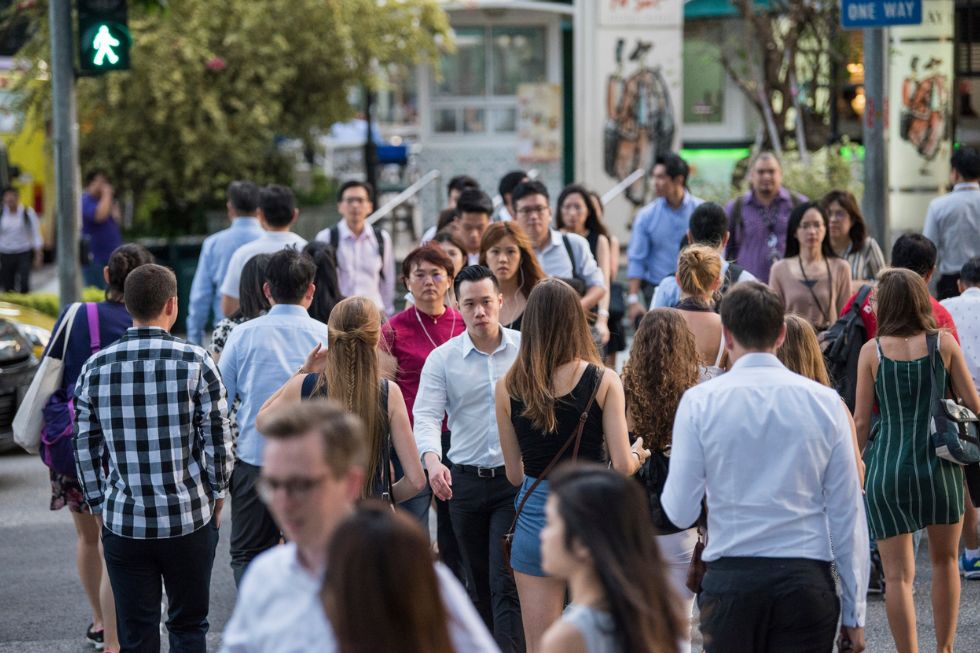



Singapore’s evolution since 1965 is not one of natural endowment but of deliberate choice. With no oil, no fertile hinterland and a population of only 5.7 million, the city-state’s leaders recognized early that its only true resource was its people. This insight reshaped national policy: Invest first in human capital through education and health, and use that foundation to power industrialization, trade and global competitiveness. The outcome is plain to see.
Singapore today ranks among the world’s highest in literacy, life expectancy and productivity, consistently outperforming far larger Association of Southeast Asian Nations (ASEAN) neighbors. The World Bank places it at the top of the Human Capital Index, with children expected to reach nearly 90% of their full productivity potential, compared to 54% in Indonesia.
Education at the cornerstone of growth
In the 1960s, Singapore instituted universal education and invested heavily in teacher training, school infrastructure and curriculum development. The National Institute of Education was tasked with ensuring teachers were not only highly trained but also continuously upskilled. A Compulsory Education Act in 2000, reinforced universal access, while curriculum reforms gradually shifted from rote learning towards creativity, resilience and socioemotional skills.
By 2022, Singaporean students had dominated global rankings: 92% of 15-year-olds achieved basic proficiency in mathematics, compared to an OECD (The Organisation for Economic Co-operation and Development) average of 69%, and 41% were considered top performers, compared to 9% across the OECD. In creative thinking, 60% of Singaporean students reached the two highest proficiency bands, more than double the OECD average.
These outcomes were not confined to elites. Even students from low-income households outperformed wealthier peers in many OECD countries, proof that equity was built into the system.
Health measures given equal weight
While total health expenditure remains only about 4.5% of GDP — half the OECD average — Singaporeans enjoy one of the highest life expectancies in the world, at 83.7 years. Infant mortality is among the lowest globally, with a 99.7% child survival rate. This achievement stems from a hybrid model that combines mandatory health savings, catastrophic insurance and targeted subsidies, underpinned by preventive campaigns that encourage individual responsibility.
Smoking rates have plummeted, chronic disease is carefully managed and stunting — a persistent challenge in neighboring Indonesia and the Philippines — has been nearly eradicated. As the UN Development Program has emphasized, longevity and productivity are inseparable: Healthy citizens sustain economic dynamism and reduce fiscal burdens.
Singapore’s socioeconomic journey highlights these benefits in health and education. Annual GDP growth averaged 7% from independence until the late 2000s, elevating the country into the high-income group. Its workforce is now among the most skilled and adaptable globally.
Children starting school today can expect nearly 14 years of effective education, compared to just over 12 in Indonesia. These two extra years are not just facts; they create an innovation-ready workforce capable of supporting advanced manufacturing, biotechnology and financial services. The OECD estimates that a single year of schooling can increase lifetime earnings by up to 10%, making Singapore’s education advantage a significant structural benefit.
Implications of Singapore’s success
The broader implications for ASEAN — and especially Indonesia — are profound. Many states in the region still default to “hardware-first” development: airports, highways and mega-dams as visible signs of progress. Yet without matching investments in classrooms, clinics and skills training, such infrastructure risks becoming hollow.
Indonesia’s Human Capital Index score of 0.56 means a child born today will achieve barely half of their productivity potential, a figure that starkly limits its long-term growth trajectory. Even recent reforms, such as Merdeka Belajar (Freedom to Learn), while laudable, remain underfunded and unevenly delivered.
Singapore offers both inspiration and caution. Its model cannot simply be transplanted — its political system, size and historical context are unique. But the principles travel well: prioritize people, institutionalize continuous learning, integrate health with economic policy and pursue equity as a growth strategy.
The UN’s 2030 Agenda makes this point explicit: Sustainable Development Goal 4 (quality education) and Goal 3 (good health) are not secondary aspirations but the bedrock upon which all other goals rest. ASEAN governments that underinvest in these areas court instability, inequality and lost opportunity.
Lessons for ASEAN
The environmental dimension is also instructive. Singapore’s Green Plan 2030 shows how human capital and sustainability can be pursued in tandem. Urban planning integrates green spaces and water security, while public transport expansion reduces emissions. For ASEAN, one of the regions most vulnerable to climate change, this linkage is critical. Health and education gains are unsustainable if citizens face worsening air pollution, food insecurity or displacement from rising seas. Investing in climate resiliency is part of investing in people.
For Indonesia, Vietnam and the Philippines, the lesson is urgent. Without decisive shifts towards human-centric policies, their demographic dividends could decay into demographic burdens. Rising youth populations, if undereducated and underemployed, may fuel unrest rather than growth.
The International Labour Organization estimates that 23% of young people in Southeast Asia are not in employment, education or training — a figure that starkly contrasts with Singapore’s near-universal participation in some form of lifelong learning.
Singapore’s achievement is not flawless. Questions about political freedoms and inequality remain. Yet its human-capital-first model has become conventional wisdom in development policy: Durable growth comes not from monuments of steel but from citizens equipped to innovate, adapt and thrive. The challenge for ASEAN is to translate this wisdom into action.
The message is clear. ASEAN does not need to copy Singapore, but it cannot ignore the lesson. Human capital is not a luxury; it is the driver of resilience, fairness and long-term prosperity. As Singapore’s experience shows, a country’s most valuable infrastructure isn’t its tallest tower or biggest dam — it’s the mind of a child who can read, the health of a worker who can endure and the creativity of a citizen who can lead. For ASEAN’s future, investing in people isn’t just a smart policy; it’s the only way forward.
[Natalie Sorlie edited this piece.]
The views expressed in this article are the author’s own and do not necessarily reflect Fair Observer’s editorial policy.
Unlocking the Longevity Dividend for Growth and Resilience
The narrative around aging populations is shifting from decline and dependency to opportunity and resilience. With proper investments in health,...

China and Its Mentor, Singapore
China’s rapid transformation owes much to former leader Deng Xiaoping’s reforms, which were deeply inspired by Singapore’s model of state-led...
Is Indonesia’s Mentorship the Key to Timor-Leste’s Entry into ASEAN?
Indonesia’s “close brother” ties with Timor-Leste hold the potential to offer a strategic pathway for the tiny nation towards full...
The Enduring Relevance of Development Economics in an Unequal World
Some economists argue that as developing countries’ incomes rise and mainstream economics converge with development studies, the distinctiveness of development...

Support Fair Observer
We rely on your support for our independence, diversity and quality.
For more than 10 years, Fair Observer has been free, fair and independent. No billionaire owns us, no advertisers control us. We are a reader-supported nonprofit. Unlike many other publications, we keep our content free for readers regardless of where they live or whether they can afford to pay. We have no paywalls and no ads.
In the post-truth era of fake news, echo chambers and filter bubbles, we publish a plurality of perspectives from around the world. Anyone can publish with us, but everyone goes through a rigorous editorial process. So, you get fact-checked, well-reasoned content instead of noise.
We publish 3,000+ voices from 90+ countries. We also conduct education and training programs
on subjects ranging from digital media and journalism to writing and critical thinking. This
doesn’t come cheap. Servers, editors, trainers and web developers cost
money.
Please consider supporting us on a regular basis as a recurring donor or a
sustaining member.
Will you support FO’s journalism?
We rely on your support for our independence, diversity and quality.





Comment