




Editor-in-Chief Atul Singh and academic & author David Tizzard explore South Korea’s turbulent political landscape, its regional alignments and the social and cultural issues shaping the country. Tizzard stresses that while South Korea is often in the global spotlight for cultural exports, its political challenges deserve closer attention.
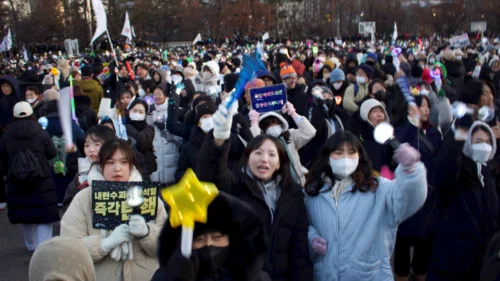
The discussion begins with the impeachment of former President Yoon Suk Yeol. He was found guilty of violating the Constitution after attempting to impose martial law. Citizens responded by peacefully flooding the streets, demonstrating their democratic resolve. Their protests led to Yoon’s removal and the inauguration of President Lee Jae Myung from the Democratic Party in June.
This transition demonstrates the resilience of South Korea’s democracy, established only in 1988. Tizzard adds a vivid analogy, describing the country as “a 15-year-old with a PhD” — young and turbulent, but remarkably accomplished. Despite scandals, everyday life functions efficiently, with safe public spaces, reliable hospitals and strong education systems.
South Korea & Japan
Singh turns the conversation toward foreign policy, which he and Tizzard describe as the dividing line in Korean politics. The conservative camp, which Yoon represented, traditionally leans toward Washington and Tokyo. Conservatives highlight shared democratic values while maintaining a tough stance against Beijing, China’s capital, and North Korea’s capital of Pyongyang. Yet Yoon faced criticism for being “too nice to Japan,” a sore point given Japan’s 1910–1945 colonization of Korea.
The Democratic Party, by contrast, historically favored closer ties with Beijing and Pyongyang. All Democratic presidents, from Kim Dae-jung to Moon Jae-in, met North Korean leaders. They also often pursued tense relations with Tokyo, framing Japan as a historical adversary. For decades, these alignments defined Korea’s internal debates more than domestic issues.
Lee, however, has surprised many with pragmatism. Though a Democrat, he was prepared to visit Tokyo before Washington — an unheard-of move for his party. This suggests an effort to move beyond Cold War patterns. Tizzard adds that Lee “played his hand very well” with tariffs under former US President Donald Trump, winning favorable deals despite South Korea’s reliance on the United States.
Cost-of-living crisis
Singh shifts the conversation to economics. South Korea faces a severe cost-of-living crisis alongside plummeting fertility rates. Tizzard emphasizes these are not uniquely Korean problems, but part of a global issue afflicting developed economies.
To stimulate growth, Lee handed every citizen 150,000 won (roughly $106). His platform resembles the centrist economics of UK Prime Minister Tony Blair or US President Bill Clinton, prioritizing growth and stability over ideology.
South Korea has experienced a remarkable economic journey. Once one of the poorest countries in 1953, it is now an advanced industrial power producing cars, ships, semiconductors and smartphones. But Tizzard warns that the “East Asian tiger” model is creaking under global pressures.
Demographics pose another obstacle. With the world’s lowest fertility rate, far beneath even Japan, South Korea faces population decline. Homogeneity, limited immigration and low levels of teenage or out-of-wedlock births compound the challenge. Tizzard argues that intervention often backfires, citing China’s one-child policy, and suggests Korea may be better off ignoring its example. He frames these as “First World problems” that reflect how far the nation has come since its devastation in the 1950s.
Tensions with North Korea
Singh steers the discussion toward North Korea. Lee departs sharply from Yoon’s confrontational rhetoric, which included drones and loudspeaker propaganda. Instead, he avoids calls for unification or harsh demands, settling for managing the relationship pragmatically.
Tizzard characterizes North Korea as a communist monarchy modeled on Stalinism, while speculating that North Korean dictator Kim Jong Un himself may not actually want to hold power. Yet the peninsula’s division remains politically convenient. Conservatives, Democrats, Beijing and Pyongyang all tacitly accept the status quo. Singh compares this to Germany and Ireland, where unification fears hinge more on costs than principle. Both speakers agree that reunification may no longer be realistic.
Polarization in South Korea
Turning inward, Singh highlights the volatility of South Korean politics. Former presidents often end up in jail on corruption charges, reflecting both accountability and a cycle of vendetta. In the 1990s, President Kim sought to break this cycle by inviting his political enemies — even those who once tried to kill him — to his inauguration.
Tizzard underscores how polarization today is worsened by social media, which fragments opinion and deepens divides. This is not uniquely Korean but mirrors global democratic challenges. Still, the willingness of citizens to mobilize peacefully shows that beneath the drama lies a resilient culture of democracy.
Religion in South Korea
Religion is not a political battleground in South Korea. Despite ethnic homogeneity, the country hosts diverse traditions: Buddhism, Confucianism, Christianity and shamanism. Tizzard points out that, unlike the Abrahamic West, East Asian thought lacks a central Satan figure. Religion in Korea often serves as community support and a form of mental healthcare.
As secularization advances, people increasingly invest their faith elsewhere — in political leaders, celebrities or even K-pop stars. Singh suggests this reflects broader cultural patterns, where modern societies relocate the sacred outside traditional institutions.
A new world
Tizzard closes the discussion with philosophy. He invokes Italian philosopher Antonio Gramsci’s observation: “The old world is dying, and the new world struggles to be born: Now is the time of monsters.” Singh and Tizzard agree that while democracy and capitalism have been successful in South Korea, they may no longer function as effectively as before. Rising inequality and social strain signal that the model needs rethinking.
Yet they see hope. With one of the world’s most educated, technologically adept populations, South Korea could play a role in shaping the “new world” Gramsci envisioned. Its struggles with politics, demographics and economics may, paradoxically, position it as a pioneer of future solutions.
[Lee Thompson-Kolar edited this piece.]
The views expressed in this article/video are the author’s own and do not necessarily reflect Fair Observer’s editorial policy.





























Comment