

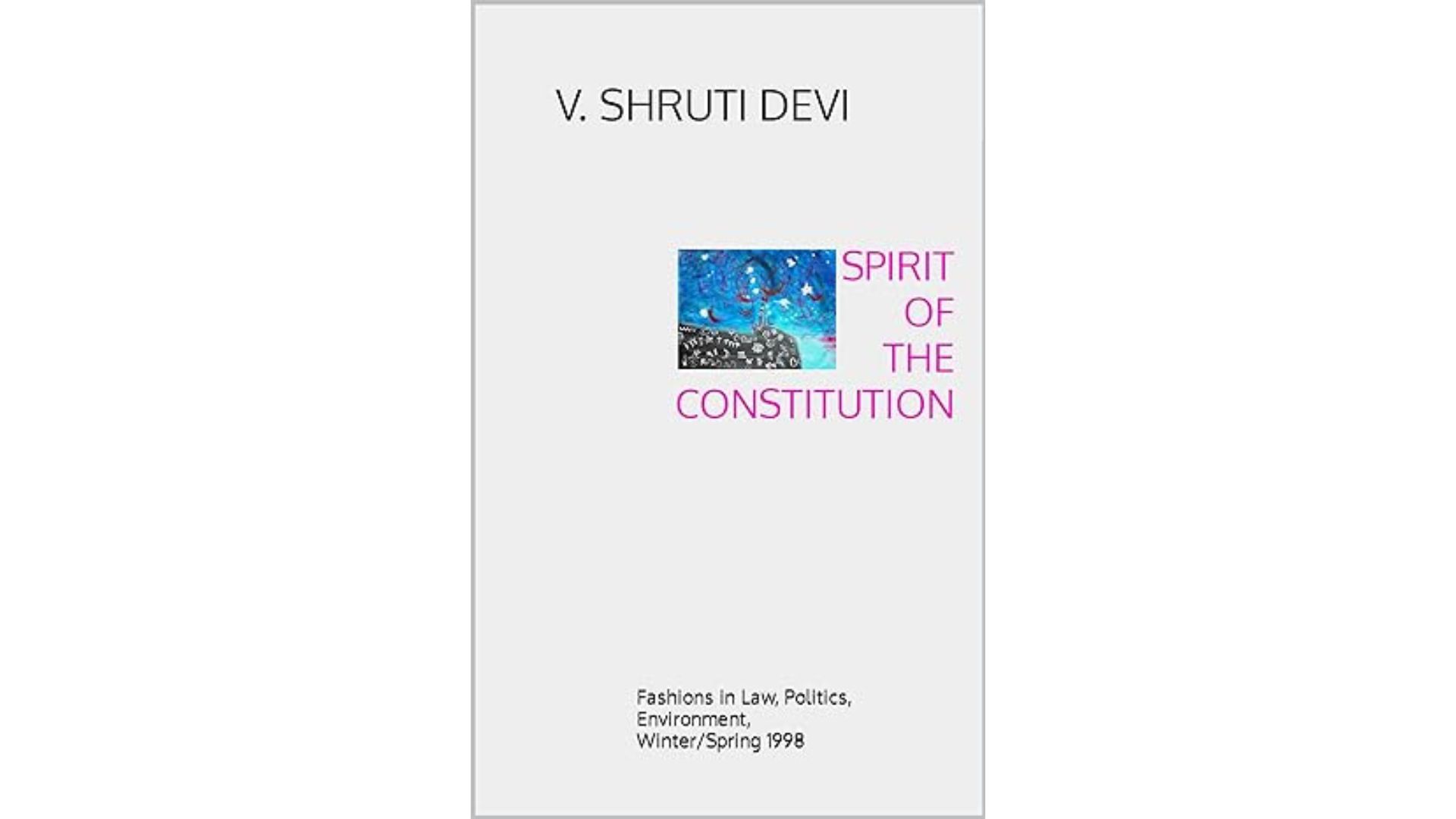


Vyricherla Shruti Devi is a multifaceted individual with roles spanning writer, politician, social activist, and lawyer. She achieves this remarkable feat in her latest work, Spirit of the Constitution: Fashions in Law, Politics, Environment, Winter/Spring 1998. The title aptly captures the essence of the book, which serves as a compelling chronicle of Shruti Devi’s journey to the United States during a period marked by significant political shifts in both the US and India in the late 1990s. Rarely does one encounter a travelog that so engages the reader from start to finish.
Shruti Devi meticulously documents her firsthand experiences of these seminal political changes throughout the course of four months. She particularly details her tenure as an India Visiting Environmental Law Fellow at Golden Gate University in San Francisco, California. Her narrative extends beyond the confines of California, offering vivid accounts of her travel across the United States.
The book delves into a variety of topics, ranging from politics and environmental issues to the intricacies of law. Of particular interest are Shruti Devi’s personal anecdotes, including her discerning sartorial choices, which add an engaging dimension to the narrative. The use of the word “fashion” in the title cleverly alludes to the ever-evolving nature of law and the seasonal trends observed within the legal realm.
Readers may wonder if Spirit of the Constitution offers a glimpse into the mind of Shruti Devi, a prominent lawyer and politician. Written in a conversational style, the book reveals her perspective as a progressive lawyer deeply concerned with the law’s impact on policy, especially regarding the environment.
Devi starts informally, perhaps easing readers into complex topics. Her fondness for cranberry juice becomes a symbol of her four-month American experience. We follow her journey as a young scholar in a new country, exploring both her own development and broader societal issues. Through her daily life, she subtly introduces readers to important socio-political issues. However, the book’s layered approach with socio-political analogies requires patient readers willing to question their own views on environmental law, tribal rights, and child rights.
While the author astutely contrasts the political landscapes of India and the United States, she refrains from critiquing the American political system or delving into its shortcomings. An example of this is her brief mention of an altercation witnessed on public transport in San Francisco. The city, to this day, grapples with issues of violence and homelessness, exacerbated by the 2008 financial crisis and the 2020 COVID-19 pandemic. The book would have benefited from a more detailed analysis of the trends in the United States during the late 1990s, especially when contrasted with current social, political, and economic realities.
Shruti Devi chooses to remain focused on the past without drawing parallels to the present, perhaps to maintain the reader’s attention on the issues relevant at that time. However, there is a valid concern that readers unfamiliar with Indian and American political events of the late 90s may find the book less accessible.
Shruti Devi’s Spirit of the Constitution is a thought-provoking book that offers a glimpse into her ideas and the times she lived in. Even though it deals with the complex subject of environmental law, Devi explains it in a way that’s easy to understand, avoiding confusing legal jargon. Many justifiably consider this, her fifth book, to be her best one yet.
[Shreya Verma edited this piece.]
The views expressed in this article are the author’s own and do not necessarily reflect Fair Observer’s editorial policy





Join the conversation
Share your perspective
Log in to share your thoughts and take part in the discussion.