


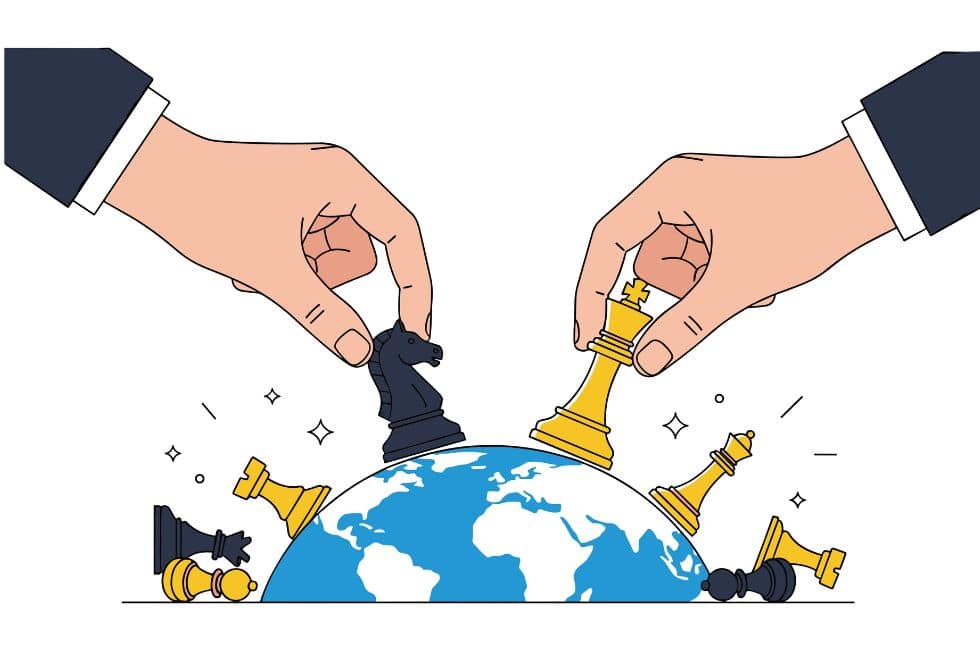



William Shakespeare’s line “the time is out of joint” is often read as a lament for disorder or moral decay. In its original dramatic setting, however, Hamlet is troubled less by chaos than by misalignment: a world in which established forms remain intact while the forces that once animated them have shifted. Authority persists, rituals continue and titles still command obedience — but the underlying logic binding them together has loosened. This image captures with unusual precision the present condition of the international system.
Managed interdependence and structural uncertainty
Contemporary global politics is not defined by the collapse of institutions. International organizations still convene, legal rules are invoked and procedural norms are performed with remarkable regularity. What has changed is the relationship between institutional form and the distribution of power, risk and strategic intent that once gave those institutions coherence. Rules remain, but they no longer align smoothly with the realities they are meant to govern.
What has emerged in place of postwar liberal universalism is not autarky, nor a simple retreat from globalization, but a system of managed interdependence. Markets, finance and supply chains continue to bind states together, yet access to them is increasingly conditioned on political alignment rather than legal entitlement alone. Efficiency, once the dominant organizing principle of the global economy, now competes with resilience. Uncertainty is no longer episodic, arising from crises or shocks, but structural, embedded in the routine operation of the system.
This shift reflects a deeper transformation in how power is exercised. The postwar order rested on the assumption that economic exchange could be largely insulated from geopolitical rivalry and that legal and procedural constraints would discipline state behavior. That assumption has eroded. Economic relationships are now routinely evaluated through the lens of security, vulnerability and strategic dependence. Trade agreements, industrial policy and investment screening increasingly function as tools for managing exposure in a fragmented environment rather than as neutral mechanisms of liberalization.
Japan, Taiwan and the recalibration of ambiguity
Japan’s evolving approach to Taiwan illustrates how states adapt to this new landscape. Tokyo’s signaling has grown more explicit in recent years — not because Japan seeks confrontation, but because ambiguity alone no longer guarantees stability. As the strategic environment around Taiwan has hardened, silence and procedural neutrality have come to carry their own risks.
Japan’s response has been multifaceted. Trade frameworks such as the Comprehensive and Progressive Agreement for Trans-Pacific Partnership (CPTPP), efforts to secure semiconductor and advanced technology supply chains, and selective forms of security coordination have become instruments for navigating uncertainty. These measures do not amount to a formal abandonment of long-standing policy constraints, but they do reflect a recalibration of priorities. Economic openness is no longer treated as an unconditional good; it is increasingly filtered through concerns about continuity, leverage and alignment.
In this context, recent remarks by Prime Minister Takaichi attracted particular attention. Her suggestion that a naval blockade around Taiwan could constitute a “survival-threatening situation” for Japan implied the possible mobilization of the Self-Defense Forces under existing legal frameworks. The importance of such remarks lies less in their immediate operational implications than in what they signal about shifting thresholds for action. Statements once avoided in the name of ambiguity are now articulated openly, not to provoke escalation, but to clarify stakes in an environment where silence may be misread.
This shift reflects a broader change in how strategic ambiguity works. In the past, ambiguity was often seen as a stopgap — a way to postpone difficult decisions while shared rules and norms kept the peace. Today, it plays a difficult role. Clear red lines can invite rivals to test how serious those threats really are, and overly specific promises can trap governments in commitments they later regret. By contrast, leaving some things unsaid can create caution. When adversaries are unsure where the real limits lie — or how a country might respond — they are often less willing to take risks.
The emergence of a G1.5 world order
The broader international system in which these dynamics unfold does not fit neatly into familiar categories. It is neither a leaderless G0 world marked by pure disorder, nor a G2 condominium in which the US and China jointly manage global affairs. Instead, it resembles what can be described as a G1.5 world. In this configuration, the US retains primacy over critical margins of access and enforcement, while China possesses growing leverage without shared rule-making authority. Power remains concentrated, yet obligation has thinned. Rules persist, but their application is selective and increasingly shaped by political considerations.
The time, then, is out of joint not because order has vanished, but because its components no longer move together. Power, law and legitimacy have fallen out of alignment. The resulting system is neither chaotic nor stable in the traditional sense. Instead, it is marked by friction — by the continuous negotiation of access, obligation and risk. In a G1.5 world, the challenge is not to resolve every tension, but to manage misalignment with patience, restraint and a clearer understanding of evolving risks.
[Kaitlyn Diana edited this piece.]
The views expressed in this article are the author’s own and do not necessarily reflect Fair Observer’s editorial policy.
The Emergence of the New World Order and the Decline of the US
The current world order is undergoing several geopolitical upheavals that are reshaping world politics to carve out a new order...
Geopolitics by Design: Rethinking Power in the Age of Critical Technologies
In this era of techno-sovereignty, national power increasingly depends on one’s ability to develop and integrate critical technologies like AI,...

Has Anyone Noticed What BRICS+ Is Telling Us About a New World Order?
The BRICS summit in Kazan from October 22 to 24 showed that the isolation of Russia sought by the West...
Support Fair Observer
We rely on your support for our independence, diversity and quality.
For more than 10 years, Fair Observer has been free, fair and independent. No billionaire owns us, no advertisers control us. We are a reader-supported nonprofit. Unlike many other publications, we keep our content free for readers regardless of where they live or whether they can afford to pay. We have no paywalls and no ads.
In the post-truth era of fake news, echo chambers and filter bubbles, we publish a plurality of perspectives from around the world. Anyone can publish with us, but everyone goes through a rigorous editorial process. So, you get fact-checked, well-reasoned content instead of noise.
We publish 3,000+ voices from 90+ countries. We also conduct education and training programs
on subjects ranging from digital media and journalism to writing and critical thinking. This
doesn’t come cheap. Servers, editors, trainers and web developers cost
money.
Please consider supporting us on a regular basis as a recurring donor or a
sustaining member.
Will you support FO’s journalism?
We rely on your support for our independence, diversity and quality.
FO° Live: A New Look at Post Asia Pivot US Foreign Policy
In this episode of FO° Live, Singh, Fontaine and Blackwill discuss how US policy squandered the 2010s. The guests say...
Abe and Kishida: The Two Contrasting Visions for Japan’s Political Economy
Japan’s recent economic history is defined by two contrasting visions: Shinzo Abe’s bold reflationary drive centered on monetary innovation and...





Comment