






In February 1968, on a bright day that felt like an awakening, 5,000 people from 124 nations gathered around a lone banyan tree in a dusty corner of Tamil Nadu. They had come to listen to an elderly woman read four sentences she had written in her own hand; All India Radio transmitted her words live from her room in nearby Pondicherry. Mirra Alfassa, whom Indian yogi Sri Aurobindo called “the Mother,” offered them not land or property or promises of wealth. She offered them something far more radical: the possibility that humanity could live as one. That humans could transcend the boundaries that had divided them for millennia — nation, creed, race, hierarchy.
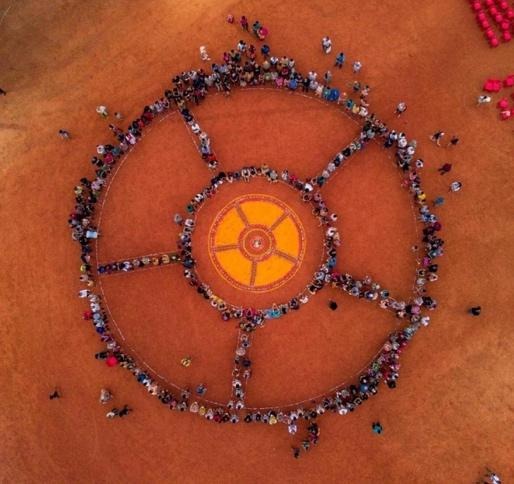
Today, 58 years later, that dream is being strangled. Auroville’s recent crisis is not merely the decline of a township; it is a blow to humanity’s capacity to imagine a world beyond greed and fear. It is being methodically destroyed by the people who were supposed to protect it.
The vision that called them home
To understand what is being lost, one must first understand what was being built. Auroville was not founded on the principle that more buildings would save humanity. It was founded on the belief that a different way of living could transform human consciousness itself.
The Mother’s charter declared unambiguously: “Auroville belongs to nobody in particular. Auroville belongs to humanity as a whole.” This was not poetic language. It was a legal and spiritual commitment. It meant that no one could own land in Auroville as private property. It meant that decisions would be made collectively. It meant that people who had given up everything — careers, family homes, the comfort of belonging to one nation — whether a retired forester from Germany, a French architect, a youth from Brazil or a farmer’s daughter from Tamil Nadu, would sit together, as equals, to decide how to live as one community. From a handful in the 1960s, their numbers grew to about 400 by the late 1970s and to 3,300 from about 60 nations in the 2020s.
This was an attempt to give deliberate choice to the people who had rejected the world’s values and decided to live differently, not because the world had failed them, but because they had glimpsed something truer.

The institution that lost its way
Dr. Jayanti Ravi (Indian Administrative Service officer, Gujarat cadre, 1991), nominated Secretary of the Auroville Foundation in July 2021, did not arrive at her position to dismantle a dream. She arrived at a moment of institutional vulnerability, when growth, development and the complications of managing a multinational community had created some tensions. At that moment, she had a choice: to facilitate the Mother’s vision or to consolidate power. She chose consolidation.
Under her watch and with the acquiescence of a Governing Board, whose term expired last October, the Auroville Foundation did something that should trouble every institutional steward in India. It took powers explicitly reserved to the Residents’ Assembly, the democratic voice of 3,300 residents, and seized them for itself. The relevant provision is unambiguous. Section 19(2)(a) of the Auroville Foundation Act states: “The Residents’ Assembly may allow the admission or cause the termination of persons in the register of residents.”
Not the Secretary. Not the Governing Board. The Residents’ Assembly.
Yet Dr. Ravi’s office issued show-cause notices to 35 residents — people who built homes with their own hands and often from their own resources, raised children here, watched grandchildren born on this land — suddenly received emails from committees with no legal authority to send them. “Show-cause notice”: the language of employers disciplining servants. Except that Aurovilians are not employees. They are citizens bound only by commitment to the Mother’s Charter and India’s laws. The accusations came without evidence. The tone was a threat, not dialogue: justify your existence, or face expulsion from the Register of Residents. Erased.
This is not a policy disagreement. This is the seizure of democratic authority.
The quiet expulsion
When 90% of residents voted to call for transparent planning decisions, the Board ignored them. When 520 residents signed an open letter objecting to the show-cause notices, it was filed away. When the International Advisory Council, composed of recognized experts in Auroville’s philosophy, issued urgent communications asking the Board to reconsider its course, they were dismissed. Not debated. Dismissed.
The response to dissent has been methodical and brutal.
More than 100 residents have left Auroville in the past three years. Some were forced out, their visas denied. Others were driven away by something more insidious: the knowledge that speaking truth would end in retaliation. A 35-year resident, founder of the Auroville Earth Institute and internationally recognized pioneer in earthen architecture had his visa revoked in June 2023 without explanation. Over 200 residents have had visa renewals weaponized against them: approvals for just three months at a time, or one year instead of the earlier five, each renewal a barely veiled exit order. A former Aurovilian-born community representative was issued a “Leave India Notice” in 2023 for speaking about administrative irregularities.
A very modest monthly allowance that keeps Auroville’s poorest residents alive was arbitrarily cut for over 200 people. Some were suddenly billed ₹3,800 for “city services,” including those who had been granted poverty waivers. Others faced backdated bills spanning three years, demanding over one lakh rupees from families already struggling to eat. Youth hostel residents were evicted. Educational initiatives focused on self-directed learning were stripped of funding and shut down. A theater group was forcibly closed for “non-compliance with Mother’s ideals,” a phrase so divorced from reality that it reads like parody.
This is not administration. This is the slow strangulation of a community by those entrusted to protect and nurture it.
The environmental betrayal
What makes Dr. Ravi’s tenure even more troubling is what has happened to Auroville’s environment. Between 2021 and 2025, the forest, the green sanctuary that made Auroville an ecological beacon, recognized internationally as a model of human-nature harmony, has been systematically bulldozed, with many thousands of trees felled. In October 2025, workers were caught cutting protected trees along the state highway with no evidence of proper environmental clearance. Not once. Repeatedly.


Protected species have disappeared. Water catchment areas have been obliterated. The environmental destruction is not a policy disagreement. It is the erasure of one of the Mother’s core commitments: that a more evolved humanity would live in harmony with nature, not dominate it.
And yet, Dr. Ravi’s administration has reframed this destruction as “development” and “progress.” The said development consisted of large roads with enormous concrete slabs laid by the Central Public Works Department (CPWD), with no proper urban development plan behind them. When residents questioned this type of development, they were met with expulsion notices or visa revocations.
This destruction extends beyond forests. For over four decades, residents transformed barren wasteland into one of India’s finest organic farms — Annapurna Farm, supplying over 30% of Auroville’s food needs. Without consulting residents, the Governing Board handed 100 of its 135 acres to IIT Madras for a truck test track.
Sixteen thousand people signed petitions against it. The Residents’ Assembly objected to it and was ignored. The lease was registered on December 23, 2025.
This is what happens when “development” destroys sustainability. When a “sustainability campus” is being built on the ruins of actual sustainability. This is not an administrative failure. This is the annihilation of principle dressed as progress.
This is the aberration that everyone can see, yet few are willing to name directly. The Secretary, backed by the Governing Board, presided over environmental destruction while expelling those who dared to question it.
The question we must answer
This is what must be understood: when an institution designed to serve a spiritual and philosophical vision becomes merely an instrument of administrative control, it dies. The buildings remain. The infrastructure persists. But the soul is gone.
The Governing Board’s mandate was clear: to facilitate Auroville’s collective life and growth. Instead, it became an instrument of control. It did not respond to resident concerns. It did not acknowledge the International Advisory Council’s repeated guidance. It refused to consult the Residents’ Assembly (as it is mandated to do) before making decisions that affected thousands of lives and Auroville’s future. It simply acted, and when questioned, it punished.
The Governing Board’s term has expired. It should not be renewed in any form.
The question before India’s Ministry of Education, which oversees Auroville, is this: Do you believe such a unique project as Auroville should be managed in collaboration with the residents who have lived and worked there, as the Auroville Foundation Act requires? Or do you believe appointed administrators should hold unilateral control?
The answer matters. Not just for Auroville, but for India’s credibility worldwide as a steward of visionary institutions.
India has a responsibility here
The Government of India cannot ignore what has happened at Auroville. A Parliamentary Committee, comprising 30 members with 16 from the ruling party, was asked to investigate several autonomous bodies under the Ministry of Education, including Auroville. It adopted a unanimous report in December 2025 identifying “deep flaws” in the Governing Board’s functioning. The report stopped short of frontal attacks on government policy, but the message was unmistakable: something is profoundly wrong with how the Governing Board has operated.
This is not a marginal issue. This is about India’s international standing. The UN Educational, Scientific and Cultural Organization (UNESCO) recognized Auroville as a symbol of human unity. The Dalai Lama blessed it. International scholars have studied it as a unique human and institutional experiment. When India allows an appointed Secretary to dismantle the democratic structures protecting that experiment, it sends a message about India’s commitment to its own ideals.
The scale of this crisis has not gone unnoticed. A petition signed by nearly 59,000 people demanding government intervention has reached the highest levels of Indian governance. Concerned Residents and Supporters have delivered soft and hard copies to the Prime Minister’s Office, the President of India and concerned ministers. The message is unmistakable: Auroville’s future is not a local administrative matter. It is a test of India’s commitment to democracy, to the ideals enshrined in the Auroville Foundation Act and to the vision of human unity it once championed.
And India still has time to correct course.
What must happen now
The new Governing Board, which should be appointed immediately, must be fundamentally different from the last one. But that is not enough. Dr. Ravi, whose term has just been extended for another year, must be removed as Secretary. The government must appoint a Secretary who understands what Auroville truly represents. Someone versed not just in administrative procedure, but in the philosophical vision animating Auroville. Someone who has studied and believes in Aurobindo’s Integral Yoga and vision of human unity. Someone who recognizes that Auroville is not a real estate project but an experiment in human evolution. Someone who sees themselves as a steward, not a master who rules by division and intimidation.
They must work with the common consciousness of Aurovilians. They must empower the Residents’ Assembly and its working groups, not circumvent them. They must believe that residents, not administrators, are the true guardians of the Mother’s vision.
With this understanding, the new Governing Board’s mandate must be unambiguous:
First, immediately withdraw all show-cause notices and put an end to the visa manipulations. These actions were illegitimate and violated natural justice.
Second, restore the Residents’ Assembly’s powers of admission and termination as mandated by law. This is not a symbolic gesture. It is the restoration of democratic governance.
Third, ensure transparent consultation with the Residents’ Assembly and the International Advisory Council on land decisions, environmental actions and major administrative changes. The Master Plan cannot be bulldozed through in closed rooms.
Fourth, compensate residents whose livelihoods were destroyed through arbitrary allowance cuts and visa manipulations. Those whose homes were threatened or taken over must be restored to their previous status.
And fifth, critically, the new Governing Board must include residents. Not just advisors. Residents. The Mother’s vision of collective governance should be reflected in how Auroville is governed. Only then can genuine growth and development take place.
This is about legitimacy, not just law
Some will argue that the Governing Board’s legal authority is not in question. They may be technically correct, although a number of legal actions are still being played out in India’s courts. The Auroville Foundation Act does vest significant power in the Governing Board and its Secretary. But legitimacy is a different matter. When an institution uses legal authority to violate the spirit of a founding vision, it loses legitimacy.
Dr. Ravi and the Governing Board exercised legal power while violating the fundamental principles they were supposed to protect. They expelled residents instead of serving them. They silenced dissent instead of addressing it. They destroyed the environment instead of protecting it. They weaponized bureaucracy against the vulnerable.
This is what authoritarianism looks like at small scale. It does not announce itself with fanfare. It comes wearing the robes of administration, speaking the language of development, order and compliance, and when you resist, it accuses you of violating the very values you are trying to protect.
The choice before India
For 58 years, Auroville has proved that humans can live beyond the boundaries that divide us. The Mother’s vision was not naive idealism. It was a deliberate experiment in consciousness, community and collective living. It worked. It produced something genuinely transformative: a place where equality mattered more than power, where truth was valued over compliance, where the poor were not discarded, and where innovation and experimentation were valued and encouraged.
Now, that experiment is under threat. Not from external enemies. From the institution designed to protect it.
India can allow this to continue. The government can appoint another Governing Board that consolidates power, continues the environmental destruction and slowly completes the dismantling of the Mother’s vision. Auroville will become another empty township, its forests gone, its residents scattered, its dream abandoned.
Or India can intervene.
The Government of India can appoint a new Secretary and Governing Board that are genuinely committed to the Mother’s vision and ready to work with residents rather than control them. A Governing Board that protects the environment while working with Auroville’s experts to develop a forward-looking model of sustainable development. A Board that facilitates collective governance instead of strangling it.
This second path requires courage. It requires the government to acknowledge that the previous Governing Board failed, that Secretary Ravi’s administration went astray, and that course correction is necessary. It requires appointing new leadership. It requires listening to the International Advisory Council’s guidance. It requires empowering the Residents’ Assembly.
But it is possible. And it is urgent.
The death we cannot accept
India has always positioned itself as a civilization rooted in philosophical depth. A nation remembering ancient insights about human unity, consciousness and collective flourishing.
Auroville was India’s proof that these were not merely historical echoes but living possibilities. The tragedy is not that Auroville tried and failed. The tragedy is that Auroville succeeded in creating something genuinely transformative, a place where people from across the world lived as equals, where truth and collective wisdom mattered more than individual power, and now that success is being systematically dismantled.
This does not mean that all was perfect: inevitably, in an experiment of this type. Auroville’s journey has not been without limitations and occasional failures, but it has pioneered developments in fields from alternative architecture to organic farming, eco-restoration, rural development, skill development or integral education, advances acclaimed in India and the world over and of great relevance to the challenges of the 21st century, beginning with the art of collective living.
What is being killed in Auroville is not just a township. It is an idea. The idea that humanity can live differently. The idea that greed and hierarchy are not inevitable. The idea that consciousness can evolve beyond the narrow confines of ego and nation.
The children born in Auroville are watching what the adults do now. They are watching to see if the dream their parents gave everything for is worth defending. They are watching to see whether conscience can guide policy or if power always wins. So are the thousands of trainees and volunteers whose lives were impacted by a stay in Auroville, the thousands of villagers who acquired skills and a better environment, and Auroville’s well-wishers in India and abroad.
The answer will echo far beyond Auroville. It will say something about India’s commitment to her own ideals: that Vasudhaiva Kutumbakam (the world is one family) is not an empty slogan, that democratic institutions matter, that collective harmony is possible, that nature is sacred and that truth is valued over control.
The Mother once said, “Auroville belongs to nobody in particular. Auroville belongs to humanity as a whole.” India’s government could respect that, and it must.
Because some things, once lost, can never be recovered. And Auroville was meant to prove that another world was possible.
The time for India to act is now. Not next month. Not after another report. Now. Because Auroville is not just a township. It is India’s conscience made visible. What India does about Auroville will define what India believes about herself.
[Kaitlyn Diana edited this piece.]
The views expressed in this article are the author’s own and do not necessarily reflect Fair Observer’s editorial policy.
Why the Indian Diaspora Must Find Its Civic Voice
Indian Americans continue to shape American life, yet their public voice remains unusually muted. Rooted in both cultural caution and...

New Economics: The Backpacker, Capitalism, and Self-Sufficiency
Capitalism leads to excessive focus on shareholder value and negative societal impacts. Instead, we need a fairer system that addresses...


Support Fair Observer
We rely on your support for our independence, diversity and quality.
For more than 10 years, Fair Observer has been free, fair and independent. No billionaire owns us, no advertisers control us. We are a reader-supported nonprofit. Unlike many other publications, we keep our content free for readers regardless of where they live or whether they can afford to pay. We have no paywalls and no ads.
In the post-truth era of fake news, echo chambers and filter bubbles, we publish a plurality of perspectives from around the world. Anyone can publish with us, but everyone goes through a rigorous editorial process. So, you get fact-checked, well-reasoned content instead of noise.
We publish 3,000+ voices from 90+ countries. We also conduct education and training programs
on subjects ranging from digital media and journalism to writing and critical thinking. This
doesn’t come cheap. Servers, editors, trainers and web developers cost
money.
Please consider supporting us on a regular basis as a recurring donor or a
sustaining member.
Will you support FO’s journalism?
We rely on your support for our independence, diversity and quality.





Comment