


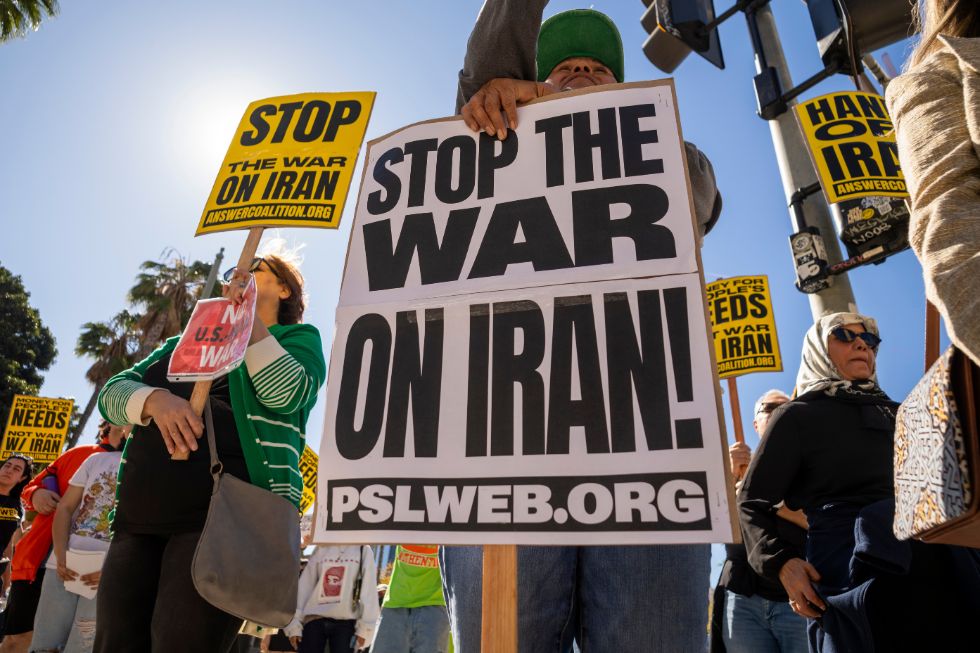



On February 28, the US military struck a girls’ primary school in Minab, in southern Iran’s Hormozgan province. The building was hit three times, killing 180 people. Most of them were schoolgirls aged seven to 12.
That sentence should not be easy to read. But it needs to be said plainly, because the language coming from Washington in this war is the language of operational success, of degraded capabilities, of targets serviced: a language that hides human tragedy in the fog of strategic data. These schoolgirls were not collateral damage. They were innocent civilian lives — lives that the laws of war are supposed to protect.
Similarly, when Pete Hegseth announced the sinking of the IRIS Dena, he did so in the register of a man describing a kill from behind a screen. Hegseth is not the Secretary of Defense. He calls himself (and has spent millions of dollars in Pentagon funds rebranding his office as) the Secretary of War. It is not a slip or a provocation. It is a declaration of intent.
The vessel he was celebrating was a frigate returning home from India’s Milan 2026 naval exercise. It was in international waters when the USS Charlotte fired, without warning. Hegseth called it “quiet death.” Eighty-seven sailors were killed. None of them were combatants in any meaningful operational sense when the torpedo struck.
Foundations and evolution of just war theory
There is a framework for thinking about how wars should be started and how they should be fought. It is older than the US. It begins, in its systematic form, with Christian theologian and philosopher Saint Augustine of Hippo, writing in the early fifth century as the Western Roman Empire collapsed around him — not metaphorically, but literally. Responding to Christians asking whether a follower of Christ could take up arms, he did not grant blank permission; he set constraints. War might be permissible, but only under specific conditions, for specific purposes, conducted in specific ways. Fellow Christian theologian and philosopher Thomas Aquinas codified what Augustine had begun: just cause, legitimate authority, right intention. The tradition that followed developed these into two operative branches: jus ad bellum, the conditions under which going to war is justified, and jus in bello, the rules governing how war must be conducted.
After 1945, this tradition was largely secularized. The Nuremberg trials established individual criminal liability for initiating aggressive war. The Geneva Conventions translated the core principles of discrimination and proportionality into binding international law. Additional Protocol I is explicit: Deliberate attacks on civilians are prohibited. Attacks causing civilian casualties disproportionate to the anticipated military advantage are prohibited. These are not aspirational norms; they are legal obligations that the US signed.
The current campaign fails both tests.
Failures of jus ad bellum and jus in bello
On jus ad bellum, the intelligence case for war was never made. Multiple assessments — including from within the American intelligence community — found no evidence of an active Iranian nuclear weapons program or an imminent restart. The foreign minister of Oman, who was overseeing negotiations between Washington and Tehran, publicly stated that talks were close to a breakthrough when the bombing began. Hours before the first strikes, he appeared on American television to say a deal was within reach, a pledge Iran had made that US President Donald Trump would later claim it had refused. British government sources separately indicated that diplomatic channels had not been exhausted and that the strikes had no lawful basis. Forces were being positioned in the region while talks were still formally ongoing: preparation wearing the mask of diplomacy. That is not a last resort. Even the 2003 invasion of Iraq, whatever one thinks of it, involved months of attempted coalition-building and a formal UN Security Council process. That acknowledgment, however cynical, that unilateral action requires justification has now been abandoned entirely.
On jus in bello: Minab and the IRIS Dena are the answer.
In the immediate aftermath of Minab, the administration moved quickly to obscure responsibility. Trump initially insisted Iran had bombed its own school, a claim requiring, implausibly, that Iran possesses Tomahawk cruise missiles, weapons only the US manufactures and deploys. When pressed, he claimed ignorance. Hegseth said the Pentagon was investigating. Within days, a Department of Defense inquiry found that a US missile was responsible. Independent investigations by The New York Times, NPR and BBC Verify reached the same conclusion, authenticated by video evidence of a Tomahawk striking the site. The posture of uncertainty was not confusion; it was a reflex.
As for the Dena, Hegseth reached for precedent, invoking the sinking of the Argentine cruiser General Belgrano during the 1982 Falklands War. It is not a flattering comparison. The Belgrano was sailing away from the exclusion zone when the HMS Conqueror torpedoed her. The sinking killed 323 sailors and remains a stain on that campaign’s moral record. Hegseth appears not to have noticed.
The moral question: rightness over effectiveness
Just war theory does not ask whether a military operation is effective. It asks whether it is right. A school full of children, a warship returning home from a peacetime exercise sunk without warning in international waters; these are not aberrations or fog-of-war tragedies. Rather, they are the opening acts of an unnecessary war that is not being conducted with discrimination or proportionality and is being led by an administration that has renamed itself, at considerable public expense, to signal its intent to keep going.
The tradition Augustine began, and that international law eventually formalized, exists precisely for moments like this. But there is no world government, no global enforcement mechanism. International law is a system of voluntary restraint; it works only as long as powerful states choose to be bound by it. When the most powerful state opts out, it does not simply break the rules. It begins to dissolve them.
[Kaitlyn Diana edited this piece.]
The views expressed in this article are the author’s own and do not necessarily reflect Fair Observer’s editorial policy.
When Strategy Fails, Civilian Infrastructure Becomes the Target
US President Donald Trump’s extension of the Strait of Hormuz ultimatum reveals strategic challenges, not success. Military coercion struggles in...

The Iran War and the Human Habit of Violence
Iran’s Supreme Leader Ayatollah Ali Khamenei’s death marks a complex moment of relief and uncertainty for Iranians and the region....
Why Legality Matters: The Crucial Role of Law in Global Order
The Trump administration’s disregard for international and domestic law threatens the very foundations of the rules-based order that has underpinned...

Support Fair Observer
We rely on your support for our independence, diversity and quality.
For more than 10 years, Fair Observer has been free, fair and independent. No billionaire owns us, no advertisers control us. We are a reader-supported nonprofit. Unlike many other publications, we keep our content free for readers regardless of where they live or whether they can afford to pay. We have no paywalls and no ads.
In the post-truth era of fake news, echo chambers and filter bubbles, we publish a plurality of perspectives from around the world. Anyone can publish with us, but everyone goes through a rigorous editorial process. So, you get fact-checked, well-reasoned content instead of noise.
We publish 3,000+ voices from 90+ countries. We also conduct education and training programs
on subjects ranging from digital media and journalism to writing and critical thinking. This
doesn’t come cheap. Servers, editors, trainers and web developers cost
money.
Please consider supporting us on a regular basis as a recurring donor or a
sustaining member.
Will you support FO’s journalism?
We rely on your support for our independence, diversity and quality.





Comment