





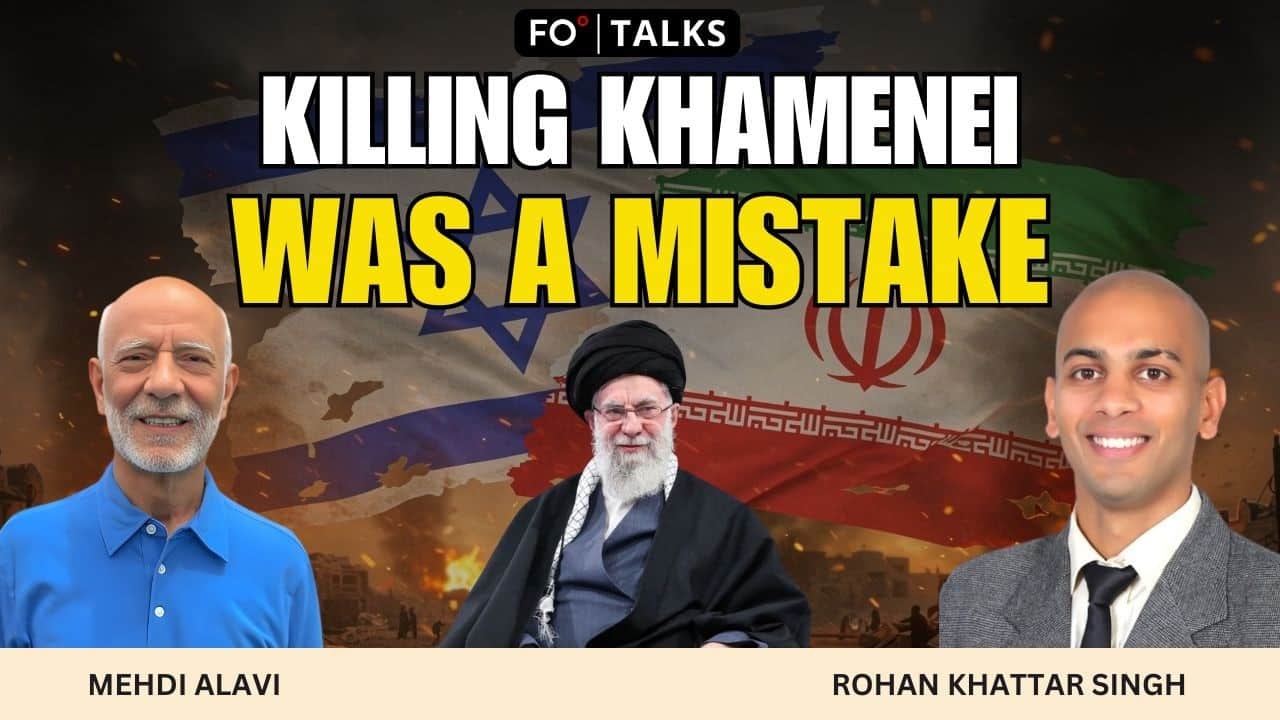
Fair Observer’s Video Producer Rohan Khattar Singh speaks with Mehdi Alavi, the founder of the Peace Worldwide Organization, about the escalating US–Israel war with Iran following Operation Epic Fury. The conversation centers on a pivotal moment: the killing of Iranian Supreme Leader Ayatollah Ali Khamenei, and the unexpected political and military consequences that followed. Rather than weakening Tehran, the strike appears to have hardened domestic unity and intensified regional tensions.
As Khattar Singh presses Alavi on military capabilities, regional reactions and global alignments, the discussion probes whether Washington and Tel Aviv have triggered a wider strategic shift they cannot easily control.
A miscalculation with unintended consequences
Alavi argues that the killing of Khamenei reflects a fundamental misreading of Iranian society and the broader Muslim world. Instead of triggering unrest, the attack appears to have consolidated support for the Iranian state. “The United States and Israel miscalculated and did not realize the popularity of Ali,” he says, pointing to emotional reactions across Shia communities and beyond.
Khattar Singh tests this claim against the expectation in Washington and Tel Aviv that regime change pressures would follow. In Alavi’s account, the opposite has occurred. The removal of a central figure has not fractured the system but instead strengthened it, reducing the likelihood of internal dissent in the short term. This inversion of expectations raises a larger question about whether external military pressure can still produce predictable political outcomes in the region.
The nuclear threshold
What lies in the future for Iran’s nuclear policy? Alavi suggests that Khamenei had acted as a restraining force against weaponization and that his absence may remove a key barrier. “With him gone, chances are Iran probably will go [for a] nuclear weapon,” he warns, framing the shift as both a response to public sentiment and a strategic necessity.
Khattar Singh connects this argument to the logic of deterrence. If Iranian leaders conclude that nuclear capability could have prevented such a strike, the incentive structure changes dramatically. The war risks accelerating precisely the outcome it may have sought to prevent. It is unclear whether this shift would be immediate or gradual, but strategic calculations can quickly evolve under pressure.
Missiles, drones and the balance of force
Turning to the battlefield, Alavi emphasizes Iran’s use of ballistic missiles and drones to target US and allied assets across the region. He claims that Tehran has already degraded American infrastructure in the Persian Gulf and retains significant reserves of more advanced weaponry. According to his assessment, the current phase of attacks may represent only a partial deployment of Iran’s capabilities.
Khattar Singh raises a critical point about sustainability. While the tempo of launches has fluctuated, the key question is how long Iran can maintain pressure. Alavi says that Iran has planned for a prolonged conflict and may be conserving its most destructive systems. US defensive capacity could erode over time. “The sky is very much open for Iran,” he warns.
Regional reactions and shifting alignments
The conversation widens to examine how regional actors are responding. Alavi portrays Gulf states as constrained, reliant on US systems they do not fully control, and increasingly uneasy about Washington’s priorities. At the same time, he suggests that public sentiment in parts of the Arab world is diverging from official policy, reflecting deeper frustrations with existing political arrangements.
Khattar Singh introduces the roles of India and Pakistan, highlighting how the war is reshaping relationships beyond the immediate theater. Alavi predicts strain in Iran’s ties with India while describing Pakistan as more cautious, at least for now. These shifts point to a broader reordering in which countries are recalibrating their positions amid uncertainty about US strategy and regional stability.
Toward a multipolar order
The discussion concludes by examining global implications. Alavi situates the conflict within a larger contest involving Russia and China, both of which he believes have incentives to support Iran through intelligence, coordination or economic alignment. The war, in this view, is not an isolated crisis but part of a wider transition in the international system.
Khattar Singh presses on whether this moment marks a turning point. Alavi argues that sustained conflict could weaken US influence and accelerate the emergence of a more multipolar order. While his conclusions are sharply framed, the underlying point is clear: the consequences of this war extend far beyond the battlefield. What began as a targeted strike may instead be catalyzing a broader transformation in regional and global power dynamics.
[Lee Thompson-Kolar edited this piece.]
The views expressed in this article/video are the author’s own and do not necessarily reflect Fair Observer’s editorial policy.



















Comment