





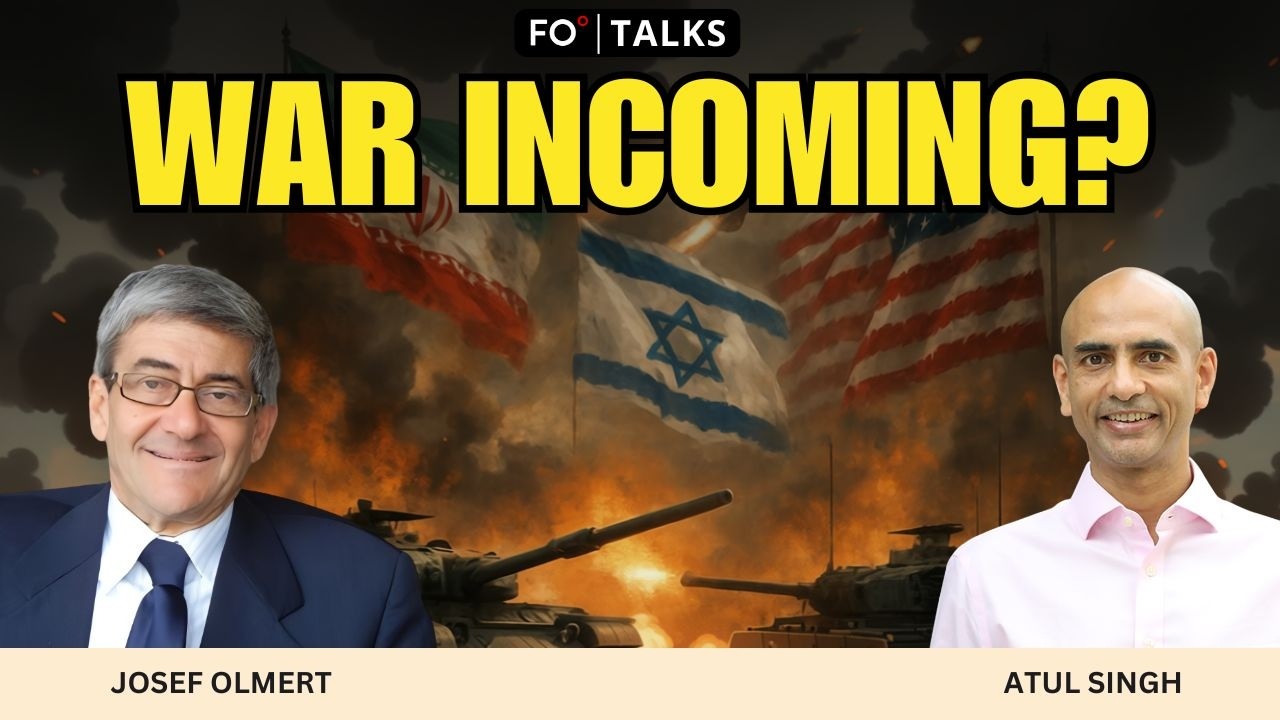
Editor-in-Chief Atul Singh and Josef Olmert, a former Israeli government official and Middle East scholar, discuss Israel’s official recognition of Somaliland, the self-declared republic that broke away from Somalia in 1991. Rather than treating the decision as a symbolic diplomatic gesture, this conversation situates it within a widening geopolitical contest stretching from the Horn of Africa to the eastern Mediterranean. Olmert argues that geography, energy politics and post–October 7 strategic recalibration explain why Israel moved when it did — and why the implications reach far beyond Somaliland itself.
Geography as strategy
Olmert begins with the simplest explanation: geography. Somaliland sits on the northern edge of the Horn of Africa, overlooking the Gulf of Aden and adjacent to the Red Sea’s southern approaches. From an Israeli perspective, this location matters for two reasons. First, it offers proximity to Iran and Yemen, where the Houthi movement has emerged as a direct security concern. Second, it places Israel near some of the world’s most critical maritime chokepoints.
Somaliland’s position shortens strategic distances and provides leverage in a region where control of sea lanes increasingly overlaps with missile, drone and naval threats. In this sense, recognition is not an ideological statement about Somali politics but a calculated move rooted in deterrence and access.
The Turkish element
A central theme of the discussion is what Olmert calls the “Turkish element.” Turkey has expanded its footprint in Somalia over the past decade, combining military presence with economic ambitions. According to Turkish claims, offshore oil reserves near Somalia may amount to 30–40 billion barrels, with drilling planned to begin in 2026. At the same time, the Turkish capital of Ankara has grown increasingly hostile toward a developing energy partnership linking Israel, Greece and Cyprus in the eastern Mediterranean.
That partnership is already operational, drawing on Israel’s offshore gas reserves and routing energy toward Europe via Cyprus and Greece. Turkey argues that the project violates the rights of Northern Cyprus, a territory occupied by Turkey and recognized only by Ankara. Olmert interprets Israel’s recognition of Somaliland as part of a broader pattern of “mutual deterrence:” Israel positions itself near Turkey’s African interests as Turkey pressures Israel’s Mediterranean energy plans.
As a result, the chessboard widens. Somaliland is becoming one square in a larger contest between two regional powers whose rivalry is no longer confined to rhetoric.
Ethiopia, the UAE and quiet alignments
Beyond Turkey, Olmert emphasizes the importance of Ethiopia, a rapidly growing regional power with a population approaching 130 million. Landlocked Ethiopia has sought access to the sea, including proposals to lease parts of Somaliland’s coastline. This ambition intersects with Egyptian anxieties over the Nile River, particularly Ethiopia’s massive dam project, which the Egyptian capital of Cairo views as an existential threat.
The United Arab Emirates plays a pivotal role here. The UAE already operates a military port in Somaliland and has maintained de facto relations with the territory for years. Notably, it did not join Arab or African condemnations of Israel. Olmert reads this silence as evidence of a growing informal alignment among Israel, the UAE and other regional actors who prioritize strategic interests over formal adherence to inherited borders.
From passivity to activity after October 7
For Olmert, the recognition of Somaliland reflects a deeper shift in Israeli foreign policy following the infamous October 7 terror attacks. For years, Israel under Israeli Prime Minister Benjamin Netanyahu pursued a strategy of containment and passivity — avoiding escalation while assuming time worked in Israel’s favor. October 7 shattered that assumption.
Olmert describes the post-October 7 recalibration as a move “from passivity to activity,” with Israel seeking alliances and leverage rather than standing apart. “Israel has become an actor within the system of Middle East politics,” he says, rather than an isolated outlier. Somaliland fits this new posture: a willingness to accept diplomatic risk in exchange for strategic positioning.
Domestic politics also play a role. Netanyahu, under intense internal pressure, benefits from actions that reset the political agenda. Recognition forces media attention outward and reframes leadership as initiative rather than reaction. Olmert acknowledges this as a political calculation but argues it does not negate the strategic logic behind the move.
Sovereignty, self-determination and fragmentation
The conversation then broadens to a more structural question: Are borders becoming less sacrosanct? Somaliland has existed as a de facto state for over three decades, holding elections and managing peaceful transfers of power despite clan divisions. Somalia, by contrast, remains fractured and heavily influenced by Islamist militancy.
Olmert cautions against universalizing the Somaliland case. While some states may fragment, others retain strong central authority. Ethiopia, Nigeria and other large states demonstrate that secessionist movements can still be contained. The emerging pattern, he suggests, is case-by-case rather than systemic collapse.
Still, examples abound: Libya remains divided between east and west. Sudan is engulfed in civil war. Yemen functions as multiple political entities. Syria is split into zones of influence. Somaliland’s recognition highlights a tension long embedded in international law between state sovereignty and self-determination — a tension now resurfacing as power balances shift.
Risks of overreach
Despite his analytical sympathy for Israel’s decision, Olmert repeatedly warns against overextension. Israel is small, its margin for error limited. Strategic confidence can easily slide into strategic hubris. “History is known only retrospectively,” he cautions, arguing that what appears momentous today may look different once regional reactions unfold.
Turkey remains unpredictable. Iran faces domestic unrest but retains disruptive capacity. The United States, under US President Donald Trump, offers support that is politically potent but strategically volatile. In such an environment, Somaliland represents both opportunity and risk.
A calculated gamble
Israel’s recognition of Somaliland signals a more assertive foreign policy, tighter alignment with select Arab states and a willingness to contest rivals beyond traditional theaters. It also underscores a changing regional order in which informal alliances and de facto realities increasingly matter more than inherited legal frameworks.
Whether Somaliland becomes a lasting strategic asset or a diplomatic liability remains uncertain. Olmert sees, however, that Israel is no longer content to remain on the margins of regional politics. It is moving pieces across a much larger board and accepting the consequences that come with that choice.
[Lee Thompson-Kolar edited this piece.]
The views expressed in this article/video are the author’s own and do not necessarily reflect Fair Observer’s editorial policy.


































Comment