



A century ago, the anthropologist Margaret Mead wrote a line that became the gospel of generations of educationists: “The children must be taught how to think, not what to think.” Many post-1945 Western nations tried to put this vision of education into practice, with mixed results. In India, we recently witnessed a striking demonstration that we have made little progress since the 19th century.
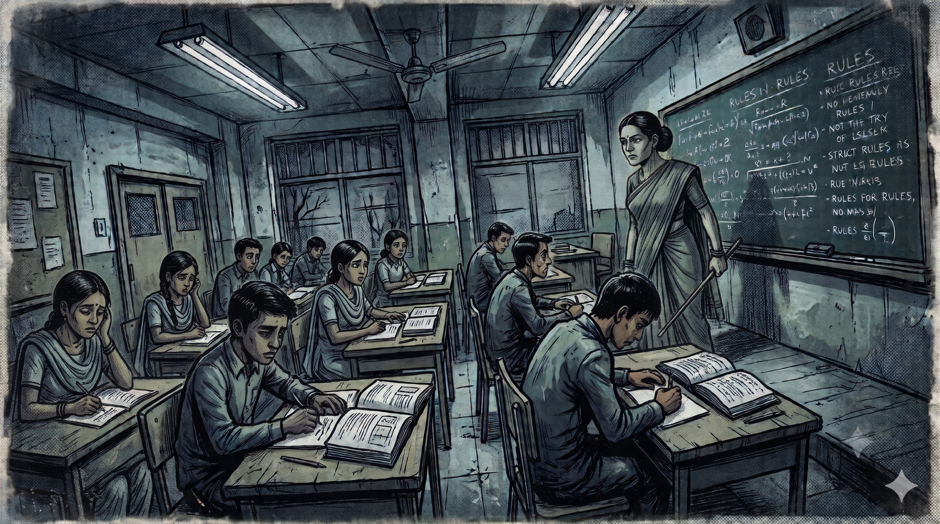
On February 25, a bench headed by Chief Justice of India Surya Kant took offense at the chapter “The Role of the Judiciary in Our Society” in Part 2 of a just-released Social Science textbook for Grade 8. Two prominent senior advocates, Kapil Sibal and Abhishek Singhvi, brought the matter to the bench’s notice, expressing indignation at the chapter — though neither they nor the Justices seemed to have seen or read it at that point. Their main source was a newspaper article that focused on just two pages in the textbook (out of 258) and discussed the huge backlog of cases in India and corruption in the judiciary.
The next day, without quoting any significant passage from the said chapter but referring twice to the newspaper article, the bench asserted that the chapter had been written in a “reckless, irresponsible, contemptuous, and motivated manner” and suo motu banned the entire textbook. Declaring that “heads must roll,” the Supreme Court threatened the textbook’s publisher, the National Council of Educational Research and Training (NCERT) and an official in the Ministry of Education with criminal contempt of court; both promptly tendered an unconditional apology, taking their cue from the Minister himself.
On March 11, the NCERT named in its affidavit the three presumed authors of the said chapter, prompting the Supreme Court to cast aspersions on their competence (without knowing anything of their backgrounds) and to forbid all institutions using public funds from associating with them — ensuring, in effect, their total ostracization from the academic world and beyond. Such an action, which one Justice on the bench later conceded was “harsh,” was in fact unprecedented in India’s judicial history.
The three targets were Mr Alok Prasanna Kumar, a respected legal author (and technically an advocate) who had prepared the chapter’s initial draft; Mrs Suparna Diwakar, an experienced educationist, founder of several institutions, and Chief Consultant of the Programme Office functioning under the National Syllabus and Teaching Learning Materials Committee (NSTC), the committee tasked by the Ministry of Education with the preparation of new school syllabi and textbooks; and Professor Michel Danino, a well-known scholar of ancient India, then visiting professor at the Indian Institute of Technology (IIT), Gandhinagar, and recipient of the Padma Shri award in 2017 for his work in education and literature. As head of the Curricular Area Group for Social Sciences (under NSTC), Danino was actively involved in the new Social Science textbooks from Grades 6 to 8 — the “Middle Stage,” in the new terminology.
The public response
The Supreme Court’s forceful intervention generated a massive outcry on social media, with thousands of posts asserting the existence of corruption in the judiciary, at times in slightly … pungent terms, shall we say. Clearly unhappy with “certain elements on social media [who] acted irresponsibly,” the Chief Justice directed the Government of India “to identify such sites/accounts as well as the persons running those sites/accounts and to furnish their full details to enable us to take suitable action.” Thankfully, it appears that nothing came of this attempt.
More significantly, a flurry of articles appeared in the mainstream press and on respected internet platforms, quite a few of them authored by legal luminaries (we compiled a list of over 20 major such articles). Several videos also circulated, including a recording of a vigorous intervention in the Rajya Sabha by a Member of Parliament (MP) condemning the ban on the three scholars.
What were the main points in these articles?
Several argued that the Supreme Court, supposedly the guardian of fundamental rights, had trampled on several of the three scholars’ rights and grossly violated the principle of being heard before being sentenced. Others pointed out that the Supreme Court did not have the power to ban a book or to blacklist an individual, so that both aspects of its order were legally flawed. More asserted that the Supreme Court’s ban amounted to censorship intended to stifle public debate. Several articles asked why a mention of judicial corruption or India’s colossal backlog of cases should be objectionable, when only official sources were used, and the overall approach was respectful, projecting a positive image of the judiciary.
In a significant development, in early April the media widely reported a letter to the President of India signed by 51 academics and scholars, who termed the Supreme Court’s intervention “judicial overreach.” The letter argued that the Supreme Court had “prevented educational experts, teachers and other stakeholders from objectively examining the contentious chapter” and had “failed to appreciate the special mandate under which the new NCERT textbooks are produced.”
The educational context
Danino and Kumar, in their affidavits of April 4 seeking to modify the Supreme Court’s order, emphasized the same point as the letter. (Danino also stated that Suparna Diwakar had nothing to do with finalizing the textbook and that the NCERT erred in dragging her name into it). They also stressed that the NCERT failed to convene an NSTC meeting on the Grade 8 textbooks, despite the NSTC’s mandate to finalize the textbooks and, therefore, give them final approval.
But leaving aside this procedural flaw (and a few more), the affidavits, judging from Danino and Kumar’s interviews, among other articles, focused on four points: (1) a vigorous denial of any mala fide intent in preparing this chapter; (2) a rejection of Sibal’s and Singhvi’s allegation that the contentious chapter had “selectively” targeted the judiciary to the exclusion of other institutions; (3) the elaborate collective nature of the textbooks’ preparation, with multiple internal and external reviews, while the three scholars were made to look as the chapter’s sole authors; and (4) the Supreme Court Justices’ lack of competence to decide whether the chapter’s content was appropriate for students of “impressionable age,” to use their own phrase.
This last point touched the core of the issue. According to Danino’s affidavit, recent research on child psychology worldwide has concluded that developing the student’s critical mind should begin at age 11, i.e., from Grade 6 onward — the current textbook was dealing with the latter part of Grade 8. In other words, the Justices’ opinion on “impressionable age” was not only subjective, but obsolete. Far from apologizing for the chapter, the three scholars stood their ground and explained the new pedagogical approach — which NCERT and the Ministry should have done in the first place, instead of “throwing [them] under the bus,” as Danino said.
Indeed, the mandate given by the National Education Policy 2020 (NEP 2020) and the subsequent National Curriculum for School Education of 2023 (NCFSE 2023) was wholly absent from the early hearings in this case. The Supreme Court bench seems to have been unaware that both documents repeatedly called for engaging students in debates and discussions to stimulate their critical thinking.
The NEP 2020, for instance, asked for the new education to “develop among the students … a conscious awareness of one’s roles and responsibilities in a changing world” so as to “truly shape our next generation of citizens”; for this to happen, “cognitive capacities, such as critical thinking and problem solving” need to be developed. Even more specifically, the NCFSE 2023 listed, among other Social Science themes suggested for Grade 8, “What types of challenges are being faced by Indian democracy in recent times?”
The Justices seemed to partly accept the three scholars’ explanations, eloquently relayed by their senior counsels, one of whom assured the Justices that their clients were no “fly-by-night operators.” On May 22, the bench rolled back much of its order, particularly its ban on the three scholars and the negative obiter dictum on their competence and intentions. But it stopped at that — the ban on the chapter (and by extension on the textbook) remained. The harm was done.
The sanitized chapter
Right from the initial hearings, the Justices directed NCERT to form a committee of three eminent jurists not only to “revise” the banned textbook, but also to vet legal studies in other Grades. That these jurists, too, had no apparent experience in the educational field hardly mattered.
The bench did not stop there; without any interaction with the NSTC committee, the Supreme Court ordered the NSTC’s reconstitution. The above-mentioned letter to the President deplored such moves in these terms: “[T]he Supreme Court, which stands as the protector of freedom of expression, has encroached upon academic freedom and created an atmosphere of intimidation which may strike fear among present or future educationists.” Quite a few articles also warned against the “chilling effect” the Supreme Court’s intervention was bound to have.
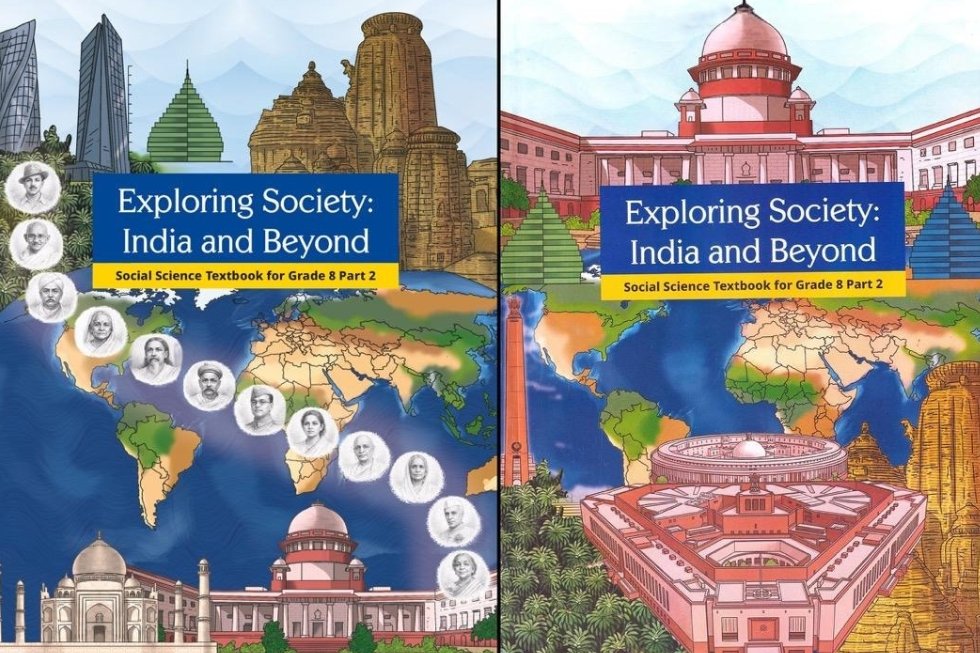
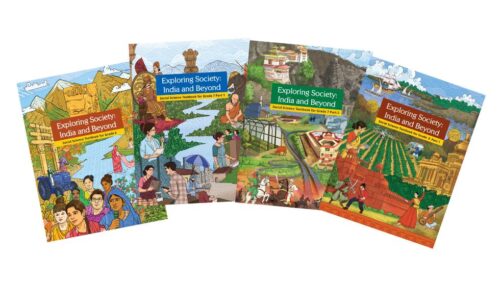
Subsequent pronouncements by the Chief Justice of India that the public had every right to criticize judgments or the judiciary itself did little to ease those apprehensions. In July, the “revised” textbook appeared — “sanitized” is the apt word. What first struck the eye was the new cover design: The Supreme Court’s building now spanned the front cover, sitting majestically at the very top and occupying nearly a third of the space. The Parliament at the bottom occupied another third — even though this textbook has no chapter dealing with the Parliament (that was in Grade 7 Part 2, and the Parliament did figure on its cover). A world map and some greenery occupied most of the remaining space. The message was clear.
In contrast, the banned textbook did depict the Supreme Court’s building, but in more modest dimensions at the bottom; prominent was a garland of freedom fighters flowing across most of the cover, since the textbook has a major chapter on India’s Freedom Movement — that chapter now has no representation on the revised textbook’s cover. (Note that Social Science textbooks in Grades 6 to 8 combine geography, history, cultural heritage, political science and economics in a single volume.)
Let us now turn to the contentious chapter itself in its revised form. As expected, all mentions of challenges to the judiciary have disappeared; the chapter now reads like a largely theoretical, all-is-well-in-the-best-of-all-possible-worlds type of treatment. At no point is the student invited to reflect on the real challenges facing our courts and justice system.
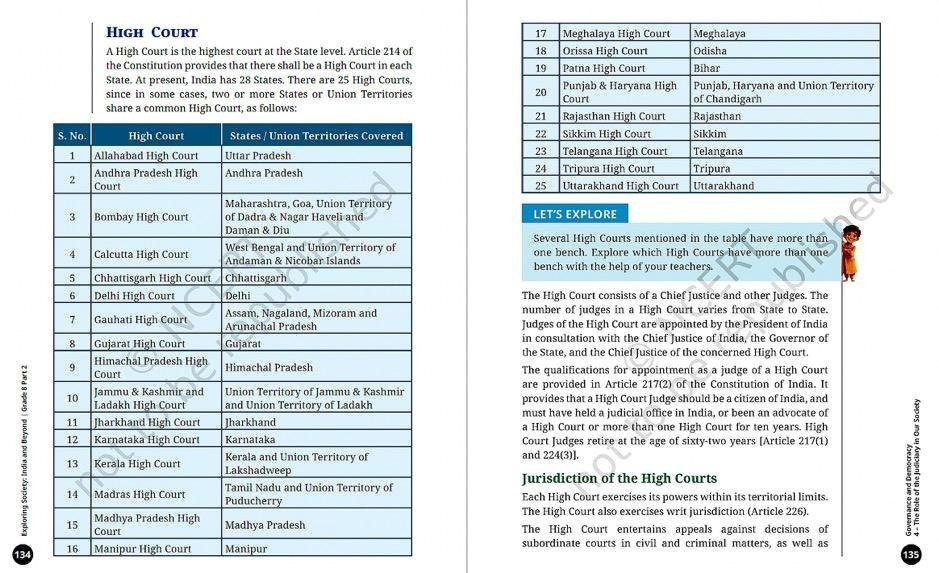
In fact, the revised chapter promotes the very same mind-numbing rote learning that NEP2020 and NCFSE2023 have censured, for instance, listing in a table all 25 High Courts of the country, which students will now need to mug up. There are also needless technical developments on writ petitions, special leave petitions, appellate jurisdiction, advisory jurisdiction, etc., none of which will engage the student in any way. Examples of ancient concepts of dharma as justice, drawn from anecdotes in the Mahabharata, were deleted, as was a reference to the ancient Lichchhavi’s elaborate judicial system. Is the intention to show that justice came to India only with British colonial rule?
The revised chapter also removed a side box dedicated to the late Kuldip Singh, the “Green Judge,” and his landmark judgments protecting the environment or declaring the teaching of Sanskrit to be in no way unsecular. It is difficult to conceive what was objectionable in this case study, which provided a shining example of how a dedicated judge can help improve our society.
The aftermath
One unexpected fallout of the Supreme Court’s intervention was aptly summed up by a professor of political science:
The greatest irony is that the portion of the book which might not have attracted any objection or even attention has now drawn widespread attention precisely because of the court’s harsh order. Since that passage has been removed everywhere with immediate effect following the court’s order, the subject of ‘corruption in the judiciary’ is now being discussed everywhere.
There is no doubt that the ban on the textbook has unwittingly turned the spotlight on judicial corruption.
On September 14, delivering the sixth Ram Jethmalani Memorial Lecture on “Justice seen to be done: Transparency and public trust as pillars of the legal system,” Justice Kant, perhaps trying to soften the counterblast, explained that the suo motu proceedings against the NCERT textbook had been an “occasion to consider the relationship between legitimate criticism and public confidence in the institution.” He now asserted that the judiciary “cannot seek the confidence of the public by placing itself beyond scrutiny; it must remain willing to be examined, questioned and, where necessary, criticised.”
But then, why should the said “scrutiny” (there was no question of “criticism” in the contentious chapter) not begin at school, inviting students to reflect on the ills of our institutions, including the judiciary? We all know that those ills are deeply entrenched and have been debated for decades. Indeed, in a 1995 interview, the same indignant Kapil Sibal had come down heavily on judicial corruption:
Judges themselves need disciplining. The judiciary has failed in its efforts to eradicate the phenomenon of corruption. This phenomenon includes receiving monetary benefits for judicial pronouncements rendering blatantly dishonest judgments, kow-towing with political personalities and obviously favouring the Government and thereby losing all sense of objectivity.
(Ironically, Sibal was sued for contempt of court for this pronouncement, with the Supreme Court eventually rejecting the complaint!)
If the past and current generations have failed to resolve these issues — and we are not suggesting that quick-fix solutions exist — should we not at least preserve some hope that the upcoming generations will do better? If so, why not trust our children’s intellect and sincerity? How will they develop the “critical mind” the NEP 2020 calls for if we sweep all contentious topics under the carpet and pretend that no challenges exist? How will the NCFSE 2023’s excellent question, “What types of challenges are being faced by Indian democracy in recent times?” ever be answered?
In Social Science at least, we seem to have abdicated the responsibility the National Education Policy 2020 placed on educators. “In India, the students generally have great capacities but the system of education represses and destroys these capacities,” said Sri Aurobindo precisely 100 years ago — a top-down system devised by adults incapable of looking at schooling through the student’s eyes. How many more years or decades before we decidedly move from “what to think” to “how to think” and stop regarding students as passive sponges unable to think for themselves?
[Kaitlyn Diana edited this piece.]
The views expressed in this article are the author’s own and do not necessarily reflect Fair Observer’s editorial policy.
The Supreme Court of India Has No Spine
The Supreme Court of India recently banned a school civics chapter for discussing judicial corruption and blacklisted its authors from...
Should India’s Supreme Court Have Banned a Grade 8 Social Science Textbook?
India’s Supreme Court has recently banned a grade 8 Social Science textbook, citing problems with the textbook’s mentions of judicial...
From Subordination to Supremacy: The Indian Supreme Court’s Rise in Governance
The rise of the Indian Supreme Court as the most powerful constitutional court in the contemporary world is a result...
Support Fair Observer
We rely on your support for our independence, diversity and quality.
For more than 10 years, Fair Observer has been free, fair and independent. No billionaire owns us, no advertisers control us. We are a reader-supported nonprofit. Unlike many other publications, we keep our content free for readers regardless of where they live or whether they can afford to pay. We have no paywalls and no ads.
In the post-truth era of fake news, echo chambers and filter bubbles, we publish a plurality of perspectives from around the world. Anyone can publish with us, but everyone goes through a rigorous editorial process. So, you get fact-checked, well-reasoned content instead of noise.
We publish 3,000+ voices from 90+ countries. We also conduct education and training programs
on subjects ranging from digital media and journalism to writing and critical thinking. This
doesn’t come cheap. Servers, editors, trainers and web developers cost
money.
Please consider supporting us on a regular basis as a recurring donor or a
sustaining member.
Will you support FO’s journalism?
We rely on your support for our independence, diversity and quality.




Comment