





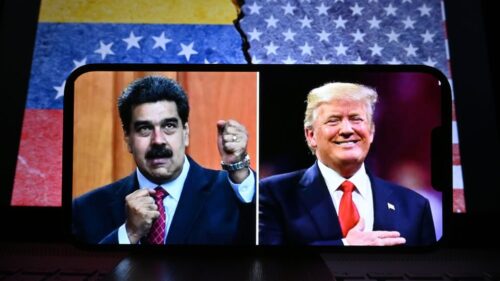
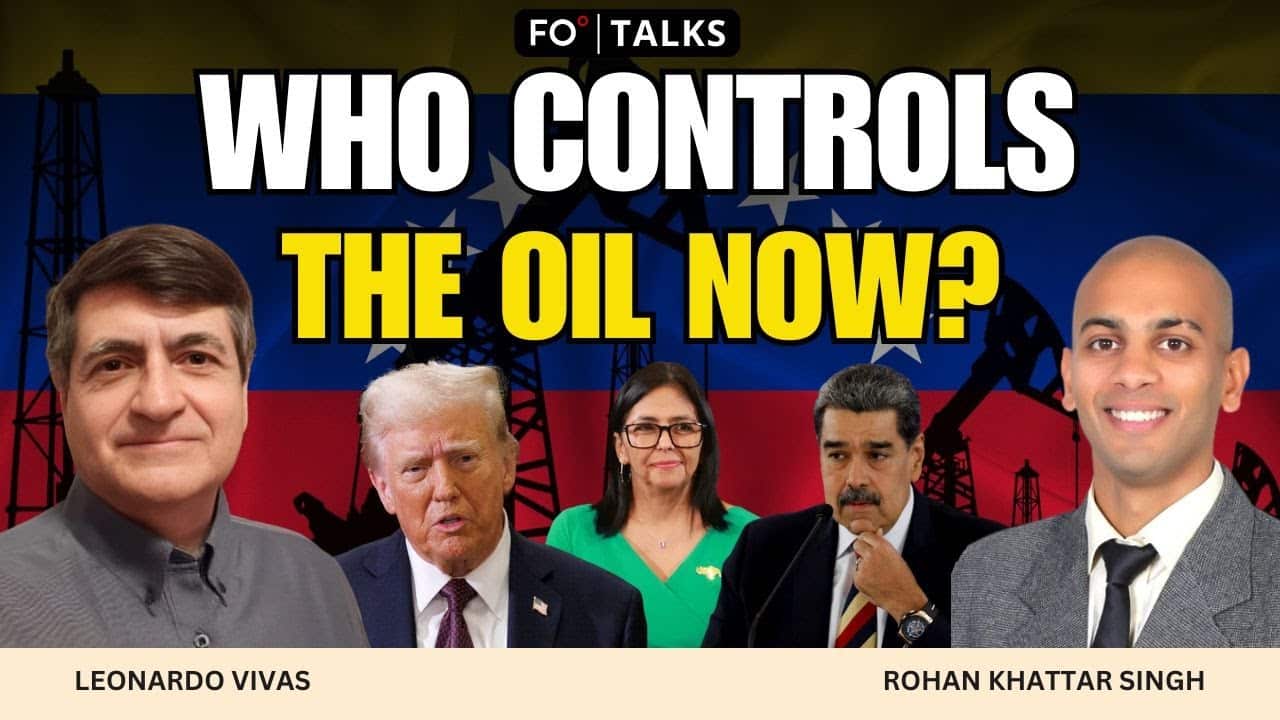
In this episode of FO° Talks, Fair Observer’s Rohan Khattar Singh speaks with journalist and researcher Joseph Bouchard about the US’ seizure of a Venezuelan oil tanker in international waters. The move marks a sharp escalation in Washington’s pressure campaign against Venezuelan President Nicolás Maduro and raises urgent questions about legality, regime change and the erosion of global norms. Bouchard situates the incident within Venezuela’s oil-dependent political economy and a longer history of US intervention in the region, while assessing how domestic US politics and global power competition shape the current moment.
The tanker seizure’s significance
Khattar Singh opens by asking what makes the seizure so consequential. Bouchard explains that this is the first time the US military has taken direct possession of a Venezuelan-owned oil tanker. Objectively, the ship was stateless and intercepted in international waters, though it belonged to Petróleos de Venezuela, SA, Venezuela’s state-owned oil and natural gas company. US officials claim the cargo was bound for Cuba and allege that proceeds from similar shipments have funded sanctioned groups.
Bouchard emphasizes the novelty of the action, noting that while sanctions on Venezuelan oil are not new, physical seizure represents a qualitative shift. As he puts it, “This is really the first time the US does this, at least in the Venezuelan context where US military forces seized an oil tanker.” US President Donald Trump reinforced the escalation by publicly declaring, “We’re going to keep the oil.”
The seizure fits within a broader pattern of pressure, including new sanctions on additional tankers and an expanded US military presence in the region. Together, these steps signal a move from financial coercion toward direct enforcement.
Oil, sanctions and Venezuela’s political economy
Oil lies at the center of Venezuela’s vulnerability. The fossil fuel accounts for roughly 80% of the country’s exports and between 20% and 25% of its GDP. US policy has increasingly targeted this sector since 2014, beginning with the Venezuelan Defense of Human Rights and Civil Society Act, which authorizes sanctions on individuals and industries deemed to obstruct democracy.
Historically, Bouchard traces the roots of the crisis to Venezuela’s oil boom of the 1970s and 1980s. He argues that failure to equitably redistribute oil wealth fueled mass discontent, culminating in the 1989 Caracazo protests and a violent state crackdown. That moment, he suggests, created the opening for Venezuelan President Hugo Chávez, whose redistributive platform reshaped Venezuelan politics.
Maduro has sought to preserve Chávez’s patronage system by using oil revenues to fund social programs and maintain military loyalty. By disrupting oil flows, Washington aims to weaken that foundation and force political change.
Legality, norms and competing power centers
A central theme of the conversation is legality. Bouchard argues that seizing a vessel in international waters likely violates international maritime law. He suggests the US could have waited until the tanker entered Cuban waters, where sanctions law is more established, but chose not to. He believes this choice reflects strategic calculation rather than legal necessity.
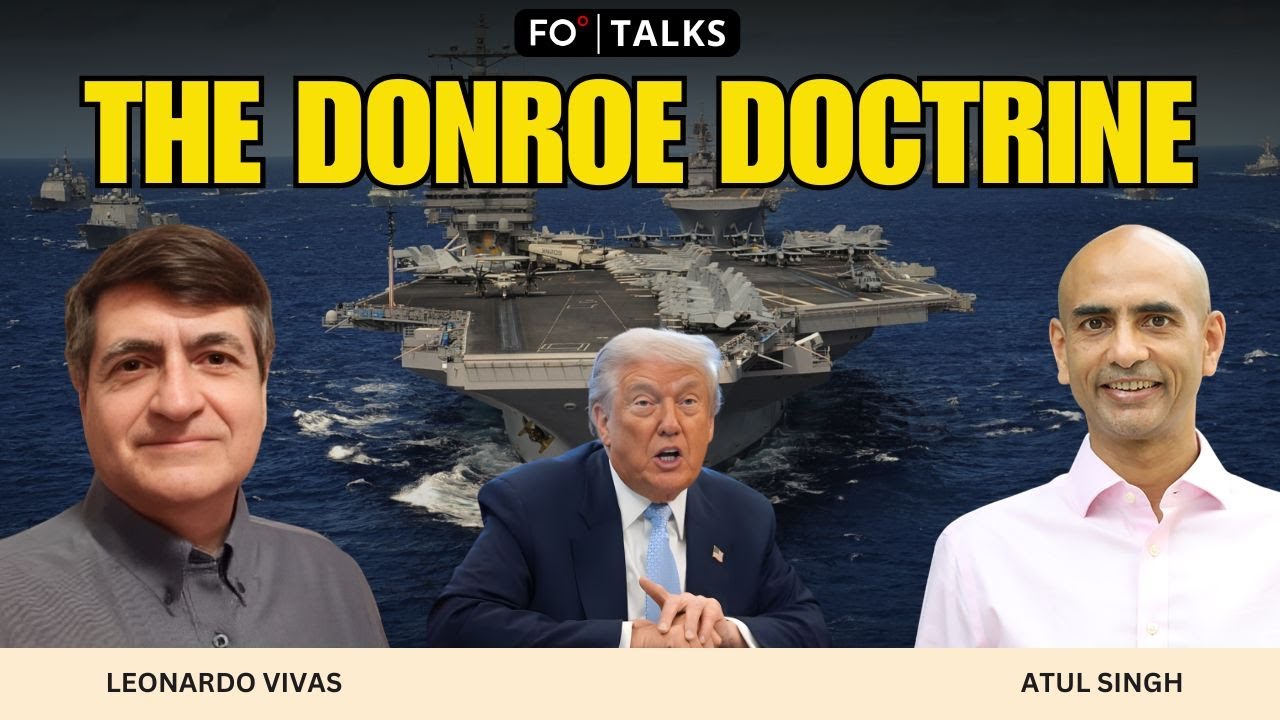
Khattar Singh raises concerns about precedent: What would stop China from seizing a Taiwanese oil tanker under similar logic? Bouchard agrees, warning that such actions contribute to what he calls the “death of the norms-based international order.” He frames the episode as a return to power politics reminiscent of the US’s Monroe Doctrine, where strength, rather than rules, governs behavior.
In a multipolar world, rivals like China and Russia are closely watching how far the US is willing to push unilateral enforcement and what new rules may emerge from these confrontations.
Regime change, domestic politics and Maduro’s strategy
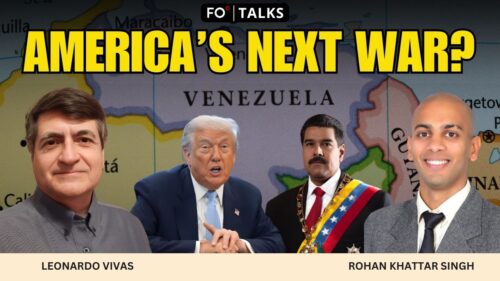
The discussion turns to US intentions. Bouchard outlines competing camps within Washington, drawing on insights shared by Professor Leonardo Vivas. One faction, led by US Secretary of State Marco Rubio, favors explicit regime change, while military leaders remain wary of large-scale intervention. Trump’s self-image as a “peace candidate” complicates the calculus, especially with elections approaching.
Bouchard identifies opposition figure María Corina Machado as central to US thinking. While objectively a prominent anti-Maduro politician and recent Nobel Peace Prize recipient, Bouchard characterizes her as a long-time hardliner who has openly sought Maduro’s removal and advocates opening Venezuela’s economy to foreign interests.
Maduro, meanwhile, is pursuing a contrasting strategy. He has launched an aggressive social media campaign portraying himself as a peace-seeker, even singing John Lennon’s 1971 song, “Imagine.” Bouchard describes him as a “fighter” who has adapted politically and learned to navigate US pressure. He argues that Maduro is now code-switching — shifting rhetoric to appeal to Trump personally — because personality often outweighs policy in the current administration.
The episode concludes with a stark assessment: Oil seizures function both as economic weapons and psychological pressure, aimed at destabilizing Maduro while testing the limits of international order. Whether this marks a one-off escalation or the opening move in a broader confrontation remains uncertain — but whatever the case, the consequences will extend far beyond Venezuela.
[Lee Thompson-Kolar edited this piece.]
The views expressed in this article/video are the author’s own and do not necessarily reflect Fair Observer’s editorial policy.





















Comment