



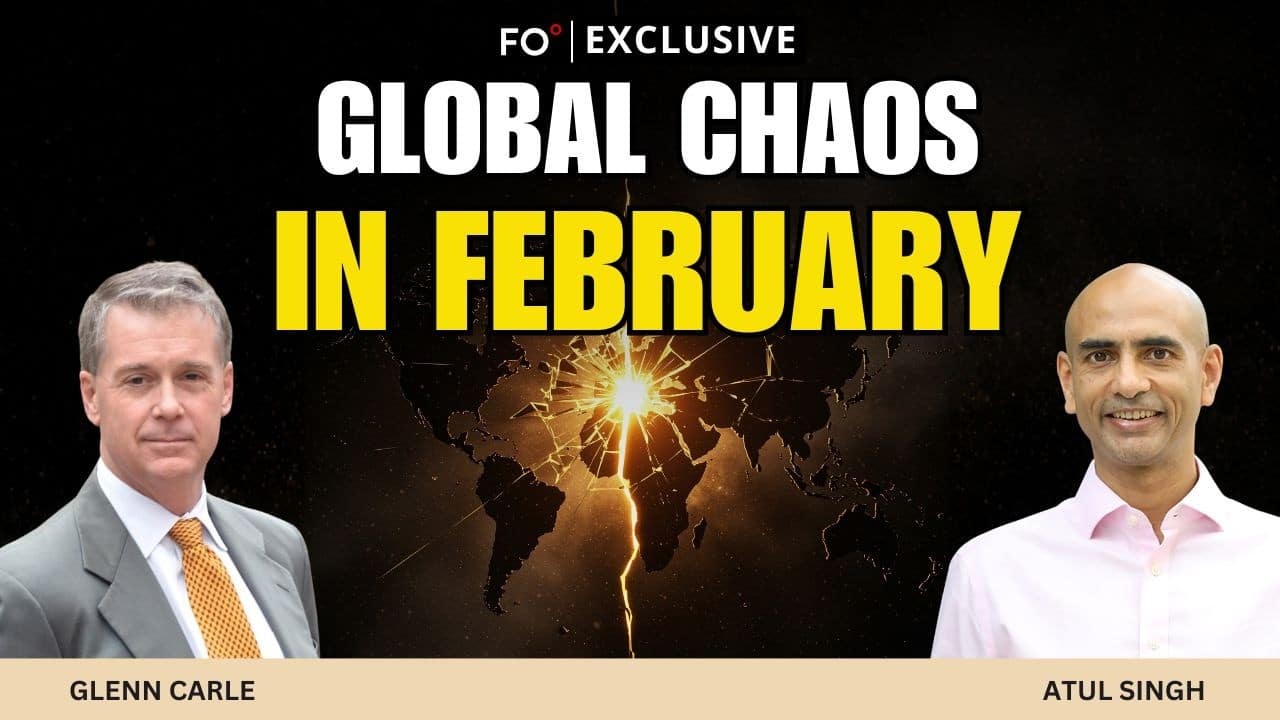
Editor-in-Chief Atul Singh and FOI Senior Partner Glenn Carle, a retired CIA officer who now advises companies, governments and organizations on geopolitical risk, rifle through a month of shocks, scandals and political turns. A pattern emerges when seemingly local events are read as signals of institutional strain, state capacity and the evolving global balance between disorder and control.
Africa: Libya’s afterlife, Congo’s minerals, Ethiopia’s fault lines
In Libya, Saif al-Islam Gaddafi, son of former Libyan dictator Muammar Gaddafi, was killed by four unknown gunmen in the western town of Zintan. Atul treats the assassination as a sign that Libya’s fragmentation persists, with no political settlement in sight.
In the Democratic Republic of Congo, a mine collapse killed 200 people, including children. This illustrates the brutal conditions miners must navigate to obtain coltan, a critical component used in smartphone manufacture. Atul notes the scale and location: It was the Bibatama Mining Concession near Rubaya in Masisi Territory, North Kivu province, which produces roughly 1,000 metric tons annually — about half of DRC output.
The M23 rebellion, operating under the Congo River Alliance banner, reportedly holds the mines and is allegedly backed by Rwanda. Thus, this mineral economy is now a regional power contest. Glenn frames Congo’s governance vacuum as an “utter state of nature.” He argues that predation, warlordism and external meddling are the operating system, not a temporary breakdown.
Elsewhere on the continent, Ethiopian troops moved toward the country’s northern Tigray region. Ethiopia and Eritrea now trade accusations of arming rebels and preparing for war, calling to mind memories of the 2020–2022 Tigray war.
The Americas: cartel power, energy pressure, Peruvian instability
In Mexico, authorities killed Nemesio Oseguera Cervantes (known by the alias “El Mencho”), notorious leader of the Jalisco New Generation Cartel (CJNG), after tracking down his wife, Rosalinda González Valencia. The cartel response was immediate and violent. CJNG torched buildings and vehicles and killed 62 people, including 25 National Guard members. Mexican President Claudia Sheinbaum deployed 2,000 troops to stabilize the situation.
Atul notes that the United States supplied intelligence locating El Mencho, underscoring how cross-border security problems are also cross-border intelligence operations. Glenn emphasizes that decades of US counter-narcotics efforts have not changed the economics that make cartel power rational and durable.
Elsewhere, energy has become leverage. Cuba announced fuel rationing after Venezuela and Mexico reportedly curbed supplies under US pressure, prompting Canadian airlines to suspend flights due to aviation fuel shortages. In Colombia, Atul notes the political mood swing as US President Donald Trump and Colombian President Gustavo Petro publicly reconciled after trading sharp insults; Trump called their meeting “terrific.”
Peru provides a concentrated case of governance stress. Deadly floods struck the south. Simultaneously, rising global gold prices now accelerate illegal mining in the Amazon, expanding deforestation, mercury contamination and violence against remote communities. Politically, José María Balcázar became interim president, the ninth in a decade, after the previous leader was impeached amid lurid allegations about late-night meetings at the presidential palace. Peru’s government is a system where corruption, fragmentation and electoral overload blend into dysfunction, with 36 presidential candidates and 39 parties ahead of a first round this April.
United States: migration calm, market froth, AI spam, climate rollback
In the US, the hosts treat domestic developments as both policy choices and cultural signals. Seven hundred federal immigration agents were withdrawn from Minneapolis, Minnesota, with roughly 2,000 still present. Officials claim “relative peace” has returned. Atul flags personnel politics at the Federal Reserve (or the Fed). Former Member of the Fed Board of Governors Kevin Warsh is nominated to replace Fed Chair Jerome Powell when Powell steps down in May. Economists remain uncertain whether Warsh would prioritize rate cuts or inflation discipline.
Regarding US markets, Walmart reached a $1 trillion market capitalization, becoming the first traditional retailer to do so. In tech culture, the AI “social” layer looks less like a breakthrough and more like an old Internet problem in new clothing. Moltbook, a chatboard for AI agents, reported 1.5 million registered accounts, yet only 17,000 are truly autonomous. The rest are spam.
The sharpest US clash is environmental. Trump reversed the 2009 “endangerment finding,” the legal foundation for federal action against greenhouse gas emissions, especially vehicle rules. Glenn argues from lived memory of pre-regulation pollution and treats the reversal as historic backsliding. The White House touts it as “the largest deregulation in American history,” claiming savings of $2,400 per vehicle. Atul frames the choice more strategically, citing the contrast between a US doubling down on fossil energy and a China betting on electrification.
Epstein’s aftershocks: elites, exposure and moral credibility
The conversation then shifts from policy to legitimacy. In the United Kingdom, Prince Andrew Mountbatten-Windsor and Lord Peter Mandelson were arrested for dealings connected to late sex trafficker Jeffrey Epstein. The infamous Epstein files are corrosive not only because of individual allegations, but because they degrade trust across elite categories, from aristocratic and business circles to political and spiritual brands.
The scandal’s radius extends beyond Britain. Fallout touches Norwegian Crown Prince Haakon, as well as former US President Bill Clinton and Microsoft cofounder Bill Gates. Even celebrity spirituality is pulled into the undertow. Atul highlights allegations involving Indian-American new age guru Deepak Chopra and his disturbing comments, “bring your girls” and “zero in on your prey,” as lines that have returned to haunt him.
Europe and Asia: reassurance theatre, electoral churn, hardening states
In Europe, Atul selects three signals of shifting mood. In Munich, Germany, US Secretary of State Marco Rubio received a standing ovation. Atul reads this as a performance of reassurance tied to arguments about Europe’s civilizational mission and strategic posture. In France, the National Assembly passed a budget after months of instability, frustrating both far-left and far-right efforts to topple the government. French President Emmanuel Macron and Prime Minister Sébastien Lecornu were the immediate winners, but institutional survival is under strain.
The Milano Cortina Winter Olympics provide a rare upbeat civic note. The US won both men’s and women’s hockey gold against Canada in extra time, while Norway topped the overall medal table.
Asia delivers harsher headlines. China was angered after Panama’s Supreme Court annulled a contract allowing Hong Kong conglomerate CK Hutchison to operate in the Panama Canal. In Hong Kong, publisher Jimmy Lai was sentenced to 20 years in prison for offenses tied to foreign collusion and seditious publishing. In Thailand, the Thai Pride Party, aligned with military-royalist power, won about 40% of seats, the largest margin in 15 years.
In Bangladesh, the Bangladesh Nationalist Party under Bangladeshi Prime Minister Tarique Rahman won a two-thirds majority in the first election since the 2024 student-led uprising that ousted the previous prime minister, Sheikh Hasina. Atul stresses the strong performance of the Jamaat-e-Islami political party, which he reads as a rightward, more Islamist drift with clear implications for India and Pakistan.
Japan closes the lightning round. Sanae Takaichi, Japan’s first female prime minister, won Japan’s general election in a historic landslide. Her Liberal Democratic Party won a two-thirds majority in Japan’s lower house of parliament. She campaigned on cutting food-related consumption taxes and boosting defense spending amid fears of Chinese conflict, with markets and the yen surging in response.
[Lee Thompson-Kolar edited this piece.]
The views expressed in this article/video are the author’s own and do not necessarily reflect Fair Observer’s editorial policy.



























Comment