





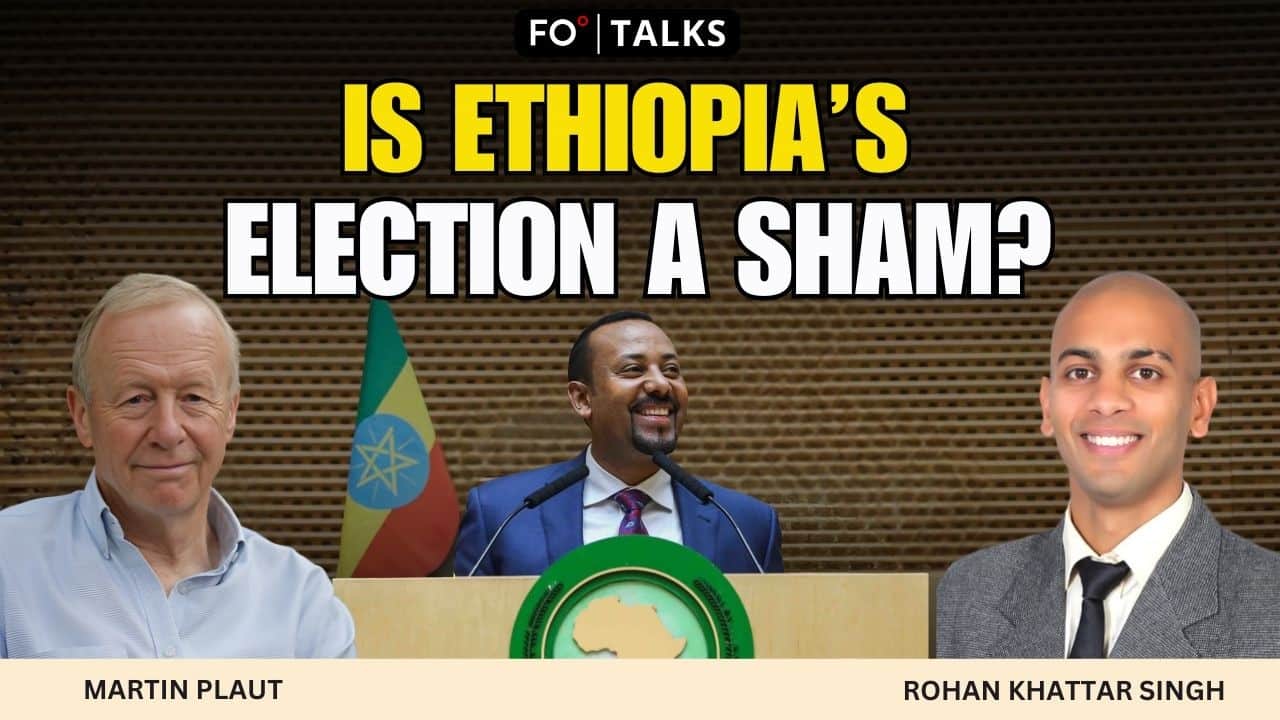
Fair Observer’s former Video Producer Rohan Khattar Singh speaks with Martin Plaut, a journalist, academic and author, about Ethiopia’s June 1 election and the broader political and geopolitical crises facing the country. While Ethiopian Prime Minister Abiy Ahmed’s Prosperity Party secured an overwhelming victory, Plaut argues that the vote took place amid widespread insecurity, opposition skepticism and growing regional tensions. They examine whether meaningful elections are possible in a country grappling with internal conflict and mounting pressures across the Horn of Africa.
A predicted landslide becomes reality
The election has delivered Plaut’s expected outcome. Abiy’s Prosperity Party secured an overwhelming victory, reinforcing its dominance over Ethiopian politics.
Plaut argues that the result was never seriously in doubt. Although opposition parties participated and more than 10,000 candidates contested parliamentary and regional council seats, he maintains that none posed a meaningful challenge to the ruling party. Opposition groups had already questioned the credibility of the process, arguing that the vote lacked the conditions necessary for fair competition.
Plaut acknowledges that voter registration and mobilization efforts were extensive, but argues that participation alone could not guarantee legitimacy. Reports from local communities suggest that access to fertilizer and other essential services could be linked to voter registration, creating pressure on citizens to engage with the process. More broadly, he contends that the political environment favored the ruling party so heavily that the election functioned less as a competitive contest than a confirmation of existing power.
The key question was not whether people would vote, but whether they could do so in conditions that allowed genuine political choice.
The contrast between Addis Ababa and rural Ethiopia
Khattar Singh notes that Ethiopia’s capital has become a symbol of the government’s modernization agenda. Images of Addis Ababa’s renovated streets and new developments have attracted attention abroad, with some observers comparing the city favorably to urban centers elsewhere in the developing world.
Plaut does not dispute the visible transformation. He acknowledges that parts of the capital have been rebuilt and modernized, creating an image of rapid progress. Still, this picture captures only a small part of the country’s reality. Redevelopment projects have displaced residents from older neighborhoods, generating resentment among some communities affected by the changes.
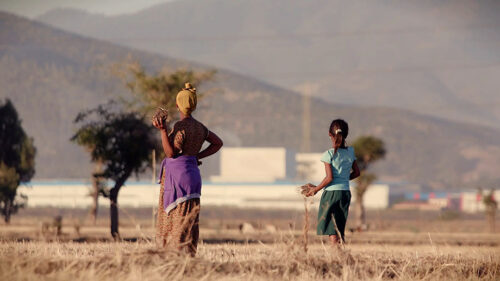
More importantly, Plaut stresses that Ethiopia remains overwhelmingly rural. While international media and foreign visitors often focus on Addis Ababa, most Ethiopians live far from the capital. Understanding the country requires looking beyond showcase projects and examining the conditions faced by ordinary citizens in rural communities.
That perspective was largely missing from coverage of the election. The concerns of farmers, local communities and residents of conflict-affected regions received far less attention than the government’s development narrative.
Elections amid conflict
A central theme Plaut discusses is the extent to which ongoing conflicts limit the reach of the Ethiopian state itself.
Plaut points to the northern Tigray region, where the devastating war of 2020–2022 left at least 600,000 people dead and produced widespread atrocities. Although large-scale fighting has subsided, the region remains politically fractured and unstable. He argues that meaningful participation there was extremely difficult.
The situation in the states of Amhara and Oromia is similarly troubling. In Amhara, the Fano militia controls significant parts of the countryside and continues to clash with government forces. In Oromia, which contains roughly a third of Ethiopia’s population, insurgent groups operate in areas where government authority remains limited.
These realities lead Plaut to question whether a truly national election was possible in Ethiopia. Large sections of the country faced security conditions that restricted campaigning, voting and independent observation. The government could and did organize polling where it maintained control, but significant portions of Ethiopia remained beyond its effective reach.
The election result, therefore, does not resolve the underlying conflicts that continue to shape Ethiopian politics. Instead, it highlights the contrast between the government’s electoral mandate and the persistent instability affecting much of the country.
Regional rivalries and growing tensions
The conversation also places Ethiopia’s election within the wider geopolitical landscape of the Horn of Africa.
Although Abiy received the Nobel Peace Prize in 2019 for helping end decades of hostility with neighboring Eritrea, Plaut argues that relations between the two countries have deteriorated. He points in particular to Abiy’s increasingly forceful statements regarding Ethiopia’s need for access to Red Sea ports. For Eritrea, whose independence struggle lasted three decades, control of those ports remains a core national interest.
Plaut describes a region increasingly divided into competing camps. Ethiopia and the United Arab Emirates have developed close ties, while Egypt, Saudi Arabia, Eritrea and the Sudanese Armed Forces have found common ground on several regional issues. These alignments overlap with Sudan’s civil war, creating a complex web of rivalries that extends beyond any single conflict.
Reports of cross-border military activity and external support for armed groups suggest that tensions are already spilling across national boundaries. These developments create a volatile environment in which local disputes can quickly acquire regional significance.
Media blind spots and Ethiopia's future
The discussion concludes with two issues that Plaut believes receive insufficient attention from international observers. The first is the Grand Ethiopian Renaissance Dam (GERD), which enjoys broad support across Ethiopia. Built largely through domestic financing after international lenders declined support, the hydroelectric project has become a symbol of national pride and a rare point of consensus in an otherwise divided political landscape. Ethiopians view the dam as proof that the country can pursue ambitious development projects on its own terms.
The second concerns the difficulty of reporting on Ethiopia itself. Independent journalism faces significant obstacles, particularly during periods of political tension. Foreign reporters can struggle to obtain visas, while local journalists operate under increasing constraints. He points to the Tigray war as a striking example. Despite being one of the deadliest conflicts in the world at the time, independent reporting from the front lines was exceptionally limited.
These restrictions create major gaps in international understanding of Ethiopia’s political and security challenges. For Plaut, the problem is not simply what the world reports about Ethiopia, but what it cannot report. Without greater access to events on the ground, outsiders risk misunderstanding both the country’s elections and the deeper forces shaping its future.
[Lee Thompson-Kolar edited this piece.]
The views expressed in this article/video are the author’s own and do not necessarily reflect Fair Observer’s editorial policy.




































Comment